A product sampling program, from the brand’s side, is the planned sequence that takes a product from a brief to a stranger’s hand in public and back to a report: the format, the vehicle, the permits, the staff, the samples, the capture and the numbers. This is not a guide to getting free samples by mail; it is for brand, marketing and agency teams who need to know what a sampling program involves, how long it takes, what it costs and how the math changes across cities. It covers the eight-week program timeline, what is included in a full-service program, cost ranges from $50,000, the economics of multi-city programs, and a worked example from brief to report. For the formats themselves, see product sampling marketing; for choosing a partner, see product sampling companies.
Key Takeaways
- A sampling program is eight weeks from signed brief to the street in one US market, and the permit is the long pole.
- A full-service program includes seven things: vehicle, build, permits and health sign-off, samples handling, staff, capture and reporting. If any one is missing, someone else is doing it.
- Single-market programs start around $50,000, and the vehicle, the build and the number of days move the number.
- Multi-city programs get cheaper per city because the build is paid for once and the crew and the capture repeat.
- The report is the product. Units, contacts, redemptions and a cost per trial, within two weeks, or the program did not finish.
The Eight-Week Program Timeline
Every full-service sampling program runs the same sequence. The dates below count back from a single-market activation in New York, Los Angeles or Chicago; private property can compress weeks three to six.
Week 1: Brief and format. The brand supplies the goal and the number, the product and the sample unit, the cities and dates, brand guidelines and the budget range. The agency comes back with a format (counter, truck, glass truck, tour), a vehicle, a rough cost and a permit calendar.
Week 2: Concept and rendering. The wrap, the counter, the footprint and the consumer journey are rendered before anything is printed. Approvals happen on the render, which is where changes are free. See 3D renderings.
Weeks 2 to 3: Permits filed. The city permit application goes in with the location, hours, footprint and vehicle specs, plus the health department application for anything consumable. This is the step that sets the date.
Weeks 3 to 6: Build and production. Wrap printed and installed, interior fabricated, signage and serviceware produced, samples shipped to the commissary or warehouse, cold storage arranged.
Weeks 5 to 7: Staffing and training. Crew confirmed, training session on the product, the run of show, the capture script and the permit conditions.
Week 7: Permits issued, logistics locked. Load-in times, parking, power, restock plan, contingency for weather and generator failure.
Week 8: Activation. The day or days on the street, with units counted, contacts captured and photos taken.
Weeks 9 to 10: Report. Units distributed, contacts captured, redemptions to date, cost per trial, social reach and the recommendation for the next market.
The Timeline Planner runs this backwards from a launch date and tells you whether it still works.
What a Full-Service Sampling Program Includes
Seven components. A program that includes all seven under one contract is full-service. A program that includes some is a broker arrangement with the rest subcontracted, which is fine for a one-off and a risk for a tour.
- Vehicle. Owned, measured, insured and previously permitted. A rented vehicle restarts the permit and the render.
- Build. Wrap design and installation, interior fit-out, counter, signage, props, lighting.
- Permits and health sign-off. City location permits, health department approvals for consumables, property agreements for private sites, certificates of insurance.
- Sample handling. Receiving, cold storage where needed, portioning, restock between days and cities, allergen documentation.
- Staff. Brand ambassadors, demo specialists, a captain, training, and licensed servers for alcohol or estheticians for skin where required. See the brand ambassador agency guide.
- Capture. The mechanic (QR, SMS, redemption code, badge scan), the script that ends in it, and the data pipeline to the brand’s CRM.
- Reporting. The two-week report with the funnel, the photos and the recommendation.
The brand supplies the product and the samples, the brand guidelines and logos, any claims or allergen copy, and the retailer relationship if the program sits near a store.
What a Product Sampling Program Costs
Ranges for a single US market on an owned vehicle, including all seven components above; the brand supplies product.
| Program | Typical cost | Days | Lead time |
|---|
| Cart or tuk tuk sampling counter | $40,000 to $75,000 | 1 to 2 | 6 weeks |
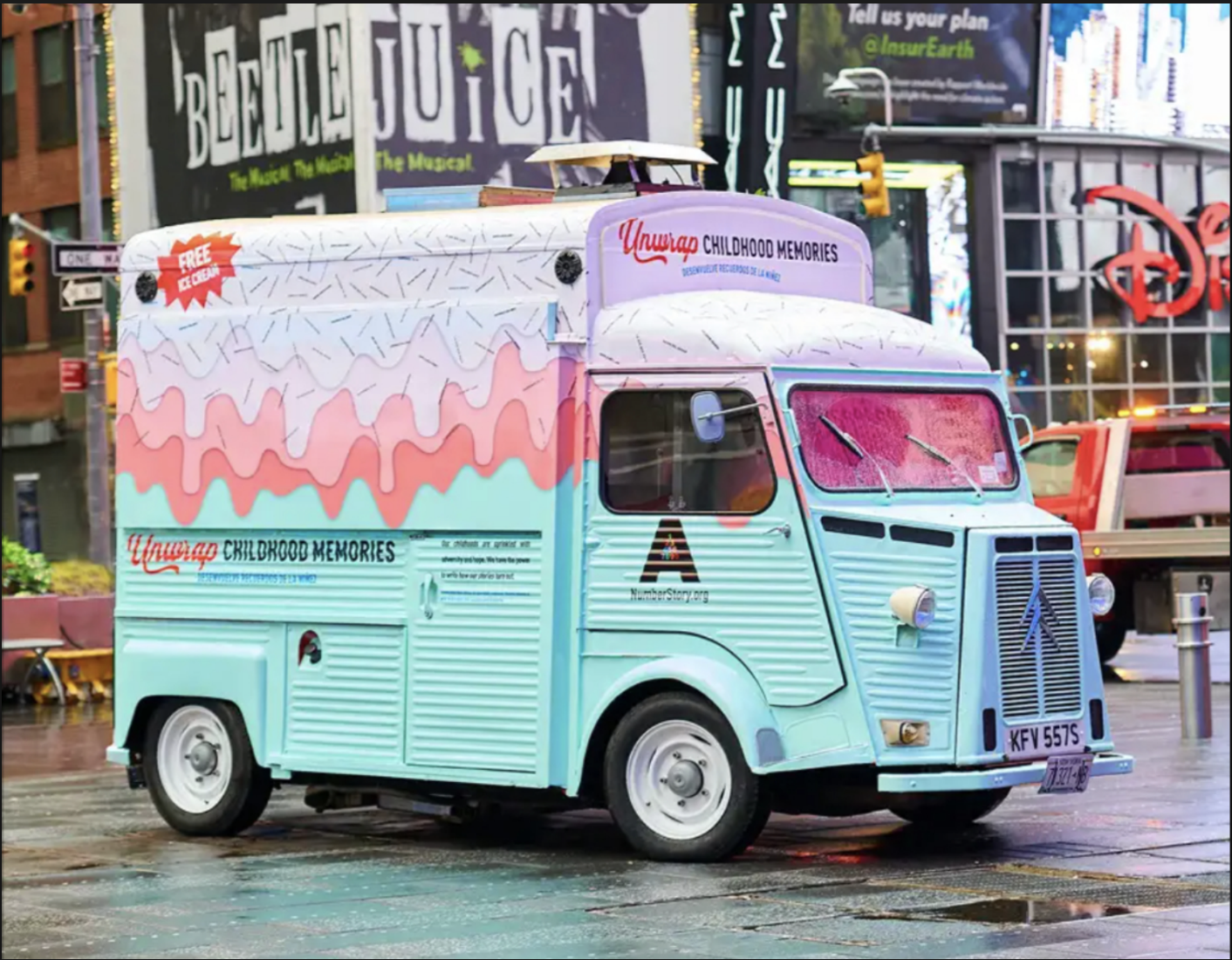
| Food truck or Citroen sampling | $70,000 to $150,000 | 1 to 3 | 6 to 8 weeks |
| Glass truck or Airstream with custom interior | $100,000 to $200,000 | 2 to 3 | 8 to 10 weeks |
| Retailer parking lot program (three stores) | $90,000 to $180,000 | 3 to 5 | 3 to 4 weeks |
| Event footprint with vehicle | $80,000 to $150,000 plus sponsorship | 1 to 3 | 10 weeks |
| Four-city tour, one build | $250,000 and up | 8 to 12 | 12 weeks |
Food Truck Promotions’ minimum engagement is $50,000. The lines that move the number most: the vehicle (a cart versus a glass truck is a 2x difference), the interior build, the number of activation days, refrigeration and alcohol handling, and the number of cities. HubSpot’s guide to sampling marketing covers the cost of the sample itself relative to customer value; the figures above are what it takes to put that sample in hands in public.
How Multi-City Economics Work
The single most important thing about sampling program cost is that the build is a fixed cost and the activation day is a variable cost. One city carries the whole build. Four cities split it.
A worked comparison. A branded truck with a custom interior for a single city: roughly $110,000 for two activation days, of which about $55,000 is the build and design, $15,000 permits and logistics, $25,000 staffing and sample handling, $15,000 management and reporting. Cost per activation day: $55,000.
The same build on a four-city tour with two days per city: the build is still about $55,000, permits and logistics run $12,000 per city, staffing and samples $18,000 per city with a traveling core crew, transport between cities $20,000 total, management and reporting $30,000. Total around $265,000 for eight activation days. Cost per activation day: about $33,000, 40 percent lower than the single city, with four markets of data instead of one.
This is why every large sampling program in beauty, fragrance, food and beverage and entertainment is a tour, and why the question in week one should be “how many cities” rather than “which city.” The mobile product sampling tours guide covers the logistics that make the per-city numbers comparable.
A Worked Example From Brief to Report
A skincare brand launching a new serum at a national retailer wants trial at scale in two markets before a wider rollout, with sign-ups for the brand’s CRM and proof of sell-through for the retailer.
Brief (week 1). Goal: 6,000 samples in hands across New York and Los Angeles, 2,000 sign-ups, measurable lift in the four activated stores. Sample unit: a sealed 7-day deluxe mini. Budget range: $150,000 to $200,000. Dates: launch week in six weeks, which is tight.
Format (week 1). A Citroen with a two-station consultation counter, parked on the public street near the retailer in each city for two days. Because the timeline is tight, the New York location is moved to a retail center’s private lot with the owner’s agreement (three weeks) while the Los Angeles street permit (six weeks) is filed immediately.
Build (weeks 2 to 5). Rendered in week 2, approved with two changes, wrap and counter produced by week 5. Minis shipped to the New York commissary and the Los Angeles warehouse.
Staff (weeks 4 to 6). A core crew of four trains on the product and routine in week 5, travels both cities. Two local ambassadors per city for the line.
Activation (weeks 6 to 7). Four activation days. Units counted by tally, sign-ups via a QR to a landing page with a store-specific code.
Report (week 9). 6,400 minis distributed, 2,150 sign-ups (a 34 percent capture rate), 11 percent code redemption at four weeks, velocity lift in the four stores versus control reported by the retailer, cost per trial of about $27 against a full-size price of $68. Program cost: $172,000. Recommendation: a four-city tour for the fall window at a lower cost per city.
When Not to Run a Sampling Program
A few honest cases. The product cannot be sampled in a form that resembles how it is used (a sachet of a product designed to be used for a month proves nothing). The margin cannot absorb the giveaway at the volume the program needs. The permit cannot be had before the launch date and private property does not fit the brief. Or the goal is awareness without any transaction, in which case a pop-up without sampling may do more for less. A good agency will say so in week one.
Case Study: TIRTIR World Tour