The Top 5 Questions to Ask Experiential Marketing Agencies Before You Hire One

By: Benjamin Goldberg 11 min read

Experiential Marketing Agencies

Experiential marketing agencies design and run the live, in-person brand experiences that increasingly define how brands get noticed, and choosing the right one is a high-stakes decision. The channel is booming: U.S. experiential marketing spending reached 64.43 billion dollars in 2025, nearly half of the global market, according to PQ Media, and it is projected to grow again in 2026. With that much investment on the line, the agency you pick matters.

From interactive digital billboards to mobile product-launch pop-ups, the creativity in marketing is off the charts compared to anything we have seen before. But where do you start, and how do you find the right partner? If you are weighing experiential marketing agencies, this guide covers what they do, the five questions to ask before you hire one, and the green flags and red flags that tell you whether an agency is the right fit for your brand.

Key Takeaways

  • Experience is the whole point: An experiential marketing agency creates in-person moments that connect with customers far more deeply than a traditional ad ever could.
  • Relevant experience matters most: An agency with a track record in your industry understands your market and builds more effective campaigns from day one.
  • Specialization beats doing everything: No single agency is an expert in every technique, so a focused specialty often means deeper expertise and better results.
  • Proof is non-negotiable: Strong client work, references, and reviews are the clearest signal of an agency’s capability and reliability.
  • Culture and fit drive the partnership: Shared values, clear communication, and a collaborative culture lead to smoother projects and stronger campaigns.

What Is an Experiential Marketing Agency?

An experiential marketing agency designs and runs live, in-person brand experiences, like pop-ups, product sampling, and brand activations, that let customers interact with a brand in a tangible, memorable way. Unlike a traditional ad agency focused on passive media, an experiential agency handles the creative, fabrication, logistics, staffing, and execution that bring a campaign to life in the real world.

Whether you work with an agency or go it alone depends on your budget, your own level of creativity, and the concept you have in mind. But if you want a polished, high-impact activation without coordinating a dozen vendors yourself, the right agency is worth it. The key is knowing what to ask.

Why Ask Questions Before You Hire

As customers grow more skeptical of traditional advertising, they are leaning into the experiential marketing that their favorite brands and creators now use to promote ideas and products. If you are exploring experiential marketing for your brand, you are on the right path toward growing your audience and creating experiences customers will not forget. But not every agency is the right fit, and the wrong one is an expensive mistake. The five questions below make the decision clear, and each comes with the green flags and red flags to listen for.

5 Questions to Ask an Experiential Marketing Agency

These are the top five questions before you hire any experiential marketing agency.

Question 1: How Do You Define Experiential Marketing, and What Is Your Experience in It?

Experiential marketing creates immersive, memorable experiences that let customers interact with a brand in a tangible way. Make sure you are working with people who know the concept deeply and understand how it differs from traditional marketing. Look for a real track record of successful campaigns, ideally in your industry, because an agency that understands the nuances of your market can point to results it has actually delivered.

Green flag: They define experiential marketing clearly and share specific campaigns and outcomes.

Red flag: They speak only in generalities or cannot point to relevant work.

Question 2: What Types of Companies and Brands Do You Work With?

The brands an agency works with tell you a lot about whether they will fit yours. They do not need to know your product inside and out, but they should be able to form a vision from what they know about your brand and audience. The best sign is an agency that asks you pointed questions about your past marketing and your goals, which shows they are genuinely trying to understand what you do and what you want to accomplish.

Green flag: They work with brands like yours and ask sharp questions about your goals.

Red flag: They treat every brand the same regardless of industry or audience.

Question 3: How Would You Describe Your Agency’s Culture?

As you define your own values and mission, you want a partner who prioritizes the same things. Strong experiential agencies are built on creativity, collaboration, and teamwork, and a positive, progressive culture leads to more original campaigns and a better relationship throughout. Ask about their core values, how the team communicates internally and with clients, and how much they prioritize relationship-building.

Green flag: Clear values, transparent communication, and a collaborative team.

Red flag: Vague answers about values or how they work with clients.

Question 4: What Types of Experiential Marketing Do You Specialize In?

As the field keeps evolving, it is hard to believe any single agency can be an expert in every area. Find out whether they try to do a bit of everything or have built a name around specific strengths. Some agencies excel with experiential marketing vehicles like mobile showrooms, branded food trucks, and event trailers. Variety is fine, but specialization usually means deeper expertise and more impactful results, so ask which experiences they find most effective for brands in your industry.

Green flag: A clear specialty and a point of view on what works for your industry.

Red flag: A we-do-everything pitch with no real focus.

Question 5: Can You Provide Examples of Client Work and References?

Client references and work samples are among the most valuable ways to evaluate an agency. Any agency you consider should have a well-designed website with plenty of case studies and past client reviews. Ask whether current or past clients would be willing to share their experience. A strong agency has a loyal following, because no matter how sophisticated marketing becomes, word of mouth is still one of the most valuable signals a business can earn.

Green flag: A portfolio of relevant work and references happy to vouch for them.

Red flag: No case studies, no reviews, and no references on offer.

What to Look for in an Experiential Marketing Agency

Beyond the five questions, a full-service experiential marketing agency should handle the entire activation from concept to execution, so you do not have to coordinate a dozen vendors. The capabilities worth confirming include:

  • Concept and design: From mood boards to detailed 3D renderings, so you can see the experience before it is built.
  • Custom fabrication and vehicle wraps: In-house build-out that turns a concept into a physical, on-brand activation.
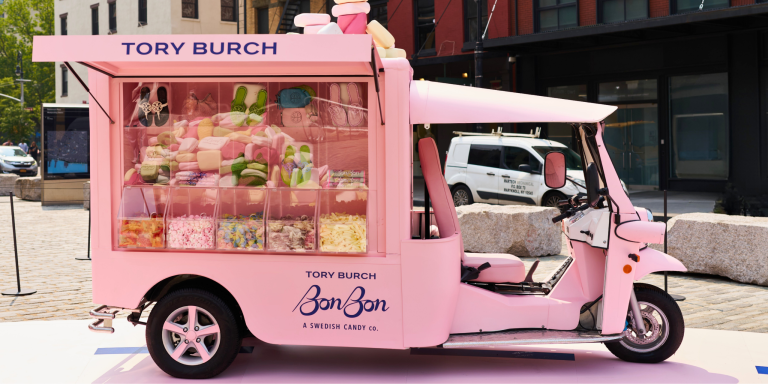
  • A fleet of experiential vehicles: From food trucks to glass cube trucks and tuk tuks, matched to your goal.
  • Location sourcing and permits: On-the-ground logistics in your target markets.
  • Staffing and brand ambassadors: Trained representatives who embody your brand and run the activation.
  • Reporting: Measurement that ties the campaign back to real results.

An agency that owns these pieces in-house gives you a smoother process and a single point of accountability. That end-to-end control is exactly why Food Truck Promotions helps brands create activations that set their name above the rest, bringing your brand directly to your audience and building real loyalty.

Case Study: LANEIGE x innisfree Glow On-The-Go Tour
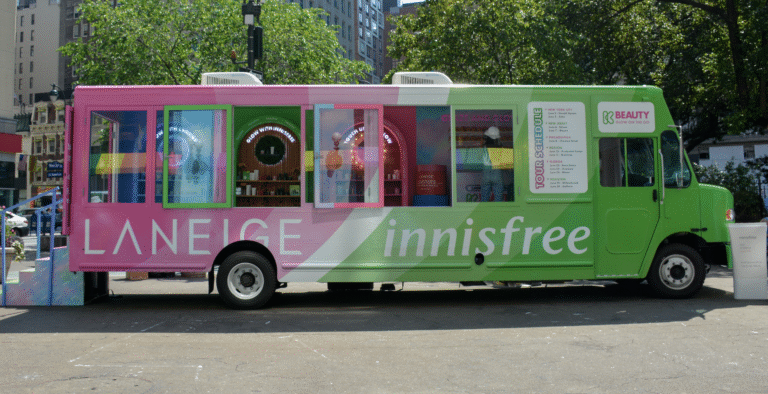
LANEIGE x innisfree beauty truck with pink and green panels, parked outside with products inside.

The best way to judge an experiential agency is by the proof it can show, so here is one example. When two of K-beauty’s biggest names, LANEIGE and innisfree, wanted to drive Sephora sales and awareness across the country, they partnered with Food Truck Promotions on a ‘Glow On-The-Go’ tour built around a custom glass truck.

The activation made 12 stops at Sephora locations across 9 cities, starting in New York and ending in Houston. Fans learned about each brand’s best sellers, collected goodie bags and exclusive giveaways, grabbed glazed donuts, and snapped a mirror selfie to show off their glow before heading to Sephora to shop and redeem a gift with purchase.

The results show why proof matters when choosing an agency: the tour generated 50 million impressions and earned features in outlets like V Magazine, Shop GMA, NBC 6 South Florida, and Fox 26 Houston. That is the kind of end-to-end execution, from concept and fabrication to routing, staffing, and earned media, that separates a specialist partner from a generalist.

The Bottom Line

Choosing among experiential marketing agencies comes down to a few clear signals: a real definition of experiential marketing and a track record to back it, relevant experience with brands like yours, a culture you would want to work with, a genuine specialty rather than a we-do-everything pitch, and proof in the form of case studies and references. Ask the five questions, listen for the green flags and red flags, and confirm the agency can handle the activation end to end. Do that, and you will find a partner that turns your budget into an experience your customers remember, and talk about, long after it ends.

Frequently Asked Questions

An experiential marketing agency designs and runs live, in-person brand experiences like pop-ups, sampling, and brand activations that let customers interact with a brand directly. It handles the creative, fabrication, logistics, staffing, and execution that bring a campaign to life.

A full-service agency manages the entire activation: concept and design, custom fabrication, experiential vehicles, location sourcing and permits, staffing, and reporting. The goal is a memorable, hands-on experience that connects a brand with its audience and ties back to results.

Ask how they define experiential marketing and their experience in it, the brands they work with, their culture, their specialties, and their client work and references. Strong, specific answers and relevant case studies signal the right fit, while vague generalities are a red flag.

The five core questions are: how they define experiential marketing and their experience in it, the types of companies they work with, their agency culture, the types of experiential marketing they specialize in, and whether they can share client work and references.

Cost depends on the scope: the type of activation, the number of markets, the vehicles, fabrication, staffing, and campaign length. A single-location pop-up costs far less than a national tour. The best approach is to scope the campaign to your goal and budget.

A traditional ad agency focuses on paid media like print, digital, and broadcast. An experiential marketing agency creates live, in-person experiences customers can touch, taste, and engage with, building deeper emotional connections and stronger recall.

Beauty, fashion, food and beverage, tech, and lifestyle brands use them heavily, but almost any brand can benefit. The key is an agency with relevant experience in your industry and audience, which is why asking about their past clients matters.

It depends on your needs. A specialist offers deeper expertise in a specific format, while a full-service agency manages the entire activation end to end. Many brands prefer a full-service partner for a single point of accountability across concept, build, and execution.

Track foot traffic and interactions, lead capture through QR scans and sign-ups, conversions from promo codes or sales, social reach through hashtags and shares, and earned media. A good agency builds measurement in from the start and reports against your goals.

Watch for no case studies or references, a we-do-everything pitch with no specialty, little curiosity about your brand and goals, vague pricing, and quantity-over-quality language that treats your campaign like a template rather than a custom activation.

Benjamin Goldberg

Author

Benjamin Goldberg

CEO @ FTP Agency

Benjamin H. Goldberg is passionate about bringing brands to life on the streets. As CEO of Food Truck Promotions and co-founder of the New York and Los Angeles Food Truck Associations, he helps create unforgettable mobile experiences that blend great food, creative branding, and meaningful connections with audiences everywhere.

More posts
Why Mobile Pop-Up Shops Are the Future of Retail