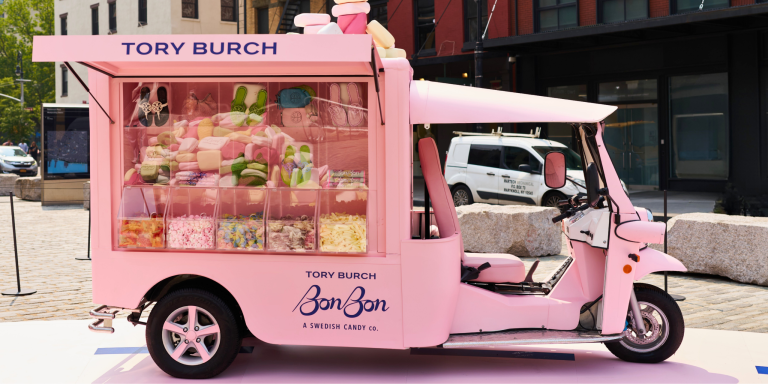
How the Best Brands Win at Fashion Marketing in 2026
Fashion marketing has never been more crowded, more expensive, or more dependent on getting a real person to stop and pay attention. The feed…
Read moreBy: Ashley Elarde • • 11 min read
College brand activations work for one simple reason: there is no other setting where you can reach tens of thousands of young customers in a single afternoon, on foot, with your product in their hands.
Reaching a younger audience through advertising has only gotten harder. Feeds are saturated, ad costs keep climbing, and this group is unusually good at ignoring anything that looks like a pitch. A campus activation sidesteps all of that by turning the pitch into a free sample and a two-minute conversation.
This guide covers why campus marketing works, who the campus audience actually is in 2026, the formats that perform, and four real activations we produced with results you can learn from.
College brand activations are in-person branded experiences staged on or near university campuses, designed to introduce a product to students through direct interaction. Common formats include sampling trucks, branded carts, pop-up lounges, multi-campus tours, and presence at existing campus events such as move-in week, game days, and career fairs.
They differ from campus advertising, such as posters or sponsored social, in one important way: the student leaves with the product, not just the message.
Here the top 4 reasons that campus marketing works at any college.
Total postsecondary enrollment in the United States reached about 19.4 million students in fall 2025, growing 1.0 percent and surpassing pre-pandemic levels, with undergraduate enrollment up 1.2 percent. A handful of campuses can put you in front of a five-figure daily audience without a media buy.
College is when many people choose their own products for the first time: coffee, skincare, groceries, banking, apps. Winning a customer at that moment can be worth far more than winning one who already has an established preference to break.
Students are generally open to new brands and are physically present in a dense, walkable environment for months at a time. The combination is rare and hard to replicate anywhere else.
A well-designed activation produces photos and posts without a creator budget, because the audience is already documenting campus life. Our guide to creating experiences that drive UGC covers how to build that in deliberately.
This is worth updating, because the labels have shifted since campus marketing became a Gen Z talking point.
Gen Z is generally defined, including by the Pew Research Center, as those born between 1997 and 2012. That means the oldest members of the generation are now approaching thirty and well into their careers, while today’s undergraduates come from the youngest part of the cohort. Within a few years, the first Gen Alpha students will start arriving on campus.
The practical implication: treat the campus audience as its own segment defined by life stage rather than by a generational label. What is true of a 27-year-old Gen Z professional is often not true of a 19-year-old sophomore, and campaign planning built on generation-wide generalizations tends to miss.
There is also a targeting opportunity most brands overlook. The growth in undergraduate enrollment has been driven primarily by a 3.0 percent increase at community colleges, ahead of a 1.4 percent increase at public four-year institutions. Almost all campus marketing budget goes to well-known four-year schools, which leaves the fastest-growing segment comparatively uncontested.
This can feel counterintuitive. If students live online, why activate in person?
Because everyone else made the same decision. The shift of nearly every brand’s youth budget into social has saturated the space, and the result is an audience with well-developed instincts for skipping ads. Meeting a student on the way to class with something free and useful is not an interruption in the same way.
The two channels are also not in opposition. A physical activation generates the content that then performs on social, which is a more credible route to a feed than a paid placement. That is the core argument for experiential marketing generally, and campuses concentrate it.
Here are the top examples of effective college brand activations.
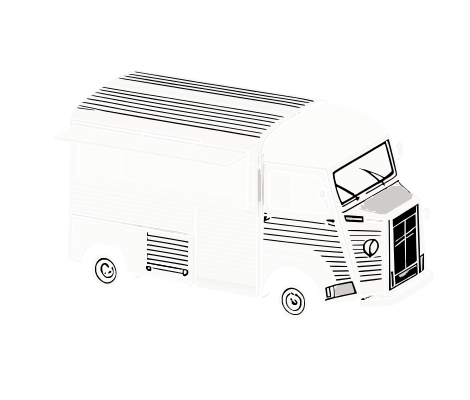
Bondi Sands, the Australian self-tanning brand, wanted new users for its 1 Hour Self-Tanning Foam among a college-aged audience. We built a branded truck and parked it at West Fourth Street and Broadway, right beside New York University.
The sign read free self tan and coffee, with Bluestone Lane coffee as the draw. Students on the way to class were greeted by a brand ambassador, scanned a QR code, joined the loyalty program, and left with a sample bottle and application mitt. The pop-up attracted thousands of potential new customers, and the loyalty sign-up turned each one into a contact the brand still owns.
Why it worked: the offer solved an immediate want (coffee) to earn attention for the actual product, and the QR sign-up made the result measurable. See the full build in our Bondi Sands coffee truck case study.
RepresentUs, a nonpartisan nonprofit focused on election and government reform, wanted to explain redistricting and gerrymandering to students in a way that would actually land.
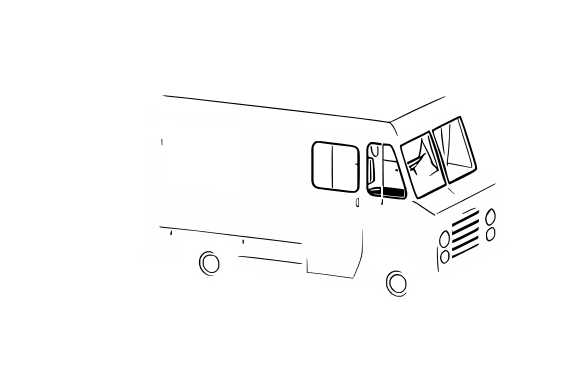
We built the Gerry’s Partisan Pizza mobile tour, driving a branded food truck to college towns across the country and serving pizza cut into deliberately uneven slices as a physical illustration of unevenly drawn voting districts. The pizza reinforced the message from the truck’s speakers and branding rather than competing with it.
Why it worked: the product was the explanation. When the giveaway itself demonstrates the idea, people remember the idea. Details are in our Gerry’s Partisan Pizza tour case study.
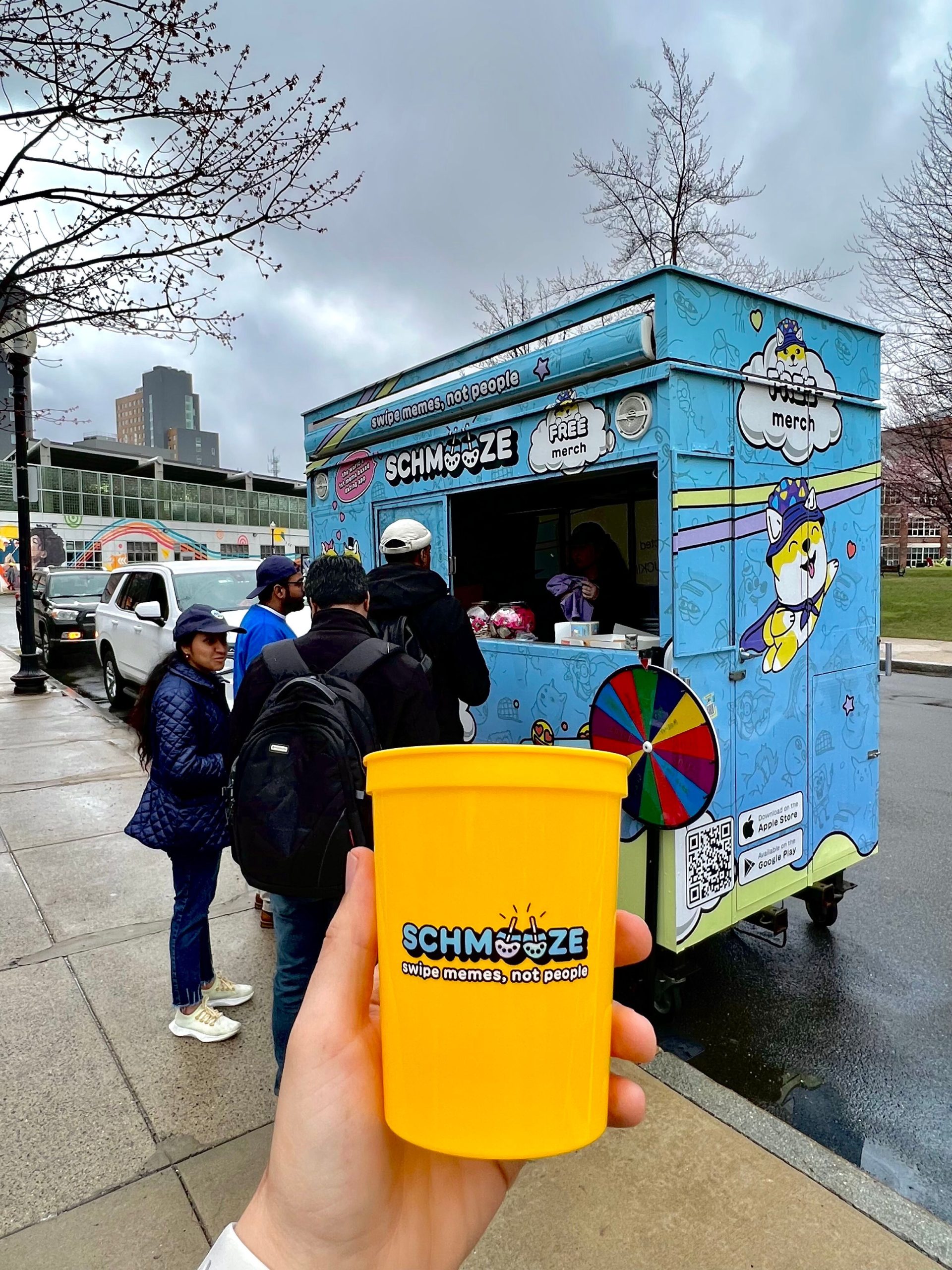
Schmooze is a dating app built on matching people by sense of humor, with the tagline swipe memes, not people. Its target user is almost exactly a college student, which makes campus the obvious acquisition channel.
We took a branded experiential cart to schools across the northeast including MIT, Northeastern, Harvard, and Boston University, explaining the app and signing up users on the spot.
Why it worked: for an app, campus activation is direct user acquisition, not brand awareness. Downloads happen while the ambassador is still talking.
Alpha Foods needed students to believe that plant-based food tastes good, which is a claim no advertisement can settle. Only a bite can.
We fully customized a food truck into a sampling pop-up and visited seven campuses across Los Angeles and New York: NYU, Cornell, Columbia, FIT, Fordham, USC, and UCLA. Students chose between breakfast sandwiches, spicy maple BBQ chick’n nuggets, chick’n fajita burritos, and steak ranchero burritos, all meatless. While waiting, they scanned a QR code to enter to win a fully stocked Alpha Foods freezer, and a branded signable photo frame gave them a reason to post.
Why it worked: seven stops from one build, product trial as the core mechanic, and two capture devices (the sweepstakes entry and the photo frame) running at once. Read more in our Alpha Foods campus sampling case study, or browse the full brand activation case studies library.
Campus remains one of the few places where a brand can hand its product to thousands of new customers in a day, at a moment when those customers are still deciding what they buy. The brands that get the most from it treat it as an acquisition channel with a capture mechanic and a route, not a one-off awareness stunt.
If a campus tour is in your plan for the coming school year, we design, build, and staff them. Explore our brand activation services or contact our team to scope a route.
College brand activations are in-person branded experiences staged on or near university campuses to introduce a product to students through direct interaction. Formats include sampling trucks, branded carts, pop-up lounges, multi-campus tours, and presence at events like move-in week or game days.
Campus concentrates a large young audience in a walkable space, and students are often choosing products in a category for the first time. Winning that first choice can be worth more than displacing an established preference later, and sampling converts far better than impressions.
Total postsecondary enrollment reached roughly 19.4 million students in fall 2025, up 1.0 percent and above pre-pandemic levels. Undergraduate enrollment grew 1.2 percent, with community colleges accounting for most of that growth at 3.0 percent.
Partly. Gen Z spans births from 1997 to 2012, so its oldest members are approaching thirty and out of college, while current undergraduates are the youngest part of the cohort. Plan around student life stage rather than generation-wide generalizations.
Usually yes. Most universities require approval, and often a sponsoring department or student organization, to be on university property. Lead times can be long, which is why many brands activate on the public street immediately adjacent to campus instead.
Align with the academic calendar. Move-in week, the opening weeks of term, homecoming, and game days deliver the heaviest foot traffic. Avoid reading periods, exam weeks, and breaks, when campuses empty out and turnout collapses.
Free food and drink paired with product trial performs consistently, because it solves an immediate want and earns time to talk. Add one clear capture mechanic, such as a QR code to a sign-up or app download, so the interaction is measurable.
Cost depends on the vehicle or build, the number of campuses, product volume, staffing, and permits. A single-campus activation and a multi-city tour differ substantially, though cost per interaction usually falls as you add stops to the same build.
Track samples distributed per campus, sign-ups or app downloads captured, cost per interaction and per sign-up, tagged posts and content produced, and redemption or repeat purchase in that market. Set these metrics before the tour begins.
Start with the categories of student you need, the campuses with the densest foot traffic, and the window in the academic calendar you want to hit. A partner can handle build, permits, routing, and staffing. Share your timing with our team to map a route.

Author
Social Media Manager @ FTP Agency
Ashley Elarde is a social media strategist, content creator, and experiential marketing professional with experience bringing brands to life through engaging digital content. She has helped execute campaigns for brands across beauty, fashion, retail, and entertainment, developing campaigns that drive engagement and meaningful consumer connections.
Fashion marketing has never been more crowded, more expensive, or more dependent on getting a real person to stop and pay attention. The feed…
Read more →
Beauty marketing lives or dies on one thing: getting the product onto an actual face, in an actual hand, in front of an actual…
Read more →
The best fashion marketing campaigns do not just look good in a case study deck, they get people to show up, try something, and…
Read more →




We use and share personal information through cookies and similar technologies on our sites to personalize your shopping experience and ads. Others may use this information for their own marketing and business purposes. . Check our Privacy Policy for more details.
Browser Opt-Out Honored
We use and share your personal information with others to personalize your shopping experience and show you targeted ads on other sites based on your interests and online activities.
Online Info includes cookies, pixel tags, and similar technologies connected to your browser or device. Offline Info includes information associated with your email address based on your other interactions with us.
We use and share your personal information with others to personalize your shopping experience and show you targeted ads on other sites based on your interests and online activities. Information includes cookies, pixel tags, and similar technologies connected to your browser or device (Online Info), as well as information associated with your email address based on your other interactions with us (Offline Info). Others may use this information for their own marketing and business purposes.
You can choose to opt out of sharing one or both types of information.