The 5 Luxury Brand Marketing Strategies Used by the Top Fashion Houses
Luxury brand marketing strategies work by inverting almost every rule the rest of marketing follows. Mass brands chase reach, discount to convert, and optimize…
Read moreBy: David Botbol • • 8 min read
The nonprofit marketing campaigns that raise money are rarely the ones with the biggest budget, they are the ones where the mechanic does the persuading.
Awareness alone does not fund a mission. What separates a campaign that raises money from one that gets sympathy is a structure that makes giving, signing, or showing up the obvious next step.
This guide breaks down the campaign formats that work for mission-driven organizations, the mechanics behind each one, and how corporate partners pay for activations your budget could never approve.
A nonprofit marketing campaign is a coordinated push built around a single goal, such as raising funds, recruiting volunteers, growing an advocacy list, or shifting public understanding of an issue. It usually combines email, social, and earned media with a defined moment, and increasingly with a physical activation that gives people something to do.
The distinction from ongoing communications matters. A campaign has a start, an end, a target, and a mechanic. Without those four things you have a newsletter.
The following nonprofit marketing campaign examples have been used by brands worldwide to drive real results.
A corporate partner pledges to match donations up to a ceiling within a set window. This works because it gives donors a multiplier and a deadline at once, and it gives the partner a clean story to promote. It is also the easiest first ask to put in front of a company that has never sponsored you.
A brand donates a share of revenue on a product or during a period. The nonprofit gains exposure to the brand’s entire customer base at no media cost, and the brand gains a reason for customers to choose it that month.
Rather than asking for money first, these ask for a signature, a pledge, or a message to a representative. The list you build converts to donors later, and the low commitment means far more people take the first step.
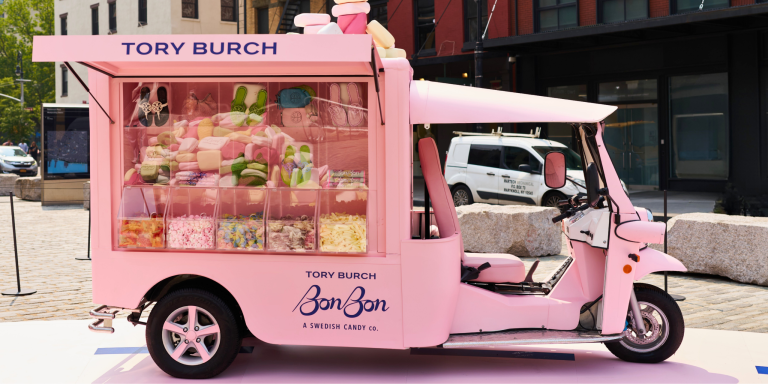
A partner brand funds a physical presence, your organization staffs it with people who can explain the mission, and both sides gain. This is the format most often overlooked by small teams, and it is the one that produces the most face-to-face conversations per dollar.
An awareness month, a giving day, or a news moment supplies urgency you did not have to manufacture. The risk is being one of hundreds of organizations posting the same day, which is precisely why a physical activation stands out in that window.
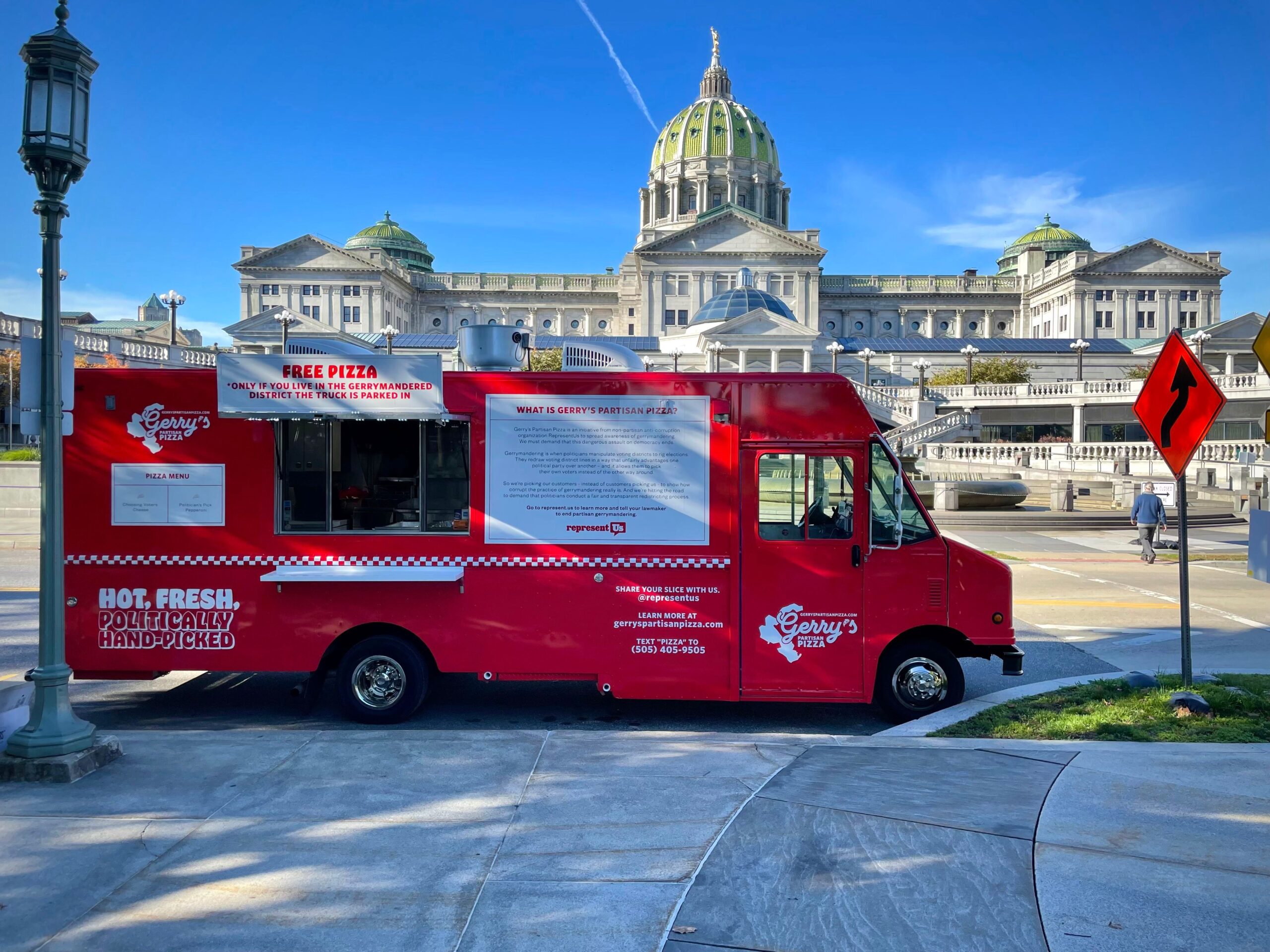
RepresentUs, a nonpartisan nonprofit focused on election and government reform, needed to explain redistricting and gerrymandering to students in a way that would land in the time it takes to hand someone a slice.
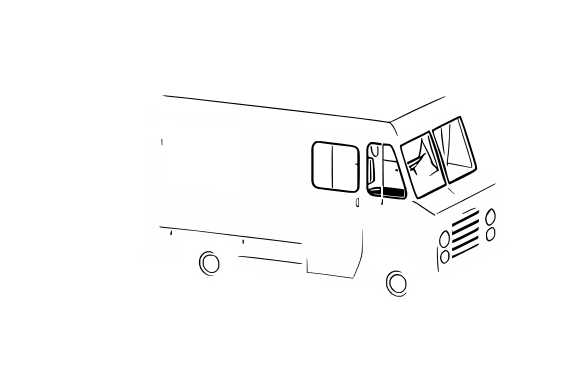
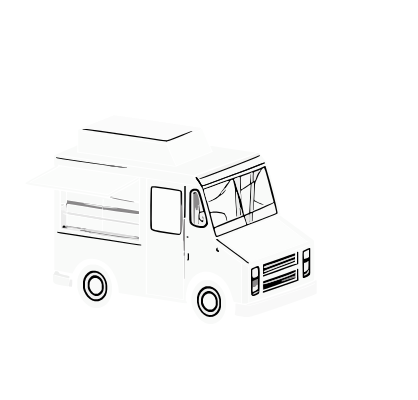
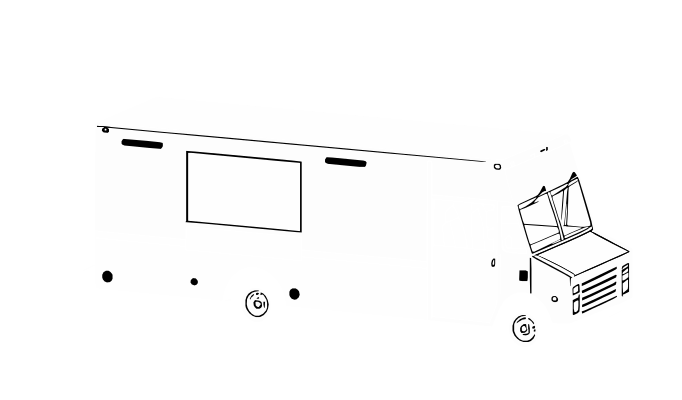
We built the Gerry’s Partisan Pizza mobile tour, driving a branded food truck to college towns across the country and serving pizza cut into deliberately uneven slices as a physical illustration of unevenly drawn voting districts. The pizza carried the message from the truck’s branding rather than competing with it.
Why it worked: the giveaway was the explanation. When the mechanic itself demonstrates the idea, people remember the idea rather than the snack, and they can repeat it to someone else. Read the full campaign in our Gerry’s Partisan Pizza tour case study, or browse more brand activation case studies.
Plant-based brand JUST Egg shows the corporate side of the same structure. The brand enlisted us to turn a food truck into a mobile billboard carrying its climate message around Washington, D.C., with menu designs poking fun at government officials, free breakfast sandwiches, and a QR code that sent people to write directly to Congress.
For a nonprofit, this is the template to pitch. The brand pays for the vehicle, the build, and the product. You supply the cause, the credibility, and the volunteers who can answer a real question. Both sides get something they could not have bought alone. We cover more of these in our roundup of guerrilla marketing campaigns.
The nonprofit marketing campaigns worth copying share a structure rather than a style. They have a deadline, a mechanic that carries the idea without explanation, and wherever possible a corporate partner paying for the parts a mission budget cannot. Community presence is where all three come together.
If a partner brand is ready to fund an activation, we handle concept, build, permits, and staffing. Explore our brand activation services or contact our team to scope it. For the wider picture, see our guide to nonprofit marketing.
A nonprofit marketing campaign is a coordinated push built around one goal, such as raising funds, recruiting volunteers, or growing an advocacy list. It has a start, an end, a target, and a mechanic, which is what separates a campaign from ongoing communications.
A clear deadline, a specific ask tied to a concrete outcome, and a mechanic that makes the next step obvious. Campaigns that explain an issue in copy tend to underperform campaigns that demonstrate it through something people can see, hold, or taste.
A traditional pop-up occupies a leased storefront or space for a fixed period, while a mobile pop-up is built into a vehicle and can change locations daily. The mobile version carries an identical brand experience across stops and doubles as a moving billboard between them.
Cause marketing pairs a nonprofit with a company on a shared campaign. The brand usually funds the activation and gains goodwill and reach, while the nonprofit gains exposure, donations, and access to an audience it could not otherwise afford to reach.
A corporate partner pledges to match donations up to a set ceiling within a defined window. Donors get a multiplier on their gift and a deadline to act, which reliably lifts response rates, and the partner gets a clear story to promote to its own customers.
Approach brands with audience overlap and a specific offer covering what the brand gets, what you provide, and what the campaign looks like. Sponsored activations are the easiest entry point, because the deliverables are concrete and the timeline is short.
Not directly, but they build the list that does. Advocacy and awareness campaigns ask for a low-commitment action such as a signature or a pledge, and those contacts convert to donors over time at far better rates than cold prospects.
There is no universal figure, and the more useful question is what the campaign is designed to produce. If a corporate partner funds the activation, your cost is staffing and coordination, which changes the economics entirely.
Yes, usually by finding a brand partner to fund it. That is the whole point of the sponsored activation model: the brand covers the vehicle, build, and product, and your organization contributes the cause, the volunteers, and the credibility.
Track funds raised against target, contacts captured, cost per acquired donor, conversion from action-taker to donor, and the value delivered to any corporate partner. That last one is what secures the next campaign.
Start with the audience, the neighborhoods or events where they gather, and whether a corporate partner could fund it. A production partner can handle build, permits, and logistics. Share your timing with our team and we will map it out.
7 steps, 37 checkpoints, and a one-page brief to plan and launch a mobile pop-up shop that converts.
Instant PDF · No Cost
Author
EVP, Managing Director @ FTP Agency
David Botbol thrives on turning bold ideas into real-world brand moments. As Executive VP and Managing Director of Food Truck Promotions, and a leader within the New York and Los Angeles Food Truck Associations, he draws on a background in business development and startups to help brands connect with audiences through creative, unforgettable mobile experiences.
Luxury brand marketing strategies work by inverting almost every rule the rest of marketing follows. Mass brands chase reach, discount to convert, and optimize…
Read more →
Fashion marketing has never been more crowded, more expensive, or more dependent on getting a real person to stop and pay attention. The feed…
Read more →
Beauty marketing lives or dies on one thing: getting the product onto an actual face, in an actual hand, in front of an actual…
Read more →We use and share personal information through cookies and similar technologies on our sites to personalize your shopping experience and ads. Others may use this information for their own marketing and business purposes. . Check our Privacy Policy for more details.
Browser Opt-Out Honored
We use and share your personal information with others to personalize your shopping experience and show you targeted ads on other sites based on your interests and online activities.
Online Info includes cookies, pixel tags, and similar technologies connected to your browser or device. Offline Info includes information associated with your email address based on your other interactions with us.
We use and share your personal information with others to personalize your shopping experience and show you targeted ads on other sites based on your interests and online activities. Information includes cookies, pixel tags, and similar technologies connected to your browser or device (Online Info), as well as information associated with your email address based on your other interactions with us (Offline Info). Others may use this information for their own marketing and business purposes.
You can choose to opt out of sharing one or both types of information.