An experiential marketing agency builds brand experiences people can physically walk up to, rather than advertisements they scroll past.
Marketing comes in many forms: video, social, content, search, inbound. Experiential is the one that happens in the street, and it works on a different principle. Instead of buying attention, you give someone a reason to stop.
This guide covers what these agencies actually do, when it makes sense to hire one, how to choose between them, and what to ask before you sign anything.
Key Takeaways
- The product is a moment, not a message: an experiential agency designs, builds, and runs a physical experience rather than producing creative for someone else to place.
- Full-service means fabrication, not just concepts: the meaningful difference between agencies is whether they build and operate, or outsource both.
- Four common triggers: product launches, test marketing, event presence, and general brand awareness.
- Lead time is the real constraint: permits, fabrication, and staffing decide your earliest possible date, not the creative.
- Ask about permits and staffing before creative: the answers tell you far more about whether an agency can deliver than a portfolio does.
What Does an Experiential Marketing Agency Do?
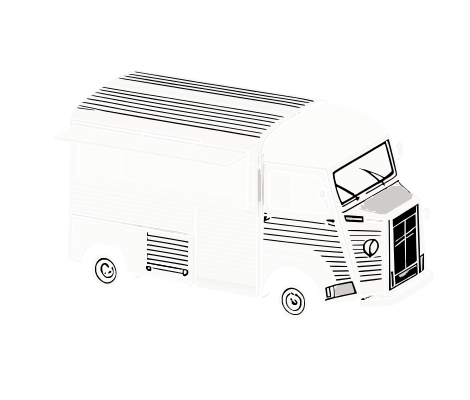
An experiential marketing agency creates in-person brand experiences and handles everything required to put them on the street. For a mobile agency like Food Truck Promotions, that means transforming vehicles into interactive experiences that connect brands with customers.
The scope usually runs across six areas: concept development, design and 3D renderings, fabrication of the vehicle or build, location procurement and permits, staffing with trained brand ambassadors, and running the activation itself. Our capabilities page breaks each of those out.
The distinction worth understanding is between agencies that produce ideas and agencies that produce the thing. Plenty of shops will develop a concept and then subcontract the build, the permits, and the staff. That is a different service with different risks, and it is the single most useful question to ask early.
What Makes Experiential Marketing Agencies Different
These are all the ways that separate experiential marketing agencies from traditional agencies.
Face-to-Face Interaction
In a market where nearly every brand competes for the same digital attention, experiential works by not competing there at all. A targeted social ad can reach the right person, but it does not create the kind of memory an in-person moment does.
The goal is a real connection between a brand and a customer, built on something they did rather than something they saw.
Complete Customization
When an agency partners with a client, the work is bespoke. A one-day activation or a multi-month campaign both start from the brand rather than from a template.
Sampling a product on college campuses, building a mobile billboard with pointed menu items, letting people try a self-tanning lotion on the spot: each requires a different build, a different route, and a different kind of staff. There is no formula, which is exactly why the format works.
Long-Term Results
Those two qualities combine into the point of the exercise. Experiential agencies are creative, detail-driven, and increasingly data-driven, so the return is not only a temporary lift in sales or store traffic.
Both of those happen, but the durable outcome is a better quality of customer: people who tried the product, spoke to someone about it, and remember doing so.
Three Activations That Show the Range
Here are 3 activations that FTP Agency did that illustrate the value of experiential marketing.
JUST Egg
JUST Egg enlisted us to turn a food truck into a mobile billboard carrying its climate message around Washington, D.C. The build included witty menu designs, direct calls to action, and an exterior that made an argument rather than an advertisement.
Kate Spade
To mark Mother’s Day, we parked six floral-printed food carts along Broadway in New York City to celebrate motherhood and introduce the new Kate Spade collection. The carts were wrapped in a delicate white base with pink, yellow, and purple floral accents drawn from the collection itself, with flower arrangements as the main attraction before they landed in the hands of New Yorkers.
Bacardi
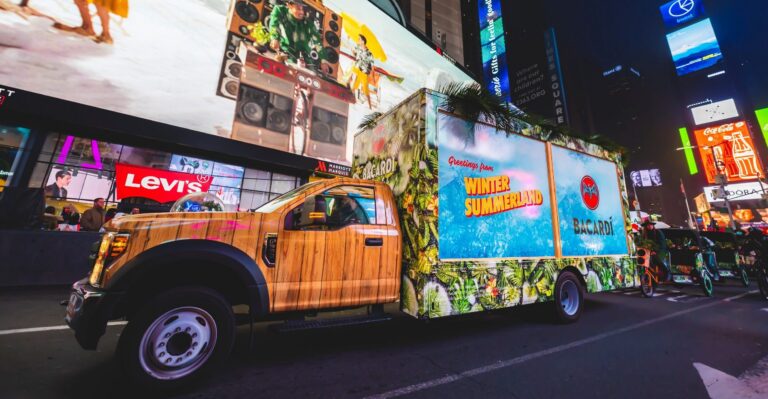
A branded glass truck parked in Times Square for the Winter Summerland campaign, with surprise guests, a flashmob, and a fully built-out interior. Covered in full in the case study below.
When to Use an Experiential Marketing Agency
Here the key reasons you would need to partner with an experiential marketing agency.
Product Launch
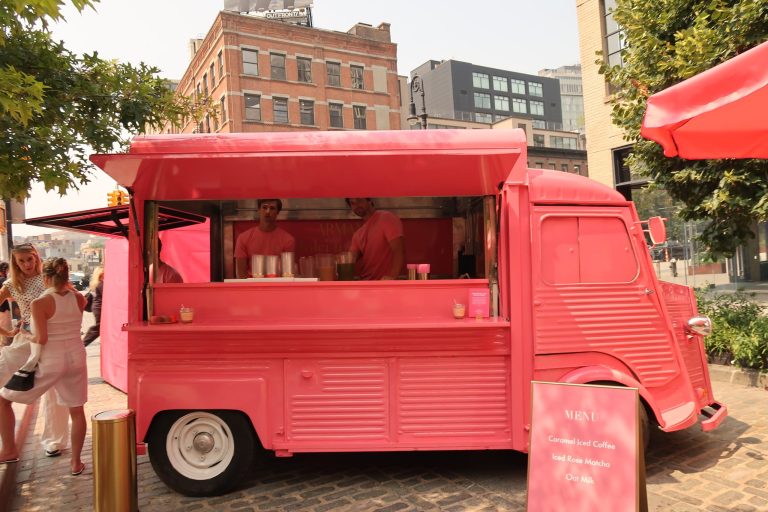
If you have just released something, this is the moment to get it into as many hands as possible. Moisturizer, tanning lotion, a mixer, ice cream: anything that is easier to judge by trying than by reading about. The Rose Inc mobile pop-up is a good example of a launch handled this way.
Test Marketing
If the product has not launched yet and you want to know how a specific audience responds, an activation is faster and cheaper than a market entry. A mobile showroom, a pop-up, or a sampling tour all give you direct feedback before you commit.
Event Marketing
Take your brand to a Pride celebration, a conference, or a marathon. Event marketing puts you in front of a crowd that has already assembled, which is far cheaper than building one. Our Zara WorldPride activation is an example of that at scale.
Brand Awareness
Sometimes there is no launch and no event. Building a brand name that resonates matters on its own, and a physical presence does that in a way paid impressions do not.
Our roundup of guerrilla marketing campaigns covers awareness-led activations that ran without a product launch attached.
How to Choose an Experiential Marketing Agency
Portfolios all look good. These are the questions that actually separate agencies, and none of them are about creative.
- Do you build in house or subcontract? In-house fabrication means one team is accountable from rendering to street. Subcontracting introduces a gap between what was promised and what gets built.
- Do you own vehicles or rent them? Owned fleets mean availability, customization, and no third-party scheduling risk.
- Who handles permits? This is the most common cause of a delayed or relocated activation. Ask which cities they have permitted in and what lead time they need.
- Who staffs it? Brand ambassadors with product knowledge convert; agency staff who read from a card do not. Ask how they brief and supervise.
- What happens if the date moves? Launches slip. Ask what that costs and how they absorb it.
- How will we measure this? If the answer is impressions only, press for more. Samples, sign-ups, redemptions, and cost per interaction are all trackable. For more on matching a format to a goal, see our guide to brand activation strategies.
Case Study: How Bacardi Took Over Times Square With a Glass Truck