How to Choose a Brand Activation Company
Choosing a brand activation company is difficult for a specific reason: every portfolio looks good, and none of them show you the part that…
Read moreBy: David Botbol • • 10 min read
Brand activation strategies exist to solve a problem advertising cannot: getting someone to do something rather than see something.
An impression is passive. An activation asks a person to stop, take something, try something, or sign up for something, and that difference is why the format keeps growing while attention in digital channels keeps getting more expensive.
This guide covers what a brand activation is, six strategies that work, how to choose between them, and five real activations we produced for brands including Chanel, Christian Louboutin, and Gopuff.
A brand activation is a marketing campaign built around a live, interactive experience rather than a message. It can be a pop-up, a mobile tour, a sampling program, a guerrilla takeover, or a branded vehicle placed where customers already are, and it succeeds when people participate rather than simply notice.
The distinction from advertising is participation. An advertisement asks for attention. An activation asks for a small action, and once someone has taken that action, they have a relationship with the brand rather than an impression of it.
Most brands are competing for the same attention in the same handful of digital channels, which has driven up costs and driven down patience. The result is an audience skilled at ignoring advertising and increasingly appreciative of anything that happens in the real world.
An activation sits in a useful position between the two. It creates a face-to-face moment, and that moment generates content, word of mouth, and press that then perform online. You are not choosing between physical and digital, you are using one to feed the other.
Here are the six brand activation strategies you should launch.
Put the product in someone’s hand. This is the most direct strategy and the right one when the barrier to purchase is uncertainty about the product itself, which is common in food, beverage, beauty, and fragrance.
When the product cannot practically be sampled on a street, give something else that people want and use the time it buys. All five activations below used this approach, and it is the single most reliable way to start a queue.
Bring a considered purchase to the customer rather than waiting for them to come to it. Suited to products that need demonstrating, where dwell time matters more than throughput.
One build, many markets. This is the strategy when the goal is national or international reach, because the fabrication cost is fixed and every additional stop lowers cost per interaction.
Place the activation outside or near a store so street traffic becomes store traffic. Bounce-back cards and in-store-only offers close the loop and make the campaign measurable.
Trade something of value for a sign-up, download, or subscription. A QR code on a cup is the mechanic, and the metric is contacts captured rather than impressions delivered.
For the vehicle side of these decisions, our guide to experiential marketing trucks compares the formats.
Something worth noticing across the five activations below. Chanel, Christian Louboutin, Miu Miu, Rose Inc, and Gopuff are wildly different businesses at wildly different price points, and all five chose the same mechanic: free hot chocolate.
That is not a coincidence, and it is the clearest illustration of strategy two above. A luxury fashion house cannot hand a handbag to a passerby, and a delivery app has nothing physical to sample at all. What both can do is give someone something genuinely welcome on a cold street, and use the ninety seconds it buys to introduce the brand, run a demonstration, or capture a sign-up.
The lesson generalizes. When your product cannot be sampled, the giveaway does not need to be your product. It needs to be something people actually want in that moment.
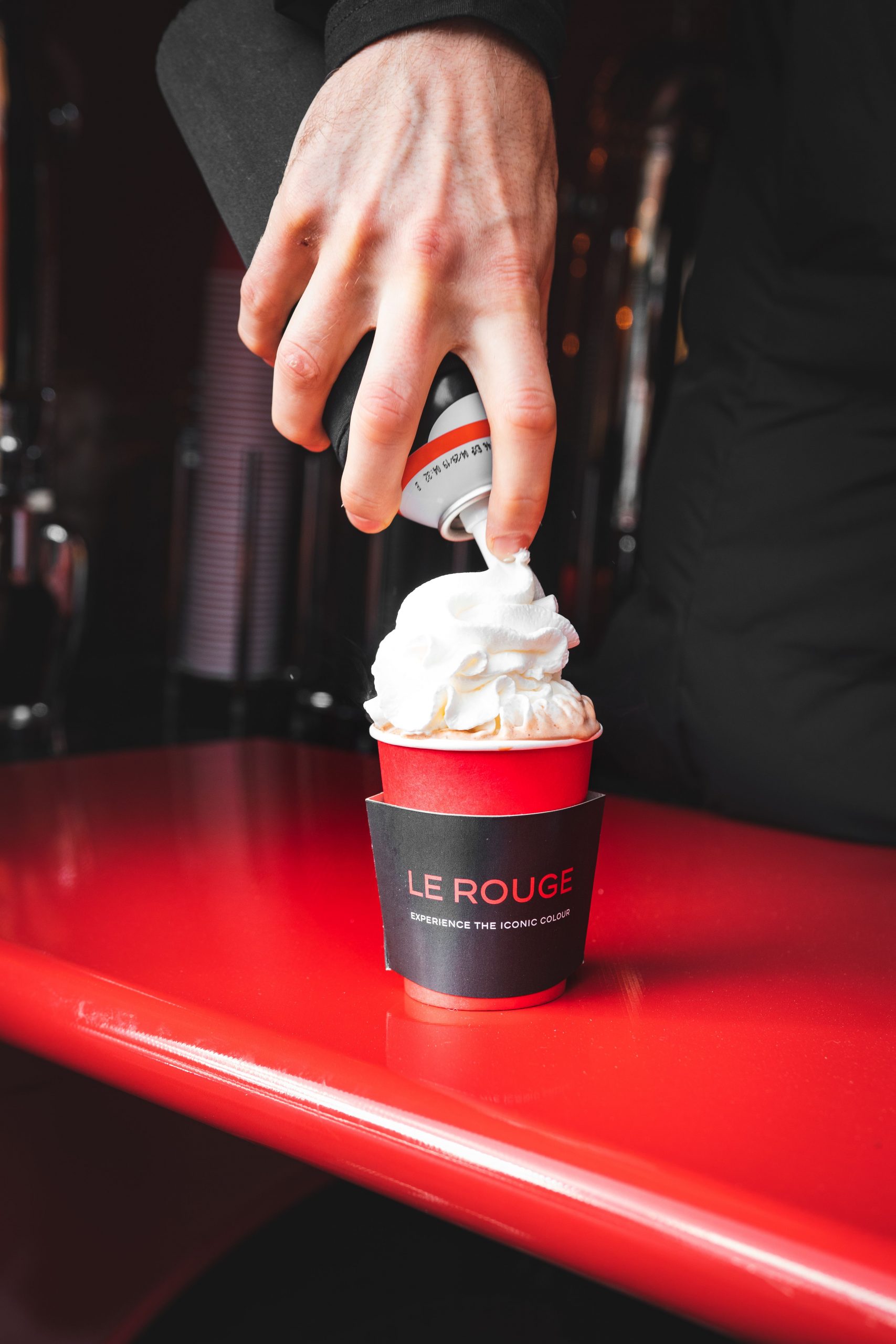
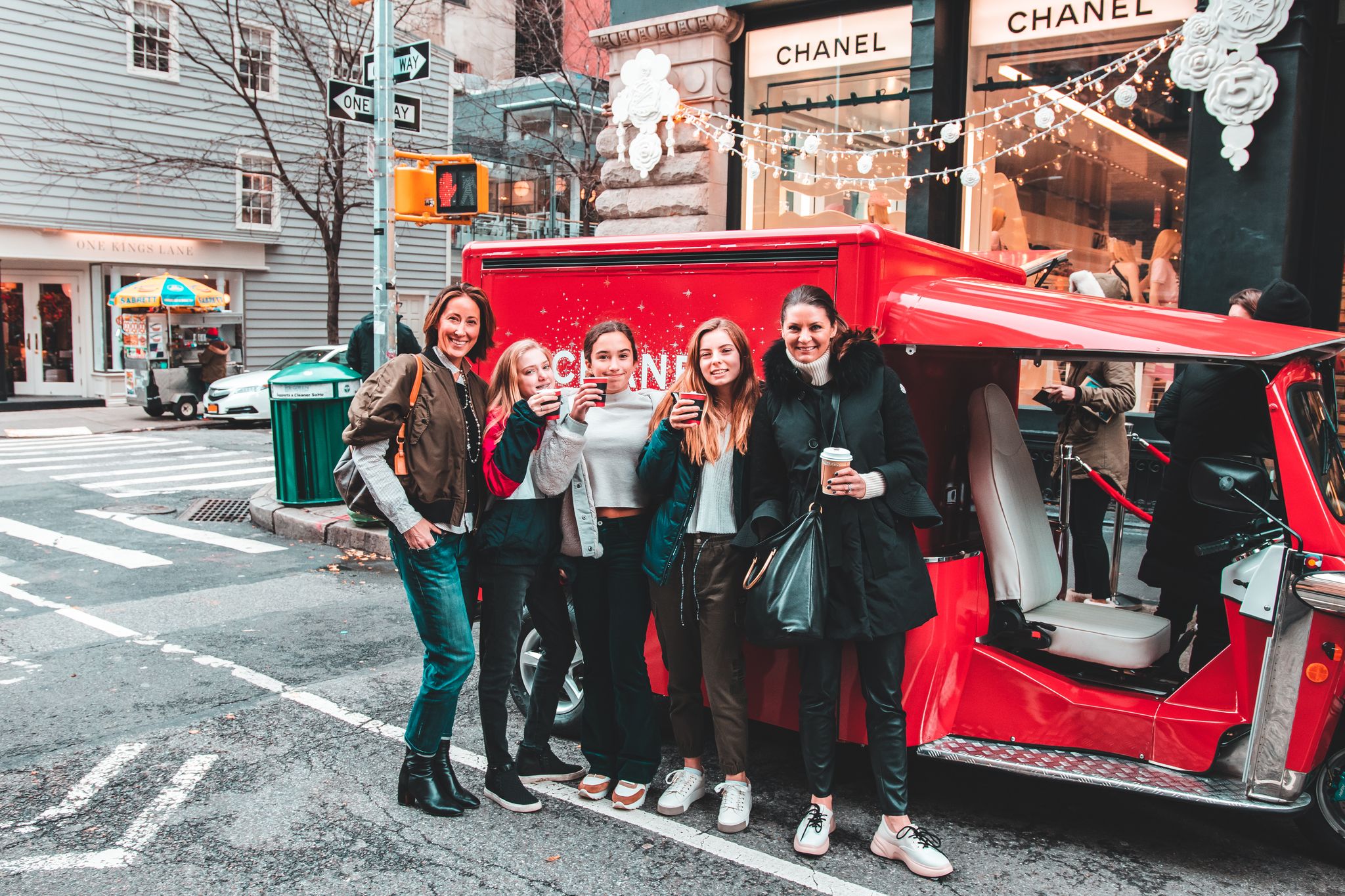
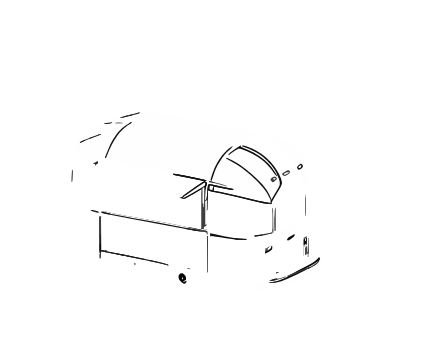
As part of Le Rouge Chanel, a month-long pop-up in New York City, Chanel extended its in-store interactive beauty experience onto the streets, built entirely around the house’s signature red.
The brand worked with our in-house culinary team on a rich hot chocolate served from branded trucks as a complimentary luxury treat on cold winter days. The trucks created lines around the block, giving out over 10,000 servings each weekend, and the campaign drove more than 5 million impressions across the month and the weeks that followed.
Why it worked: the activation extended an existing retail experience rather than replacing it, the giveaway matched the brand’s own aesthetic rather than sitting beside it, and the scale of servings turned a pop-up into a recurring city fixture for a month. Browse more work in our brand activation case studies.
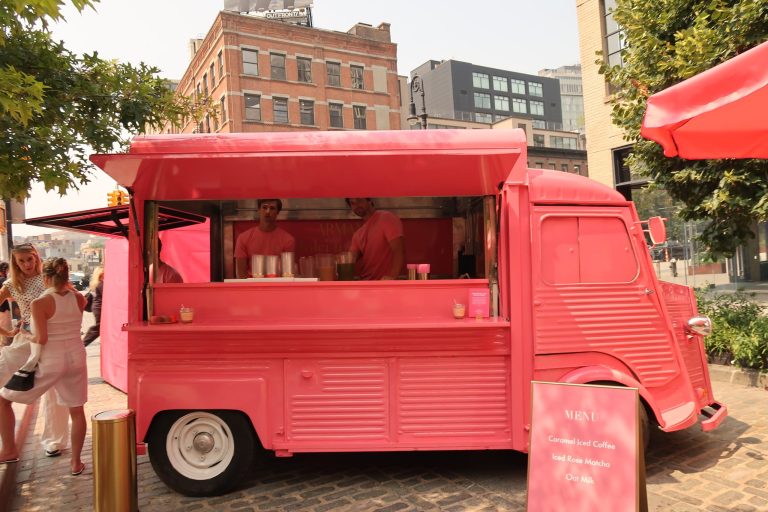
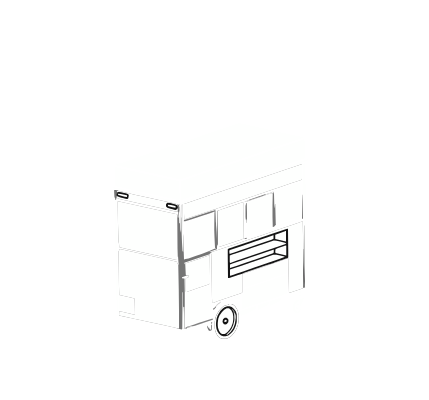
We built a bright red mobile crêperie for Christian Louboutin, serving crepes and hot chocolate from a branded vintage vehicle on the streets of New York. The color was the point, matching the house’s most recognizable asset.
The strategy: retail driver. The activation pulled street traffic toward the store, which filled with customers as a result.
Gopuff ran with us from October through March, having extended an initial partnership after seeing the results. Through the coldest months the brand served complimentary hot chocolate in exchange for a QR scan and an app sign-up, gaining thousands of new subscriptions.
The strategy: acquisition. The drink was the offer and the download was the product, which makes this the clearest example of an activation with a hard conversion metric attached.
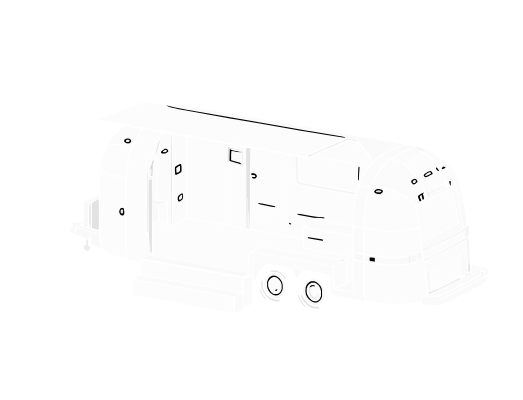
Rose Inc took an international tour across Los Angeles, New York, and London, our first activation outside North America. We branded three vehicles, secured permits across multiple high-priority locations, and built a product display wall where guests could sample the tinted serum or read the brand newspaper while queueing for hot cocoa customized to represent the range of skin tones the makeup is made for.
The strategy: multi-city tour, with a detail worth stealing. Matching the giveaway to the product’s actual proposition, in this case shade inclusivity, turns a queue into a demonstration.
We cover the routing side of this format in our guide to mobile marketing tours.
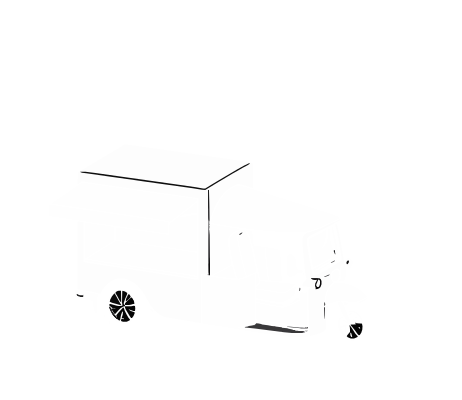
For Miu Miu we used a vintage E-tuk, chosen because its unconventional character suited the brand. The exterior carried the new graphic while the interior did double duty, serving gourmet hot chocolate on one side and displaying the season’s handbags on the other.
The strategy: mobile showroom. A single compact vehicle worked as both a giveaway point and a retail display, which is efficient use of a small footprint.
Brand activation strategies work when the strategy comes first and the creative follows. Decide what action you want, be realistic about whether your product can be sampled, choose depth or reach, then build the vehicle and the capture mechanic around that decision. The five brands above span luxury fashion to on-demand delivery, and every one of them succeeded by giving people something they wanted on a cold street.
If you are planning an activation, we handle concept, fabrication, permits, staffing, and logistics. Explore our brand activation services or contact our team to scope it.
A brand activation is a marketing campaign built around a live, interactive experience rather than a message. Formats include pop-ups, mobile tours, sampling programs, guerrilla takeovers, and branded vehicles. It succeeds when people participate rather than simply notice.
An advertisement asks for attention, while an activation asks for a small action such as taking a sample, scanning a code, or signing up. Once someone takes that action they have a relationship with the brand rather than an impression of it.
Sampling for trial, a giveaway that buys a conversation, the mobile showroom, the multi-city tour, the retail driver, and the acquisition play. Each maps to a different goal, so the strategy should be chosen from the outcome you need rather than the format you like.
Give something else people want and use the time it buys. Luxury brands including Chanel, Christian Louboutin, and Miu Miu all used free hot chocolate for exactly this reason, since a handbag cannot be handed to a passerby but a warm drink can.
By trading something of value for the download on the spot. Gopuff served complimentary hot chocolate in exchange for a QR scan and app sign-up through the winter months, gaining thousands of new subscriptions from a mechanic built into the cup.
Yes, provided the execution matches the positioning. The activation should give away an experience rather than discount the product, and the design has to meet the standard customers expect, which is why luxury activations lean on craft and detail.
Start with the action you want, then decide between depth in one market and reach across several. Choose the vehicle after that, since the format should follow what the activation needs to do rather than dictating it.
Track items distributed, sign-ups and scans captured, bounce-back redemptions, impressions and tagged content, and cost per interaction against cost per acquired customer. Decide these metrics before the build so measurement is designed in.
Anywhere from a single day to several months. Chanel’s ran across a month, Gopuff’s extended from October through March, and a tour can run longer as it travels. Length should follow the goal and the budget rather than a default.
Define the action you want customers to take, the markets that matter, and the window. A partner can handle concept, fabrication, permits, staffing, and logistics from there. Share your timing with our team and we will scope the strategy around it.
7 steps, 37 checkpoints, and a one-page brief to plan and launch a mobile pop-up shop that converts.
Instant PDF · No Cost
Author
EVP, Managing Director @ FTP Agency
David Botbol thrives on turning bold ideas into real-world brand moments. As Executive VP and Managing Director of Food Truck Promotions, and a leader within the New York and Los Angeles Food Truck Associations, he draws on a background in business development and startups to help brands connect with audiences through creative, unforgettable mobile experiences.
Choosing a brand activation company is difficult for a specific reason: every portfolio looks good, and none of them show you the part that…
Read more →
The best brand activation ideas are not the most elaborate ones. They are the ones that give a stranger a reason to stop walking.…
Read more →
Brand activation displays are the part of a build that does the selling, and they are usually designed last. The wrap gets rounds of…
Read more →We use and share personal information through cookies and similar technologies on our sites to personalize your shopping experience and ads. Others may use this information for their own marketing and business purposes. . Check our Privacy Policy for more details.
Browser Opt-Out Honored
We use and share your personal information with others to personalize your shopping experience and show you targeted ads on other sites based on your interests and online activities.
Online Info includes cookies, pixel tags, and similar technologies connected to your browser or device. Offline Info includes information associated with your email address based on your other interactions with us.
We use and share your personal information with others to personalize your shopping experience and show you targeted ads on other sites based on your interests and online activities. Information includes cookies, pixel tags, and similar technologies connected to your browser or device (Online Info), as well as information associated with your email address based on your other interactions with us (Offline Info). Others may use this information for their own marketing and business purposes.
You can choose to opt out of sharing one or both types of information.