The 7 Best Examples of Effective Mobile Marketing Tours

By: Ashley Elarde 10 min read

mobile marketing tours

Mobile marketing tours solve the problem every experiential campaign eventually runs into: you built something great and only one city saw it.

A tour takes a single build and puts it in front of several markets, which changes the economics completely. The vehicle is a fixed cost, so every additional stop lowers what each interaction costs you.

This guide covers what a tour is, why brands run them, what to plan for, and seven real tours we produced across beverage, beauty, advocacy, fashion, food, and coffee.

Key Takeaways

  • The build is the fixed cost: cost per interaction falls with every stop you add, which is why the economics improve as a tour lengthens.
  • One concept, many markets: a tour delivers a consistent brand experience across cities rather than a different event in each one.
  • Routing is the real skill: transport days between stops are dead time, so cities are chosen for drive time as much as audience.
  • Permits scale with cities: each market is its own approval process on its own timeline, which is what determines your lead time.
  • Every stop produces content and local press: a tour generates a content library rather than a single shoot.

What Are Mobile Marketing Tours?

A mobile marketing tour is a form of experiential marketing in which a brand takes an interactive customer experience to multiple locations, whether that is across a state, a country, or internationally. The activation travels in a branded vehicle and repeats at each stop.

Tours run in public places where crowds already gather: festivals, concerts, fairs, stadiums, malls, parks, campuses, and city streets. They work year round, though summer draws the largest crowds because more people are outdoors. Most incorporate product sampling, a prize wheel, giveaways, or a photo moment to hold attention long enough for a real conversation.

Why Brands Run Tours Instead of Single Activations

The appeal is reach without losing intimacy. A tour creates a much larger footprint than one event while still delivering a one-to-one interaction at every stop, which is the thing paid media cannot buy.

Three reasons the format performs:

  • The economics improve with scale. Design, fabrication, and wrap are paid once. Adding cities spreads that cost across far more interactions.
  • Sampling proves the product. Handing someone the product signals confidence in it, which is why tours suit launches and new formulations especially well.
  • The relationships outlast the sales. Tours drive short-term volume, but the durable return is the contact list, the content, and the local press earned in every market. If you are weighing which markets to visit, our guide to the best cities for a summer mobile marketing tour covers how to choose stops.

Top Mobile Marketing Tours Examples

1. Fever-Tree Mixer Truck

Fever-Tree took its mixers to New York, Austin, Los Angeles, and Miami, serving specialty-crafted mocktails so people could taste the product rather than read about it. Every guest left with a complimentary four-pack in a branded tote.

Why it worked: for a mixer brand, taste is the entire argument, and the four-pack takeaway turned a sample into a first purchase at home.

2. Rose Inc International Tour

Rose Inc promoted its skin serum with an international tour across London, Los Angeles, and New York. Guests were introduced to the micro-encapsulated makeup collection, then received a complimentary hot cocoa and an exclusive gift from Space NK and Sephora.

Why it worked: the retail partner gifts tied the tour directly to the places people could actually buy the product. Read the full build in our Rose Inc mobile pop-up case study.

3. Aerie Waffle Tour

To launch its Waffle clothing line, Aerie toured New York City, Chicago, Nashville, Boston, and Washington D.C., serving branded Belgian Boys waffles from a truck we wrapped in a one-of-a-kind waffle design. Guests also received Aerie socks and coupons redeemable in store or online.

Why it worked: the wrap, the giveaway, and the product line all said the same word. The coupon then pushed the tour audience toward a purchase rather than leaving it at awareness. See the Aerie tour case study.

4. Alpha Foods Campus Tour

We customized a food truck into a sampling pop-up for Alpha Foods and visited seven college campuses across Los Angeles and New York: NYU, Cornell, Columbia, FIT, Fordham, USC, and UCLA. Students chose between breakfast sandwiches, spicy maple BBQ chick’n nuggets, chick’n fajita burritos, and steak ranchero burritos, all meatless. While waiting, they entered to win a fully stocked Alpha Foods freezer.

Why it worked: plant-based food has to be tasted to overcome skepticism, and the sweepstakes turned the queue into a list. More on this audience in our guide to college brand activations, or read the Alpha Foods case study.

5. Westgold Butter Bar

To launch its butter in the United States, Westgold ran a 12-day mobile butter bar around southern California. Alongside sampling, guests got an interactive photo booth moment, bounce-back cards, and tote bags, and entered a raffle for a kitchen supply set with a month’s worth of butter.

Why it worked: butter is the definition of a product nobody can evaluate from packaging, and the bounce-back card connected the tasting to a retail purchase.

6. Nespresso Nordic Tour

Nespresso ran a six-week cross-country tour promoting its Nordic Limited Edition Coffee, with a branded mobile showroom carrying the new flavors and the coffee and espresso machines to New York City, Los Angeles, San Francisco, and Miami. Guests sampled both hot and iced coffee.

Why it worked: a machine is a considered purchase, so the showroom format gave people time with the hardware rather than just the drink.

7. Gerry’s Partisan Pizza

A nine-city, five-state tour for a nonpartisan nonprofit, serving pizza cut into deliberately uneven slices to explain redistricting. The most logistically demanding tour on this list, and covered in full below.

Case Study: How Gerry’s Partisan Pizza Toured 9 Cities
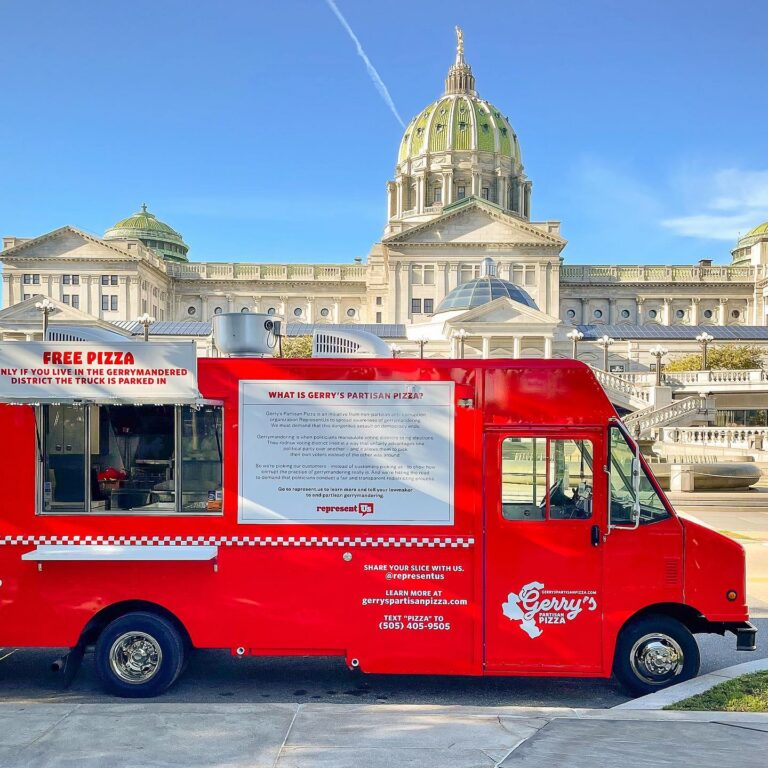
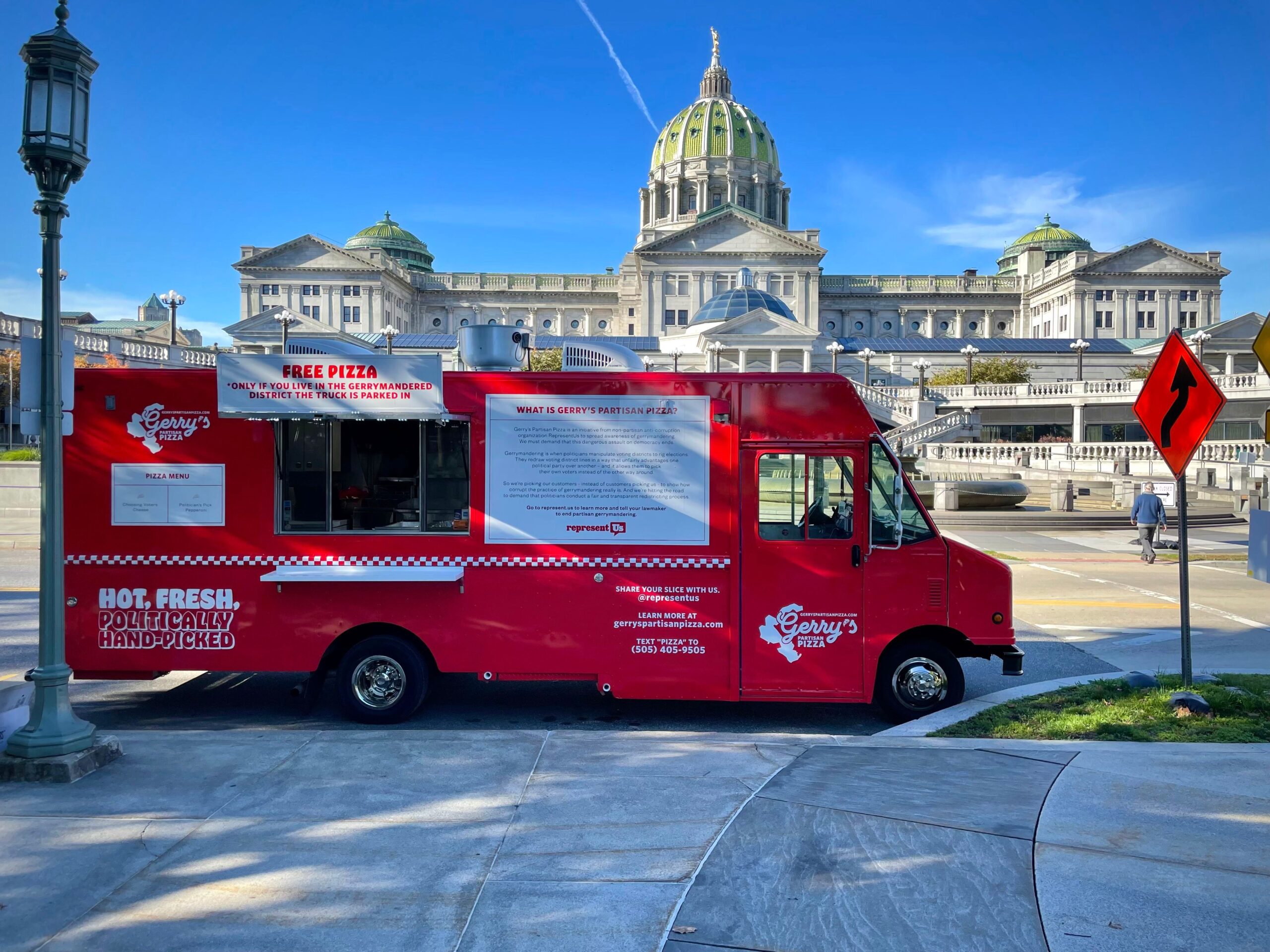
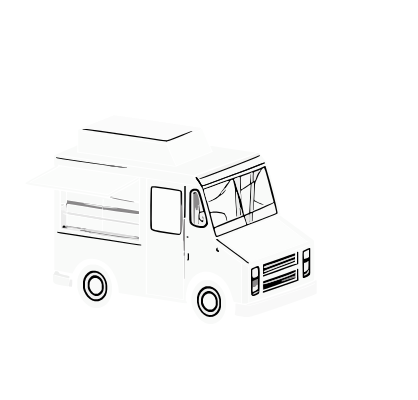
Gerry’s Pizza food truck with menu and free pizza sign parked by a green-domed government building.

RepresentUs, a nonpartisan nonprofit focused on election and government reform, needed to explain redistricting to people in the places it affected most.

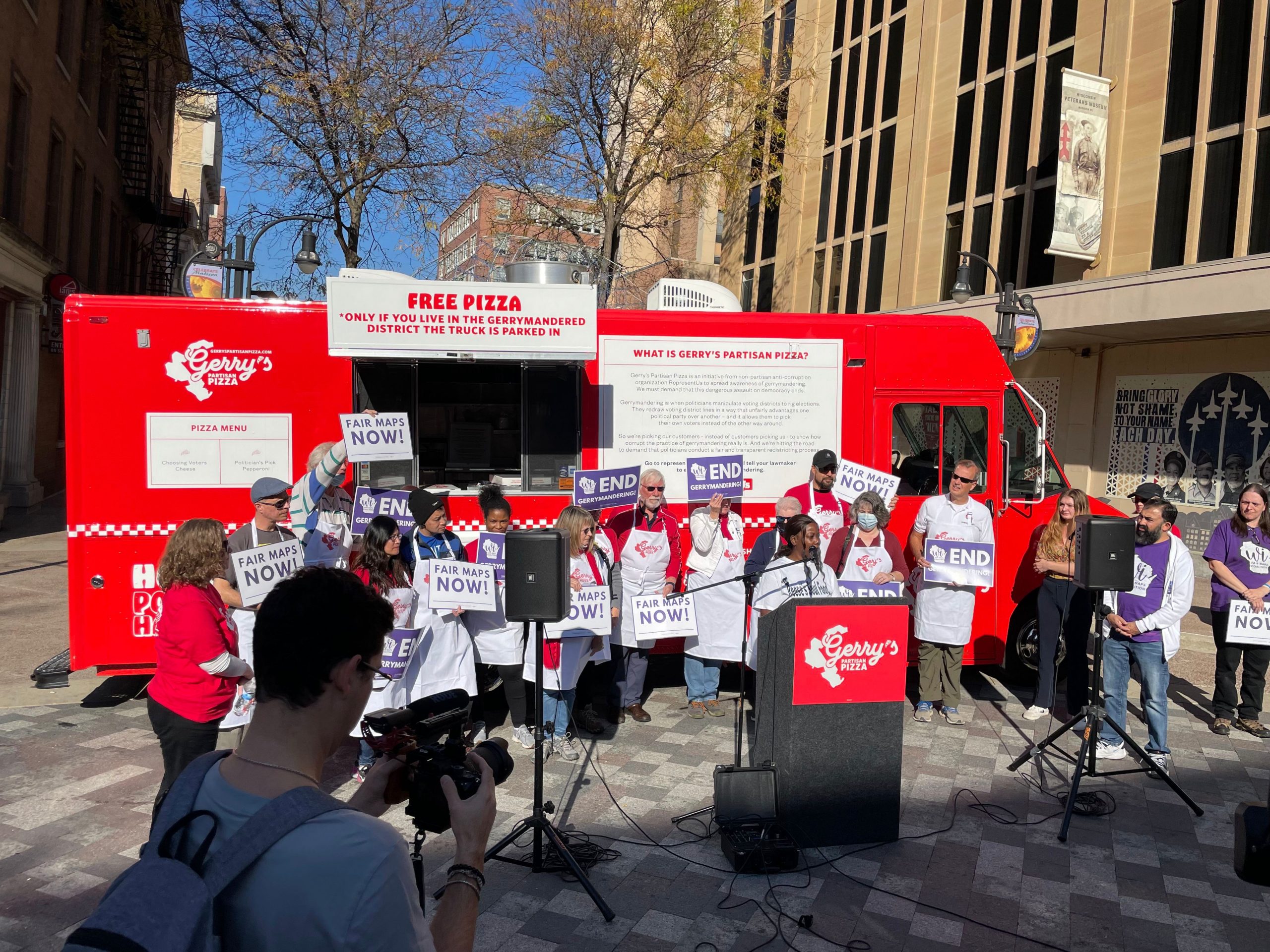
We built the Gerry’s Partisan Pizza mobile tour and took it to five states and nine cities: Raleigh and Greensboro in North Carolina, Annapolis in Maryland, Tallahassee and Orlando in Florida, Harrisburg and Pittsburgh in Pennsylvania, and Appleton and Madison in Wisconsin. The truck served pizza cut into deliberately uneven slices, a physical demonstration of unevenly drawn districts.

Why it is the best routing example here: nine cities across five states is a genuine logistics exercise, with a separate permit process in every market and transport days between them. It also shows the tour format doing something a single activation cannot, which is reaching the specific places where the message mattered. Read the full campaign in our Gerry’s Partisan Pizza case study, or browse more brand activation case studies.

What To Plan For Before You Tour

  • Prep time. Allow enough runway between pre-production and launch to work through the logistics properly. A tour has more moving parts than a single activation, and none of them compress well.
  • Permits in every market. Each city runs its own process on its own timeline. This, more than fabrication, is what sets your earliest possible launch date.
  • Routing and transport days. Drive time between stops is cost without return, so a tight regional cluster usually beats a scattered national route.
  • A call to action at every stop. Bounce-back cards, promo codes, and QR sign-ups are what turn samples into sales and interactions into a list.
  • Location scouting. Judge each stop on two things: foot traffic and audience match. High traffic only helps if the people walking past are the ones you want.
  • Stock forecasting per market. Running out mid-afternoon in city four means that market got a worse experience than city one.
  • Consistency across stops. Whether staff travel with the build or are hired locally, one brief applies everywhere, or the tour becomes a series of unrelated events.

How To Measure a Mobile Tour

  • Interactions and samples per stop: the figure that tells you which cities to repeat next year.
  • Cost per interaction by market: the truest comparison across stops, since it accounts for turnout and local cost together.
  • Sign-ups, scans, and redemptions: the trackable conversion from a crowd to a customer.
  • Local press and tagged posts per market: local coverage is easier to earn than national and compounds across the route.
  • Sales lift in tour markets: measured against comparable cities you did not visit.

The Bottom Line

Mobile marketing tours work because one good idea, built once, can meet customers in a dozen places. The creative matters, but the thing that separates a strong tour from an expensive one is routing, permits, and a capture mechanic that runs at every stop.

If a tour is in your plan, we handle routing, build, permits, staffing, and logistics end to end. Explore our mobile marketing tour services or contact our team to map a route.

Frequently Asked Questions

A mobile marketing tour is an experiential campaign in which a branded vehicle takes an interactive customer experience to multiple cities or neighborhoods on a planned route. Each stop typically includes sampling, giveaways, or a photo moment designed to hold attention and start conversations.

Because the build is a fixed cost. Design, fabrication, and wrap are paid once, so every additional city spreads that investment across more interactions. A tour also produces content and local press in each market rather than only one.

It depends on budget and timeline, though the economics generally favor more stops. The practical limits are transport days between markets, permit lead times in each city, and how long you can keep staff and stock running consistently.

Anywhere from under two weeks to several months. The Westgold butter bar ran 12 days in one region, while the Nespresso Nordic tour ran six weeks across four cities. Length follows the number of markets and the days spent in each.

Summer draws the biggest crowds because more people are outdoors, but tours run year round. Cold weather formats work well with hot drinks, and campus tours follow the academic calendar rather than the seasons.

Yes. Each market runs its own permitting process with its own requirements and timeline, and serving food adds health approvals on top. This is usually what determines the earliest date a tour can launch, more than fabrication does.

Cost depends on the vehicle and build, the number of cities, tour length, product volume, staffing, transport, and permits. The build is the largest fixed expense, which is why cost per interaction usually improves as you add stops.

One brief applied everywhere, whether staff travel with the build or are hired per market, plus forecasting stock so later cities get the same experience as the first. Inconsistency is what makes a tour feel like unrelated local events.

Track interactions and samples per stop, cost per interaction by market, sign-ups and redemptions, local press and tagged posts per city, and sales lift in tour markets against comparable cities you did not visit.

Begin with the markets that matter, the window you want to activate in, and what customers should do at each stop. A partner can handle routing, build, permits, staffing, and logistics. Share your timing with our team and we will map a route.

FTP Free download

The Mobile Pop-Up Shop Launch Checklist

7 steps, 37 checkpoints, and a one-page brief to plan and launch a mobile pop-up shop that converts.

Instant PDF · No Cost

Ashley Elarde

Author

Ashley Elarde

Social Media Manager @ FTP Agency

Ashley Elarde is a social media strategist, content creator, and experiential marketing professional with experience bringing brands to life through engaging digital content. She has helped execute campaigns for brands across beauty, fashion, retail, and entertainment, developing campaigns that drive engagement and meaningful consumer connections.

More posts
Marketing Ideas to Honor Your IPO Day in Style