Top 6 Types of Pop-Up Shops: Which Format Fits Your Brand?
There is no single kind of pop-up shop, and the different types of pop-up shops each do a different job. A sampling truck built…
Read moreBy: Ashley Elarde • • 11 min read
Mobile pop-up shops have become the way ambitious brands go offline: a store, a sampling bar, or a showroom built into a vehicle, parked exactly where the customers already are. We’ve produced hundreds of them, for Nespresso, Ralph Lauren, LANEIGE, Fever-Tree, and Rag & Bone among others, and we’ve watched the format evolve from a novelty into a core channel that launches products, fills retail stores, and earns the kind of attention paid media can’t buy.
This is the complete guide. What a mobile pop-up shop is, why brands keep coming back to the format, the formats and vehicles to choose from, how to plan, design, and launch one, and how to measure it, with real activations from our own fleet as proof at every step.
A mobile pop-up shop is a temporary retail or brand experience built into a vehicle, such as a truck, bus, trailer, cart, or vintage van, that travels to wherever a brand’s audience already is. Unlike a static pop-up in a leased space, the venue itself moves: the same branded build-out can work a flagship-adjacent sidewalk, a festival, a campus, and a new city in the same month, carrying an identical experience to every stop.
That’s the short version; the full definitional breakdown, including how the format compares to static pop-ups, lives in our companion explainer, What Is a Mobile Pop-Up Shop?. For this guide, the definition you need is simpler: it’s a store, bar, or showroom you can aim.
The format solves four problems at once, and it’s why the ideas keep getting budget. Reach: one build serves unlimited locations, including multi-city tours, so the fabrication investment compounds at every stop. Attention: a designed vehicle is inherently photographable and press-worthy in a way no leased storefront is, and it advertises the brand even while driving between stops. Flexibility: brands can test products, markets, and retail concepts with limited commitment before signing anything permanent. Connection: sampling, demos, and face-to-face conversation build affinity that display ads can’t reach.
The wider industry numbers back the format’s growth: IBISWorld sized the U.S. pop-up shop industry at roughly $16 billion in 2025, and Capital One Shopping’s research (updated June 2026) found 80% of retailers who have opened a pop-up considered it a success, with 58% planning another. But the more convincing case is what the format does for a specific brand with a specific goal, which is what the rest of this guide is about.
Mobile pop-up shop is an umbrella over several distinct formats, each tuned to a different job. Choosing the right one is the first real decision in any campaign.
A store on wheels: merchandised inventory, browsing space, and on-site sales. This is how DTC brands test physical retail without a lease and how established retailers test new markets before committing to one.
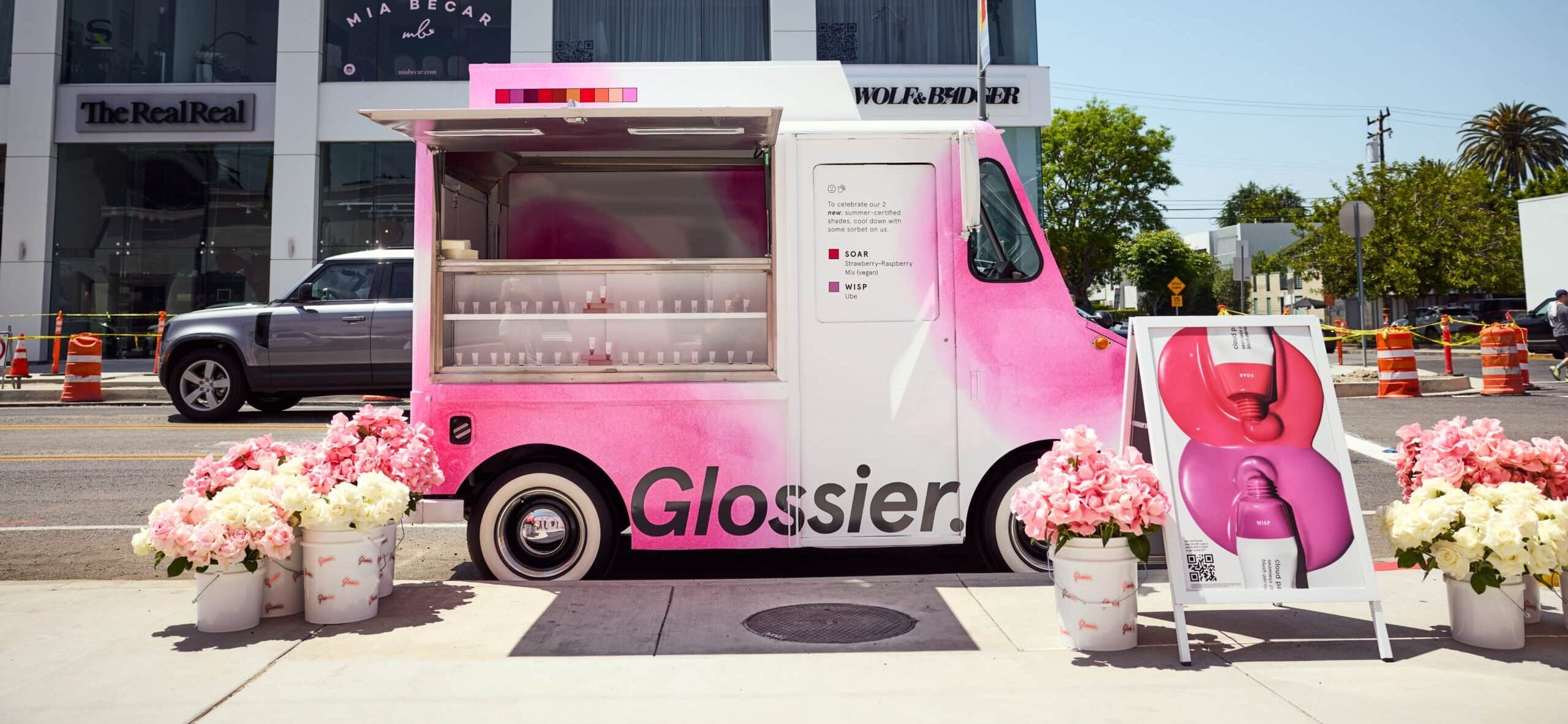
Built for trial at volume: a fast serving window, product in hands within a minute, and takeaways that convert the taste into a purchase. The workhorse format for beauty, food, and beverage launches.
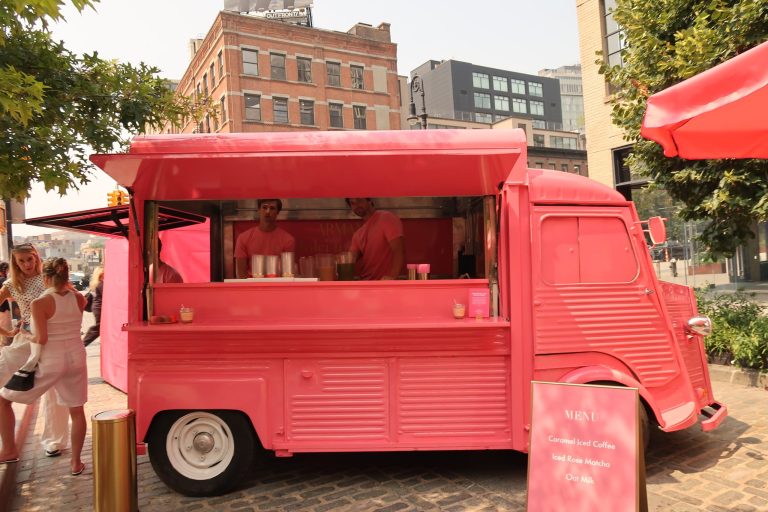
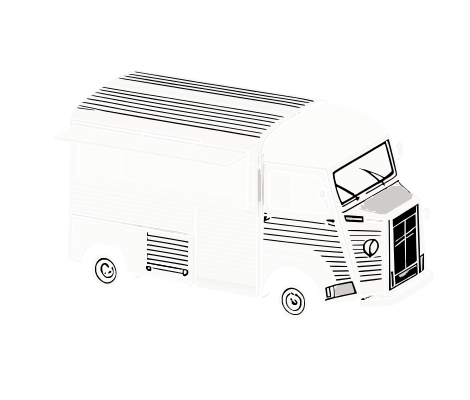
Coffee carts, cocktail trucks, and branded beverage pop-ups that wrap the brand in a daily ritual. Ralph Lauren launched Ralph’s Coffee from a vintage Citroen we customized, and Fever-Tree turned a mobile bar into more than 5,100 product trials.
Mobile showrooms are display-and-demo environments where the goal is education, lead capture, and store traffic rather than on-site sales. Nespresso’s first national mobile tour ran this format for six weeks directly outside its own boutiques.
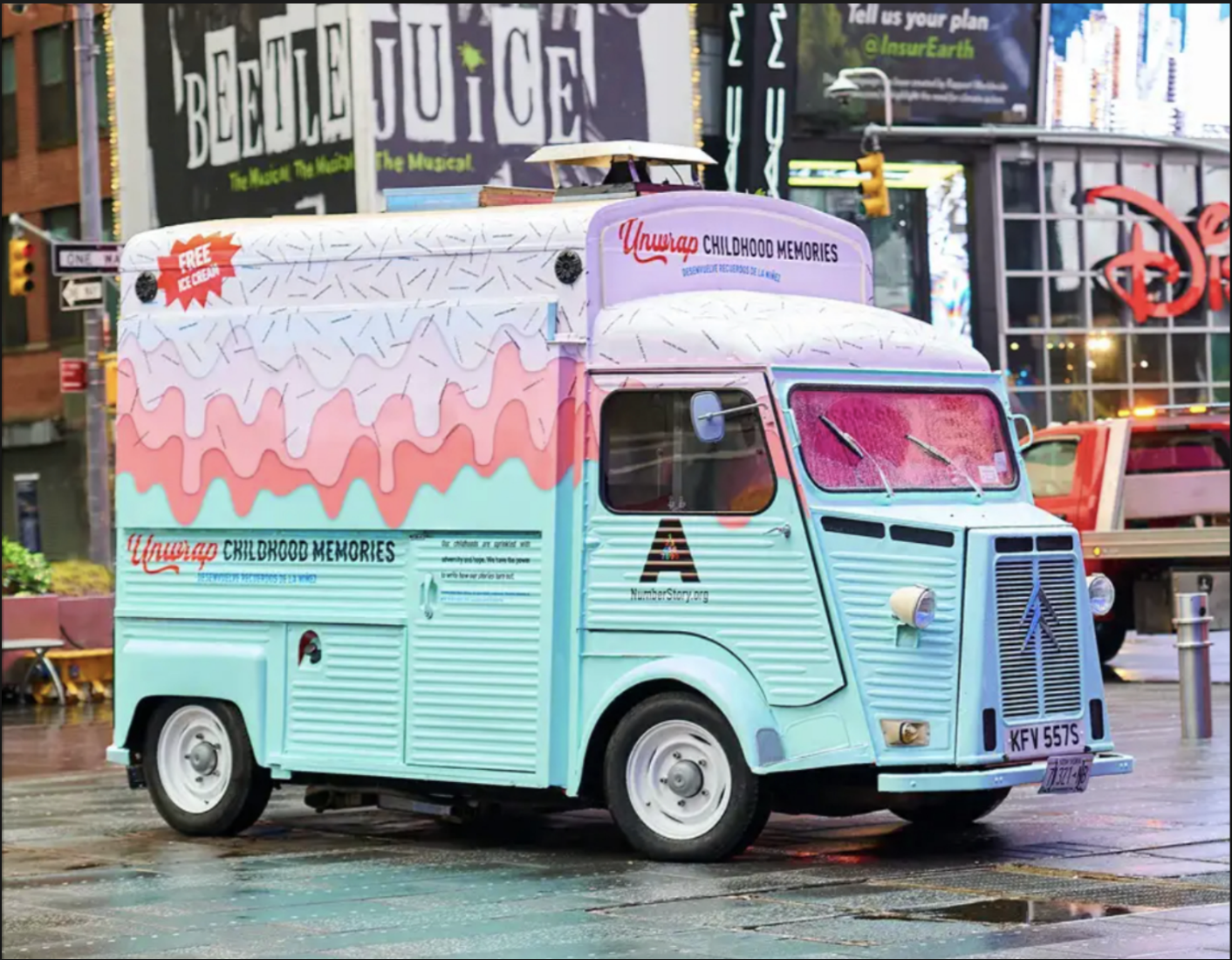
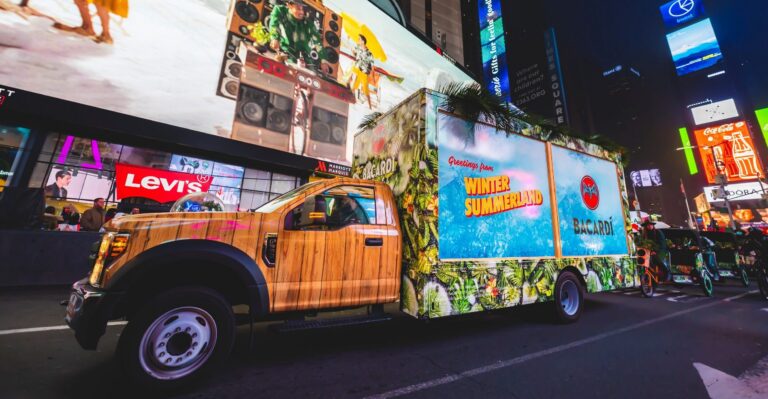
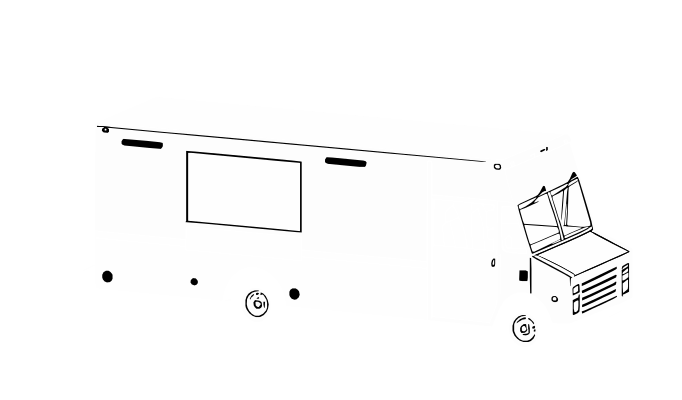
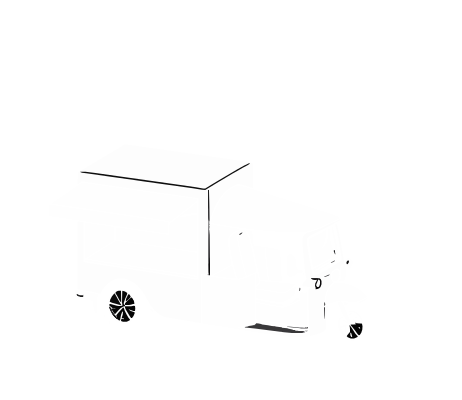
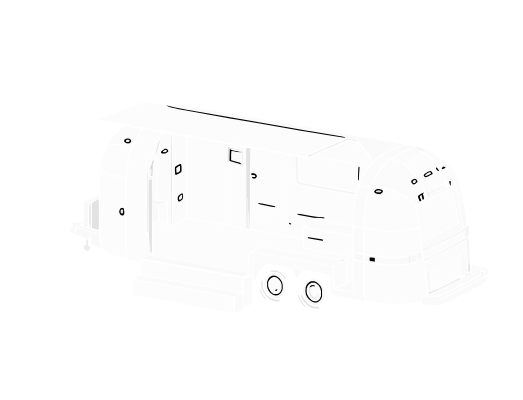
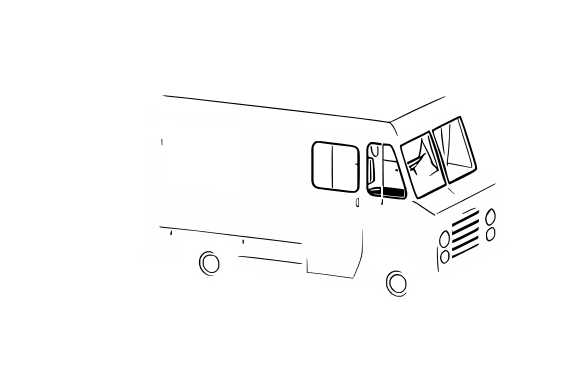
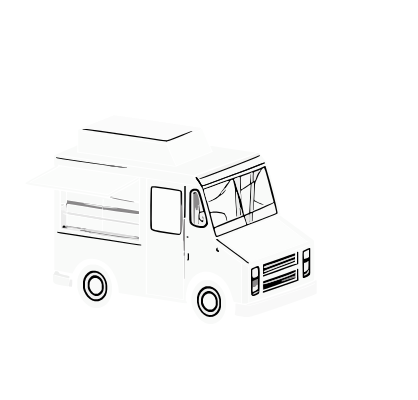
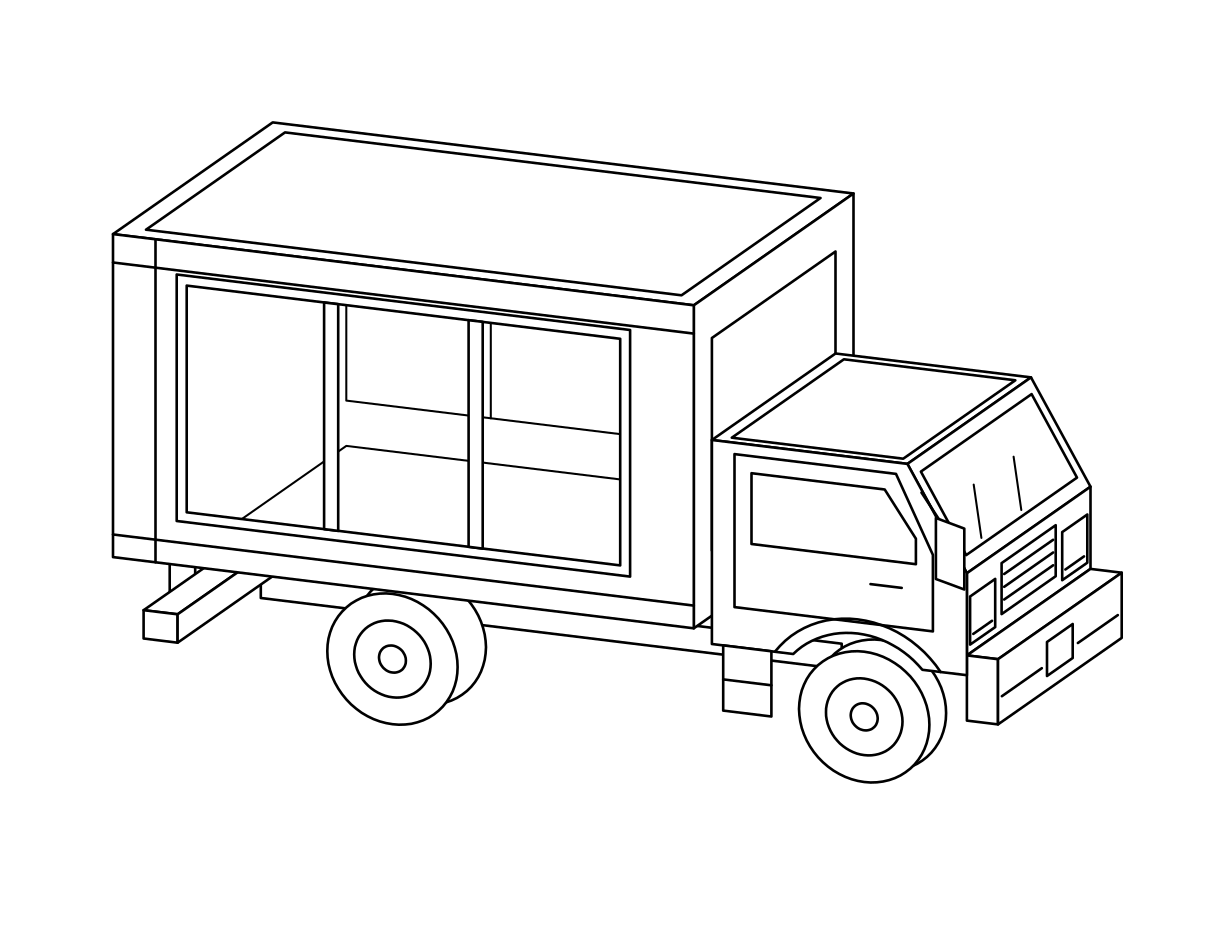
Every format above gets built onto a vehicle, and the vehicle decides your footprint, your sightlines, and what the experience can physically be. The short version of the lineup: food trucks bring full kitchens for sampling at volume; glass box trucks turn the whole build into a display case that’s striking day and night; buses and double-deckers offer multi-room brand worlds; Airstreams and trailers bring walk-in, residency-ready space with retro charm; vintage Citroens and tuk tuks trade size for personality and photograph beautifully; and carts fit the sidewalks and indoor venues nothing else can reach.
Browse the full experiential vehicles fleet, and when you’re ready to choose, our guide to choosing an experiential marketing vehicle walks the decision through the three filters that matter: goal, product, and route. One rule of thumb worth carrying in: the coolest vehicle is rarely the right one. The right one is whichever format your customer journey fits inside, which is why we always design the experience on paper before assigning it a set of wheels.
A successful launch runs the same sequence every time, and skipping a step is where activations go sideways. Here it is condensed; the full walkthrough lives in our step-by-step launch guide.
First, set the goal and one primary metric, because every downstream choice depends on it. Second, define the audience and pick locations where they already are, treating the route as a strategy. Third, choose the format and vehicle to fit. Fourth, handle the operational layer early: city permits, insurance, and any food or alcohol licensing, which vary by market and take longer than teams expect. Fifth, staff it with brand ambassadors briefed on the product, not just the pour. Sixth, market the event before doors open with teasers, influencers, and a short PR push. Seventh, capture and measure everything against the goal.
Design is where a vehicle becomes a brand world, and it’s the difference between a decorated truck and an activation with a line. The essentials: brand every exterior surface for the five-second glance, since the wrap is a moving billboard; build the interior to retail quality with deliberate flow, lighting, and merchandising; engineer one photo-worthy moment, because that single installation determines how far the activation travels online; and finish the details guests take home, from branded cups to takeaway bags.
Design and fabrication are our signature capability, from 3D renderings to two-story builds, and you can see what’s possible on our capabilities page. The full treatment, including vehicle-by-vehicle design guidance, is in our guide to designing a mobile pop-up shop.
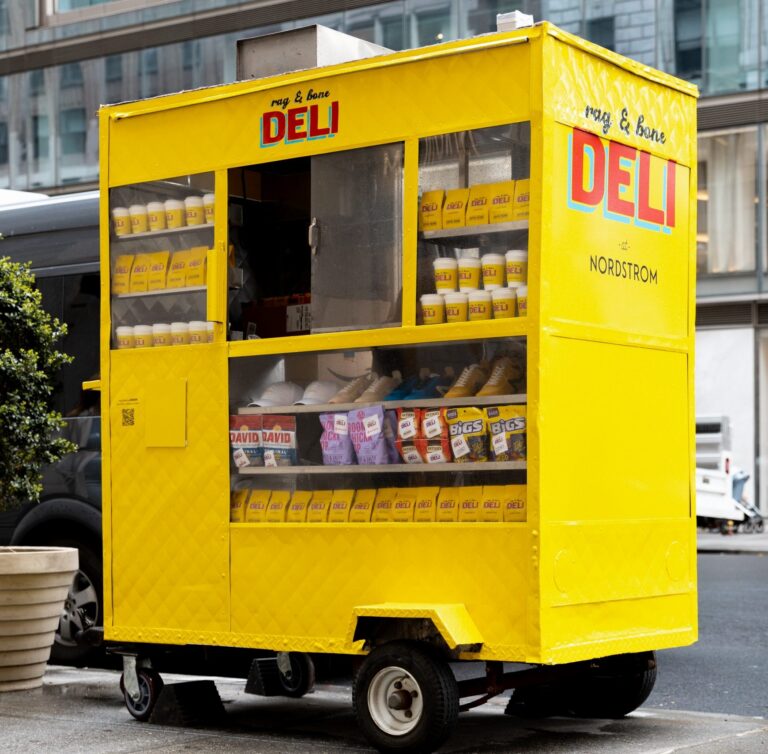
One activation shows the whole playbook working in a single frame. When Rag & Bone took over Nordstrom’s Center Stage at the New York flagship with its deli-inspired pop-up shop, an immersive concept with exclusive pieces displayed in deli fridges, on newspaper stacks, and behind a deli counter, the brand needed the street to know it was there.
Our answer was the Rag & Bone Deli coffee cart: an authentic New York City coffee cart completely rebranded in bright yellow with Rag & Bone Deli branding on every side, parked at the corner of Broadway and W 57th, directly outside Nordstrom. Passersby were drawn in for a complimentary hot or iced coffee, then headed into the store to see the deli experience, coffee in hand. Every element earned its place: the cart was the photo moment and the moving billboard, the free coffee was the interaction, and the coffee sleeves carried a QR code that entered guests into a raffle for a $1,000 Nordstrom gift card, which gave the activation a built-in attribution mechanism connecting street traffic to the retail partnership.
That’s the mobile pop-up shop formula at its cleanest: the right format (a cafe cart), the right location (the retail partner’s front door), a designed experience, and measurement built into the takeaway.
Everything above earns its budget in the counting. Set one primary metric before launch, track the core KPIs the same way at every stop (foot traffic, samples, leads, conversions, social reach, earned media), build attribution mechanisms like QR codes and promo codes into every takeaway, and package the results in a stakeholder recap that leads with the number against its target.
The complete measurement framework, including how to attribute in-person activations and what to report, is in our guide to pop-up shop metrics, KPIs, and ROI. The short rule we run every production by: count it or it didn’t happen.
A mobile pop-up shop is a temporary retail or brand experience built into a vehicle such as a truck, bus, trailer, or cart, letting a brand sell, sample, or showcase products wherever its customers are. Because the venue travels, location becomes a controllable strategy rather than a lease.
Four formats cover most campaigns: retail pop-ups that sell on site, sampling and launch pop-ups built for trial at volume, mobile cafes and bars that wrap the brand in a beverage ritual, and mobile showrooms designed for demos, education, and driving traffic into retail stores.
They combine reach, attention, flexibility, and connection: one build serves unlimited locations, a designed vehicle earns photos and press, brands can test markets with limited commitment, and face-to-face sampling builds real affinity. Capital One Shopping’s research (updated June 2026) found 80% of retailers who ran a pop-up considered it a success.
Run the sequence: set a goal and one primary metric, define the audience and locations, choose the format and vehicle, handle permits and insurance early, staff with brand ambassadors, market before doors open, and measure against the goal. Our step-by-step launch guide covers each stage in depth.
Match the vehicle to the goal, product, and route. Food trucks suit sampling at volume, glass trucks make the product the display, buses and double-deckers hold multi-room experiences, Airstreams and trailers give walk-in residency space, and carts and Citroens bring charm to tight urban placements.
Anywhere from one day to a multi-week tour. Single-location activations often run a day or a weekend, while touring builds compound the fabrication investment across cities: Nespresso’s national showroom tour ran six weeks across four markets on a single vehicle.
Yes. Requirements vary by city and venue and typically cover location permits, insurance, and food or alcohol licensing where relevant. This layer takes longer than most teams expect, which is why experienced agencies handle permitting in-house as part of production.
Choose one primary metric before launch, then track foot traffic, samples, leads, conversions, social reach, and earned media consistently at every stop. Build attribution into the takeaways, like the QR raffle codes on Rag & Bone’s coffee sleeves, so in-person results connect to reportable outcomes.
Yes, and it’s one of the format’s strongest plays. Parking beside the retail partner turns the activation into a traffic engine: Rag & Bone’s coffee cart pulled street traffic into Nordstrom’s flagship, and Nespresso’s showroom sampled directly outside its own boutiques so tasting converted into shopping.
It depends on the vehicle, build complexity, route, and duration, so proposals are scoped per campaign. A full-service agency covers the vehicle, design and fabrication, wrap, permits, insurance, staffing, and reporting as one production, which is typically more efficient than assembling those pieces separately.
Author
Social Media Manager @ FTP Agency
Ashley Elarde is a social media strategist, content creator, and experiential marketing professional with experience bringing brands to life through engaging digital content. She has helped execute campaigns for brands across beauty, fashion, retail, and entertainment, developing campaigns that drive engagement and meaningful consumer connections.
There is no single kind of pop-up shop, and the different types of pop-up shops each do a different job. A sampling truck built…
Read more →
The best pop-up shop ideas don’t start with a vehicle or a venue; they start with a concept strong enough that people line up,…
Read more →
Pop-up shop metrics are what separate an activation you can celebrate from one you can only describe. The line was long, the photos were…
Read more →We use and share personal information through cookies and similar technologies on our sites to personalize your shopping experience and ads. Others may use this information for their own marketing and business purposes. . Check our Privacy Policy for more details.
Browser Opt-Out Honored
We use and share your personal information with others to personalize your shopping experience and show you targeted ads on other sites based on your interests and online activities.
Online Info includes cookies, pixel tags, and similar technologies connected to your browser or device. Offline Info includes information associated with your email address based on your other interactions with us.
We use and share your personal information with others to personalize your shopping experience and show you targeted ads on other sites based on your interests and online activities. Information includes cookies, pixel tags, and similar technologies connected to your browser or device (Online Info), as well as information associated with your email address based on your other interactions with us (Offline Info). Others may use this information for their own marketing and business purposes.
You can choose to opt out of sharing one or both types of information.