What Is a Brand Activation and How Does It Work
What is a brand activation? It is a marketing campaign built around something people can physically participate in, rather than something they watch, scroll…
Read moreBy: Benjamin Goldberg • • 10 min read
The cheapest way to test market a new product is to ask people what they think. The most accurate way is to watch what they do.
Those two things frequently disagree, which is the single most useful thing to understand before choosing a method. Someone will tell a survey they would definitely buy a plant-based burger, then walk past it in the aisle six weeks later.
This guide covers five ways to test a product before launch, what each one actually measures, and how to choose between them.
Test marketing is exposing a product to a limited, representative slice of your market before full launch, so you can gauge demand, refine positioning, and fix problems while changes are still cheap.
It ranges from asking a few hundred people a set of questions to putting physical product in strangers’ hands and watching what happens. The methods differ enormously in cost, speed, and how much you can trust the answer.
You have probably seen the claim that 95 percent of new products fail. It is worth knowing that the figure is disputed. NIQ, whose Innovation Measurement database tracks this directly, describes it as an urban myth and reports that 52 percent of new items with national distribution increase sales in their second year on the market.
The more useful finding from the same research is about preparation. Top innovators spend, on average, four more months in pre-market preparation than low performers. NIQ also notes that the divergence between growing and declining products appears as early as four weeks after launch, which means the outcome is largely decided before you launch rather than after.
That is the argument for test marketing in one line. The extra months are not delay, they are the difference between the two groups.
These fall into two categories, and the distinction matters more than the individual method.
All three answer the same question: what do people report about a product they have not used? That is genuinely useful for narrowing options. It is not evidence of demand.
The strongest test programs use both categories in sequence: cheap methods to narrow the field, in-person testing to make the decision. For a student audience specifically, our guide to college brand activations covers how campus sampling reaches a large test group quickly.
A survey asks someone to predict their own future behavior, which people are famously bad at. An activation asks nothing. It puts the product in their hand and records what happens next.
Four things you learn in person that a questionnaire will not tell you:
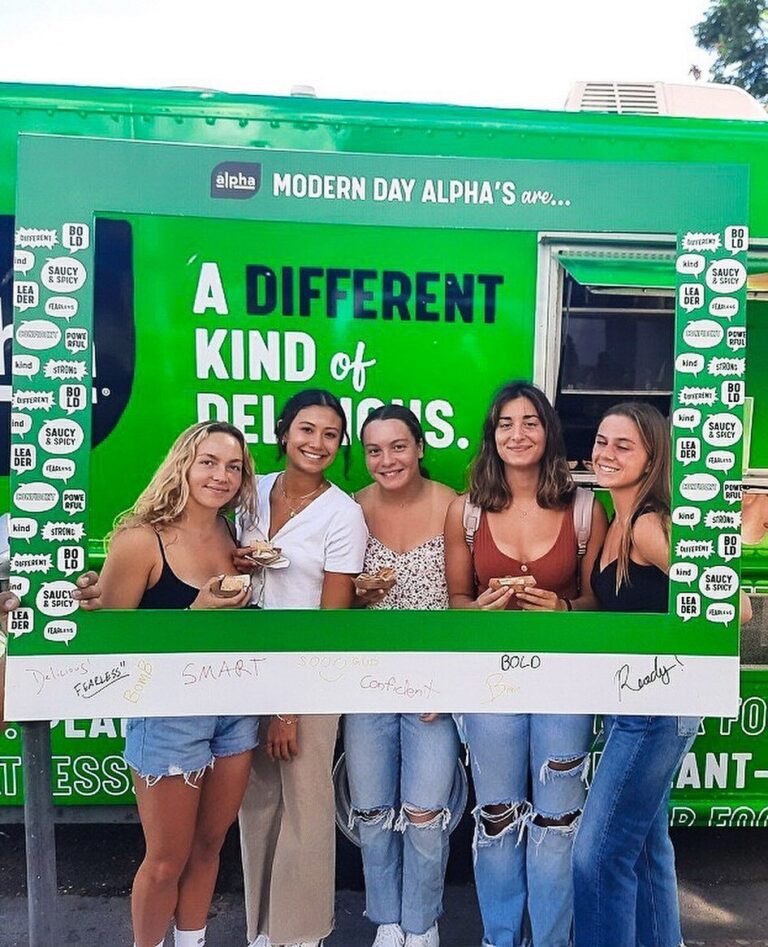
Alpha Foods had a category problem rather than a product problem. Plant-based food invites skepticism before anyone tastes it, so no amount of survey data would settle whether students would actually eat it.
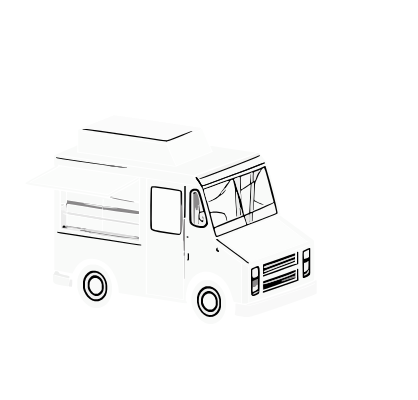
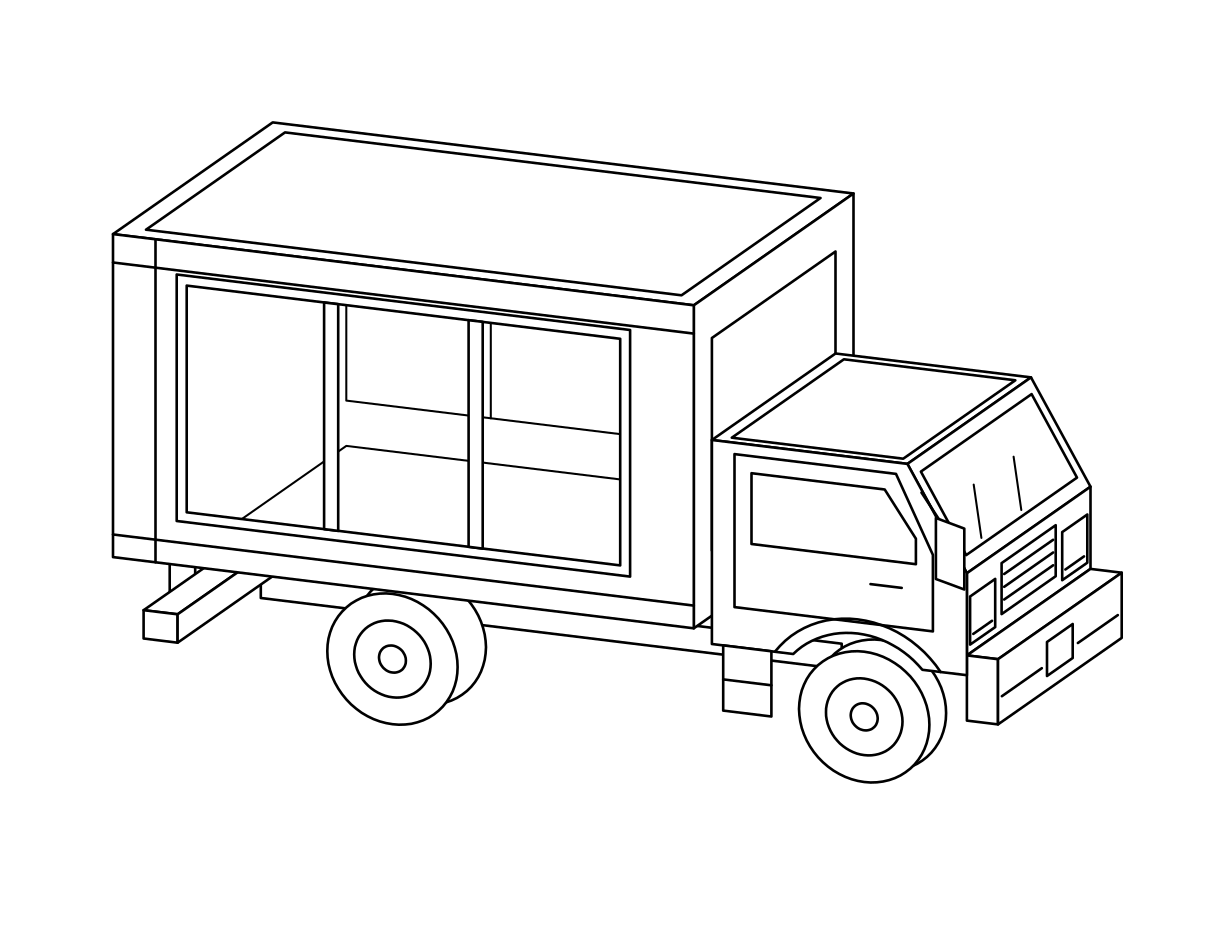
We customized a food truck into a sampling pop-up and visited seven campuses across Los Angeles and New York: NYU, Cornell, Columbia, FIT, Fordham, USC, and UCLA. Students chose between breakfast sandwiches, spicy maple BBQ chick’n nuggets, chick’n fajita burritos, and steak ranchero burritos, all meatless. While they waited, they scanned a QR code to enter to win a fully stocked Alpha Foods freezer, and a branded photo frame gave them a reason to post.
Why it is a test and not just a giveaway: the campaign targeted an audience predisposed to doubt the product, measured whether they would eat it, and captured an entry from each person who did. That produces three data points a survey cannot: attention, trial, and a small commitment. Read the full activation in our Alpha Foods campus sampling case study, or browse more brand activation case studies.
Pros: low cost, fast, large samples, easy to compare concepts side by side, and useful very early when you have several directions to narrow.
Cons: measures stated preference rather than behavior, vulnerable to how questions are phrased, and tells you nothing about whether anyone would stop in the street.
Pros: real product, real reactions, controlled environment, direct conversations, and capture mechanics that produce trackable data. Doubles as marketing while it tests.
Cons: higher cost, needs staffing, requires permits, and results depend heavily on choosing the right location.
Pros: the deepest qualitative insight available, and almost free.
Cons: small samples, slow, and easily skewed by who you happen to know.
To test market a new product properly, use the cheap methods to narrow your options and the expensive ones to make the decision. Surveys tell you what people say. Putting the product in someone’s hand on a street tells you what they do, and only one of those predicts a launch.
If you want to test a product in market before committing to a full launch, we design, build, permit, and staff the activations that do it. Explore our brand activation services or contact our team to scope a test.
Test marketing is exposing a product to a limited, representative slice of your market before full launch, to gauge demand, refine positioning, and identify problems while changes are still inexpensive. Methods range from surveys to physical sampling activations.
Paid surveys, market research apps, freelance market researchers, mobile showrooms and pop-ups, and one-on-one conversations. The first three measure what people say, the last two measure what people do, and strong programs use both in sequence.
The commonly cited 95 percent figure is disputed. NIQ, which tracks innovation performance directly, calls it an urban myth and reports that 52 percent of new items with national distribution increase sales in their second year. Failure rates vary widely by category and definition.
Because a survey asks people to predict their own future behavior, which humans do poorly. Stated preference is shaped by how questions are asked and by what respondents think sounds reasonable. Watching someone accept or refuse a product removes both problems.
A mobile showroom is a vehicle converted into a branded environment where customers can see, handle, and try a product. It suits considered purchases that need demonstration, and it lets you test in several markets without opening a location in any of them.
More than a survey and less than a failed launch. Cost depends on the vehicle or space, the build, product volume, staffing, permits, and the number of days and cities. Scoping early is the only way to get an accurate figure.
Target the skeptics deliberately. Sampling works best where doubt is the barrier, because tasting or using the product settles the question directly. Measuring how doubtful people react is far more informative than measuring how enthusiasts react.
Stop rate, trial rate, capture rate such as sign-ups or scans, redemption rate on any coupon issued, and a log of the questions people ask. That last one is where positioning problems surface before launch rather than after.
Long enough to see patterns rather than one day’s weather. Multi-day activations across several locations give more reliable signal than a single strong afternoon, and testing in more than one city guards against a market-specific result.
Define what you need to learn, the audience, and the markets, then decide what people give you in exchange for trying the product. A partner can handle build, permits, staffing, and logistics. Share your launch timeline with our team to scope it.
7 steps, 37 checkpoints, and a one-page brief to plan and launch a mobile pop-up shop that converts.
Instant PDF · No Cost
Author
CEO @ FTP Agency
Benjamin H. Goldberg is passionate about bringing brands to life on the streets. As CEO of Food Truck Promotions and co-founder of the New York and Los Angeles Food Truck Associations, he helps create unforgettable mobile experiences that blend great food, creative branding, and meaningful connections with audiences everywhere.
What is a brand activation? It is a marketing campaign built around something people can physically participate in, rather than something they watch, scroll…
Read more →
Luxury brand marketing strategies work by inverting almost every rule the rest of marketing follows. Mass brands chase reach, discount to convert, and optimize…
Read more →
The nonprofit marketing campaigns that raise money are rarely the ones with the biggest budget, they are the ones where the mechanic does the…
Read more →We use and share personal information through cookies and similar technologies on our sites to personalize your shopping experience and ads. Others may use this information for their own marketing and business purposes. . Check our Privacy Policy for more details.
Browser Opt-Out Honored
We use and share your personal information with others to personalize your shopping experience and show you targeted ads on other sites based on your interests and online activities.
Online Info includes cookies, pixel tags, and similar technologies connected to your browser or device. Offline Info includes information associated with your email address based on your other interactions with us.
We use and share your personal information with others to personalize your shopping experience and show you targeted ads on other sites based on your interests and online activities. Information includes cookies, pixel tags, and similar technologies connected to your browser or device (Online Info), as well as information associated with your email address based on your other interactions with us (Offline Info). Others may use this information for their own marketing and business purposes.
You can choose to opt out of sharing one or both types of information.