5 Best Pop-Up Shop Examples and Trends for 2026

By: David Botbol 11 min read

6 Best Pop-Up Shop Examples

The best pop-up shop examples share a signature: a clear goal, an experience people photographed without being asked, and a number at the end that made the budget meeting easy. We’ve produced hundreds of activations that fit that description, so this roundup is built differently than most. Every example below is a campaign we ran, with the published results attached, and every trend is backed by a current, dated source rather than a vibe.

Here’s how brands are using pop-up shops right now, what the 2026 data says about where the format is going, and what to expect heading into 2027.

We report results to brand teams after every activation we produce, so this guide is the measurement framework we actually use: how to set the goal, the core KPIs of a mobile pop-up shop, how to attribute in-person results, and what to put in the recap that gets the next activation approved.

We’ve produced hundreds of these activations for brands from Ralph Lauren to Nespresso, so in this guide we’ll define the format properly: the types, the benefits, where the concept came from, what one looks like in practice, and how a brand launches one.

Key Insights

  • Pop-ups have gone from experiment to line item: IBISWorld sized the U.S. pop-up industry at roughly $16 billion in 2025, and global experiential spend has passed its pre-pandemic peak, with most marketers planning to spend more in 2026.
  • The goal has shifted from awareness to earned media: Event Marketer’s EventTrack 2026 report found media coverage and PR is now the top objective for consumer event marketers, which changes how pop-ups are designed.
  • Immersion is the new table stakes: VML’s Future 100 2026 research found 87% of consumers agree the best experiences leave them feeling changed, and the strongest pop-ups now engage every sense.
  • Sampling still converts best: Free samples remain the single biggest reason consumers engage with brands at events per EventTrack 2026, which is why trial-led pop-ups keep outperforming.
  • Measurement is the 2027 dividing line: The brands winning budgets design capture into the pop-up itself, counting leads, redemptions, and store traffic rather than impressions alone.

5 Pop-Up Shop Examples With Real Results

These aren’t concept renders or borrowed screenshots; they’re campaigns from our work, each chosen because it proves a different play, with the results the brands could report.

The key word is “against its goal.” No single metric defines success for every pop-up, which is why measurement starts before the build.

1. TIRTIR World Tour: One Pop-Up, Four Cities

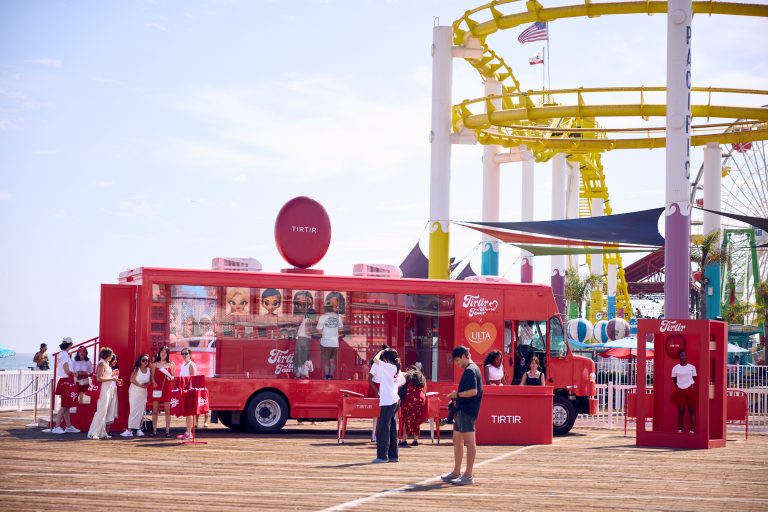
K-beauty brand TIRTIR took its signature products on a true cross-country tour, with stops in Los Angeles, Miami, Chicago, and New York, and our production team managing the vehicle, permits, and logistics at every stop. The TIRTIR World Tour is the clearest picture of where the format is heading: a single branded build carrying an identical experience across the country, turning one pop-up concept into a national campaign and putting a global brand on American streets market by market. The play to steal: plan the route like a media buy, sequencing cities around your retail footprint and cultural moments.

Red TRTR beauty truck parked on boardwalk with a line of people; roller coaster in background.

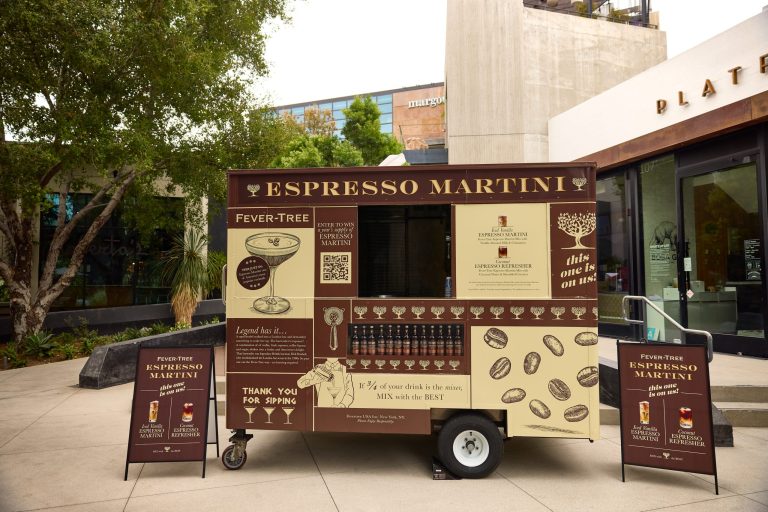
2. Fever-Tree Espresso Martini Bar: 5,100+ Trials, 70% Over Goal

When Fever-Tree launched its Espresso Martini mixer range, the mobile bar activation served the product itself in hot mocha and iced variations. More than 5,100 consumers sampled, surpassing the trial target by 70%, and over 3,400 totes, bottles, and coupons went home to finish the conversion. The play: make the product the menu and count every pour.

mobile bar event

3. LANEIGE Hydration School: A Two-Story Brand World

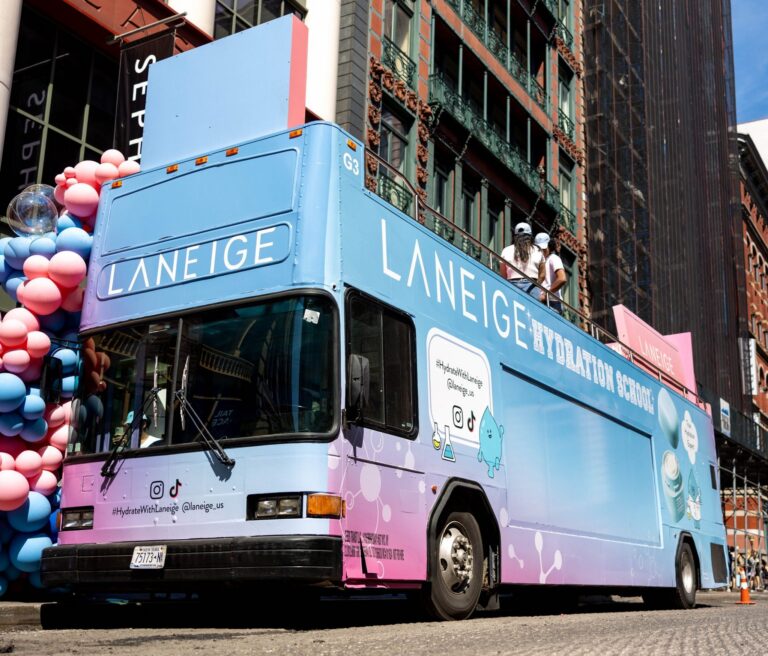
For its Water Bank collection and Lip Sleeping Mask, LANEIGE commissioned a custom double-decker bus with a blue science-lab level downstairs and an all-pink rooftop upstairs, connected by a prize-wheel journey ending at a lip-shaped couch and candy wall. It’s the fabrication ceiling of the format: two themed worlds in one footprint, every corner built to be photographed. The play: give each hero product its own room.

A blue and purple Laneige Hydration School bus is parked on a city street with people on top.

4. innisfree West Coast Tour: 3,000+ Visitors, 1M+ Impressions

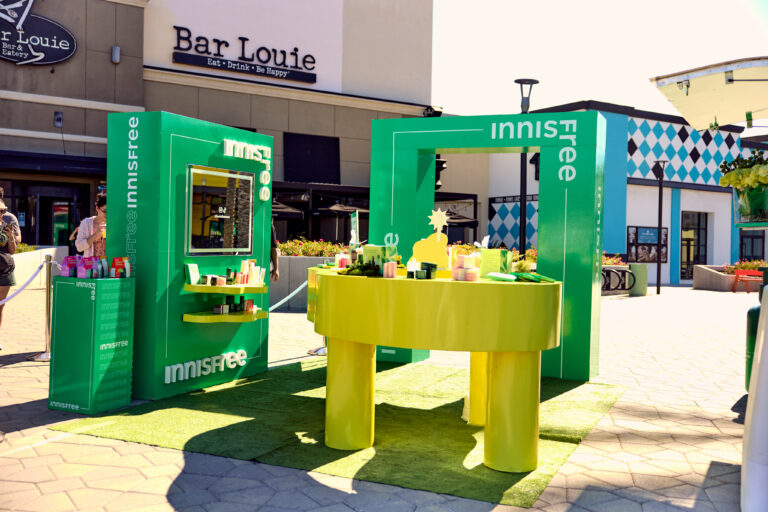
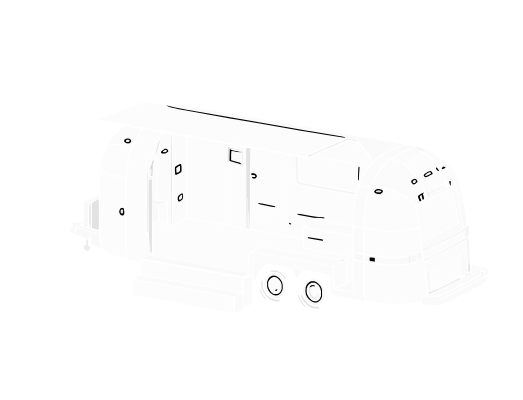
innisfree’s turf-and-floral Airstream toured six California college towns, pairing sampling and scratch-off prizes with stops positioned near Sephora so awareness had somewhere to convert. The tour drew more than 3,000 visitors and over 1 million brand impressions. The play: meet Gen Z where they already are and park beside the purchase.

Innisfree skincare display with products on tables and shelves on grass at a shopping center.

5. It Starts With Us: The Line Around Rockefeller Center

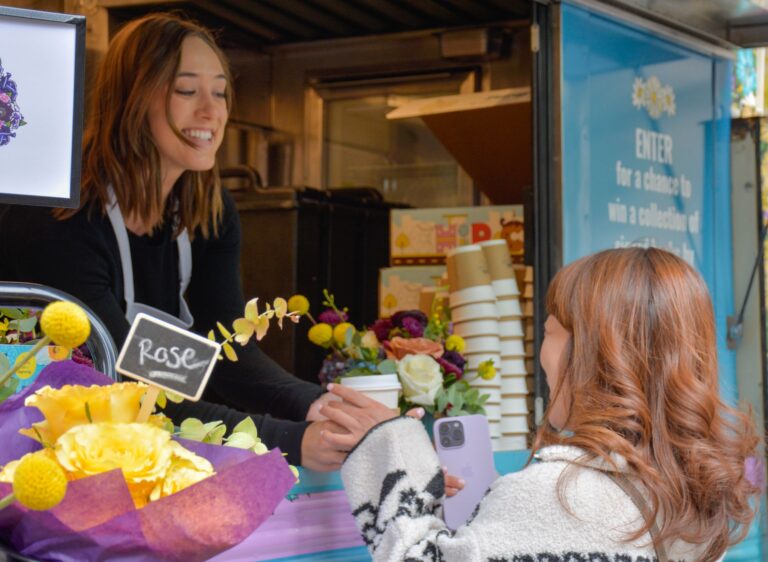
For the most pre-ordered book in Simon & Schuster’s history, we recreated the story’s flower shop on a vintage Citroen at Rockefeller Center, with exclusive signed book plates and The Strand selling on site. The line formed more than two hours before opening, and thousands came through. The play: activate a fandom that already cares and give it a place to show up.

Woman in apron gives coffee to customer with phone at a flower-decorated food truck counter.

The examples above weren’t accidents of taste; they track the direction the whole industry is moving. Here’s what the current data says, with sources and dates.

Experiential Budgets Are at Record Levels

Global experiential marketing spend passed its pre-pandemic peak for the first time in 2024 at over $128 billion, and the momentum has carried forward, with the large majority of consumer and B2B marketers planning to increase event spending again in 2026. On the pop-up side specifically, IBISWorld sized the U.S. industry at roughly $16 billion in 2025, and Capital One Shopping’s research (updated June 2026) found 80% of retailers who have opened a pop-up considered it a success. The takeaway: the format has budget gravity now, which raises the bar for what a pop-up has to deliver.

PR Is the New Top Goal

The most important strategic shift in the 2026 data: Event Marketer’s EventTrack 2026 report found that media coverage and PR is now the number one objective for consumer event marketers, overtaking brand awareness. That changes design briefs. A pop-up built for press needs a hook a journalist can write in one line: the custom vehicle, the collaboration, the unexpected location. It’s why a book launch that puts a fictional flower shop at Rockefeller Center earns coverage a standard sampling table never will.

Hyper-Immersion Is Table Stakes

VML’s Future 100: 2026 experiential report (May 2026) describes the shift to “hyper-immersion” and ephemeral retail, with 87% of global consumers agreeing the best experiences leave them feeling changed. In pop-up terms: a backdrop is no longer enough. Spindrift’s Greetings From Paradise glass box truck is what the trend looks like on the street, a tropical oasis engaging all five senses, from flavor sampling to a vacation playlist to AC standing in for the sea breeze, visible whole from across the street.

Pop-Ups Are Parking Next to the Purchase

The ANA’s event marketing briefing (March 2026) highlights the rise of purposeful, localized spaces and micro-events over one-size activations, and the sharpest version of that trend is retail adjacency: pop-ups positioned where the conversion happens minutes later. Nespresso sampled directly outside its own boutiques, Glossier’s trucks worked its own storefronts, and Rag & Bone’s bright yellow coffee cart pulled street traffic into Nordstrom’s flagship. Expect more brands to treat the pop-up as the top of an in-store funnel rather than a standalone event.

Sampling Still Wins, but Now It Counts

EventTrack 2026 found free samples remain the top reason consumers engage with brands at events, with swag close behind, which is why trial-led pop-ups keep outperforming. What’s changed is the accounting: the 2026 trend conversation has moved from impressions to dwell time, lead quality, and post-event behavior. The pop-ups earning renewals put a mechanism on every takeaway, QR codes, promo codes, and sign-ups, the way Glossier’s one-day launch banked 2,000+ SMS leads it could market to the next morning.

What to Expect in 2027

Three developments are worth planning for now. First, AI moves from novelty to operations: with AI adoption among event planners roughly doubling through 2025, expect 2027 pop-ups to use it for route planning, real-time personalization, and post-event analysis rather than gimmicks. Second, sustainability becomes a default expectation rather than a differentiator, with the large majority of consumer brands already building sustainability strategies for events; reusable builds and lower-footprint vehicles will be selection criteria, not talking points. Third, one-off activations give way to experiential programs: the brands getting the best returns run pop-ups as an always-on channel, one build touring a calendar of markets and moments, which is exactly the model TIRTIR’s world tour and Nespresso’s national run already prove out.

The through-line into 2027 is maturity. The format has the budgets, the playbooks, and the measurement expectations of a real channel, and the brands that treat it like one will keep winning it.

Steal the Playbook

Every example here reduces to the same formula: one clear goal, an experience worth photographing, a location chosen like a strategy, and a mechanism that counts the results. The trends just raise the stakes, since more budget and higher expectations reward the brands that execute the formula best.

If you’re planning a pop-up of your own, get the full format-by-format grounding in our complete guide to mobile pop-up shops.

Frequently Asked Questions​

The strongest examples pair a clear goal with published results: TIRTIR’s four-city world tour, Glossier’s one-day launch that captured 2,000+ SMS leads, Fever-Tree’s 5,100-sample espresso martini bar, LANEIGE’s double-decker brand world, innisfree’s 1M-impression college tour, and the It Starts With Us launch at Rockefeller Center.

Five stand out in the current data: record experiential budgets, PR overtaking awareness as the top event goal per EventTrack 2026, hyper-immersive multi-sensory design, pop-ups parking next to the point of purchase, and sampling campaigns built around measurable capture rather than impressions.

A traditional pop-up occupies a leased storefront or space for a fixed period, while a mobile pop-up is built into a vehicle and can change locations daily. The mobile version carries an identical brand experience across stops and doubles as a moving billboard between them.

IBISWorld sized the U.S. pop-up shop industry at roughly $16 billion in 2025 across more than 42,000 businesses, while global experiential marketing spend passed its pre-pandemic peak at over $128 billion in 2024, with most marketers planning further increases through 2026.

Event Marketer’s EventTrack 2026 report found media coverage and PR overtook brand awareness as the number one objective for consumer event marketers. A pop-up is inherently newsworthy, visual, temporary, and local, so brands increasingly design activations as stories journalists can cover in one line.

One build, four markets: the tour carried an identical branded experience across Los Angeles, Miami, Chicago, and New York, with production, permits, and logistics managed at every stop. Touring turns a single pop-up concept into a national campaign and compounds the fabrication investment city by city.

Yes, and the data has strengthened: 80% of retailers who have opened a pop-up considered it a success per Capital One Shopping’s research (updated June 2026), and free samples remain the top reason consumers engage with brands at events, which is exactly what the format delivers best.

Expect three shifts: AI moving into operations like route planning and real-time personalization, sustainability becoming a default requirement with reusable builds and lower-footprint vehicles, and one-off events giving way to always-on experiential programs where a single build tours a calendar of markets.

They choose one primary metric before launch and build capture into the experience: QR codes, promo codes, sign-ups, and sample counts. Glossier’s one-day activation captured over two thousand SMS leads, and Fever-Tree measured trials against a target and finished 70% over goal.

A growing one: VML’s Future 100 2026 research found 87% of consumers agree the best experiences leave them feeling changed. In practice that means multi-sensory builds, like Spindrift’s glass-truck beach oasis with matched flavors, sound, and climate, rather than a logo backdrop and a table.

Our Work at foodtruckpromotions.com collects case studies across beauty, beverage, fashion, retail, publishing, and tech, from double-decker builds to coast-to-coast tours. Each one documents the concept, the vehicle and build, and what the activation delivered for the brand, so you can study the plays before running your own.

David Botbol

Author

David Botbol

EVP, Managing Director @ FTP Agency

David Botbol thrives on turning bold ideas into real-world brand moments. As Executive VP and Managing Director of Food Truck Promotions, and a leader within the New York and Los Angeles Food Truck Associations, he draws on a background in business development and startups to help brands connect with audiences through creative, unforgettable mobile experiences.

More posts
The Metrics That Measure the Success of a Mobile Pop-Up Shop: KPIs and ROI