Experiential Events vs Brand Events: How to Choose Right Strategy

By: Benjamin Goldberg 10 min read

Experiential Events vs Brand Events

The choice between experiential events vs brand events comes down to one question: are you gathering people who already know you, or reaching people who do not?

Both are legitimate formats and both have their place. The comparison gets muddled because agencies that sell one tend to describe the other unfairly, so this guide gives each its real strengths and its real limitations.

Here is what each format actually does, where each one struggles, and a framework for picking between them.

Key Takeaways

  • They serve different audiences: a brand event gathers people who already have a relationship with you, while an experiential activation reaches people who did not come for you at all.
  • Brand events win on control: a guest list, a venue, and a schedule give you certainty that a public activation cannot.
  • Experiential wins on reach and cost per person: street-level activations engage far more people, most of whom were not previously in your audience.
  • Neither is a substitute for the other: the strongest programs run both, using events for existing relationships and activations for acquisition.
  • Match the format to the objective: acquisition, relationships, launch, or sales each point to a different answer.

What Is an Experiential Event?

An experiential event is a live activation designed around participation, usually staged in public space where the audience is ordinary foot traffic rather than an invited list. A branded vehicle handing out product on a busy corner, a pop-up outside a store, or a sampling presence at a festival are all experiential events.

The defining feature is that nobody came for you. The activation has to earn the stop, which is a harder job than filling a room with people who already accepted an invitation, and it is also the reason the format reaches new customers.

Our guide to what a brand activation is covers the formats in more detail.

What Is a Brand Event?

A brand event is an event a company hosts under its own name: a launch party, a showroom evening, a customer or press day, a conference, or an anniversary celebration. Attendance is usually by invitation or registration, the venue is controlled, and the audience is largely people who already know the brand.

It is worth being fair about what this format does well, because it does several things an activation cannot.

  • Complete control of the environment. Venue, lighting, sound, catering, and running order are all yours.
  • A known guest list. You choose who is in the room, which matters enormously for press, partners, retailers, and high-value customers.
  • Time and depth. An evening allows a demonstration, a conversation, and a relationship in a way ninety seconds on a pavement does not.
  • No weather or permit risk. An indoor event is not at the mercy of rain or a city approval office.
  • It suits B2B. For a considered purchase with a long sales cycle, getting the right twenty people in a room beats reaching two thousand strangers.

Where Each Format Falls Short

The Limits of a Brand Event

  • It largely reaches people you already have. An invitation list is drawn from existing contacts, so acquisition is limited by definition.
  • Cost per attendee is high. Venue, catering, and staffing for a single evening frequently costs more per person than a multi-day activation reaching thousands.
  • Attendance is a risk you carry. Invitations do not guarantee turnout, and a half-full room is worse than no room.
  • It can become about the brand rather than the guest. Events overloaded with logos, merchandise, and messaging tend to be remembered as marketing rather than as an experience.

The Limits of an Experiential Event

  • You cannot choose who turns up. Foot traffic is what it is, which is why location selection matters more than creative.
  • Interactions are short. A pavement conversation is a minute or two, not an evening, so complex propositions are hard to land.
  • Permits and weather are genuine exposure. Approvals set the timeline and rain sets the turnout.
  • The spend is committed upfront. Build, permits, and staffing are paid before anyone knows whether the day worked. We cover that trade-off in more depth in our guide to the pros and cons of experiential marketing.

The Core Difference

Strip away the detail and the distinction is about who is in front of you.

A brand event deepens relationships with people who already know you. An experiential event creates relationships with people who did not. Both are valuable, and they are not interchangeable, which is why treating one as a cheaper version of the other leads to disappointment.

There is also a difference in how each is remembered. Research from Cornell University found that people derive more enduring satisfaction from experiences than from things, partly because experiences resist the habituation that makes a possession feel ordinary

That finding cuts both ways. It supports experiential formats generally, and it also explains why a brand event built around merchandise and decoration underperforms one built around something guests actually do.

How to Choose Between Them

Choose a Brand Event If

  • Your objective is deepening relationships with existing customers, press, partners, or retailers.
  • The proposition is complex and needs time to explain.
  • You are B2B with a long sales cycle and a small, identifiable target list.
  • You need control over exactly who is present and what they see.

Choose an Experiential Event If

  • Your objective is acquisition, and you need to reach people outside your current audience.
  • The product benefits from trial, which covers most food, beverage, beauty, and unfamiliar products.
  • You want content and word of mouth as much as attendance.
  • You need reach across several markets rather than depth in one room.

Run Both If

You are launching something significant. The common pattern is a press and partner event to seed coverage, followed by a public activation to reach consumers, with the content from the second feeding the channels that promote the first. Our event marketing service covers activations tied to both.

How Bacardi Built Its Own Event in Times Square

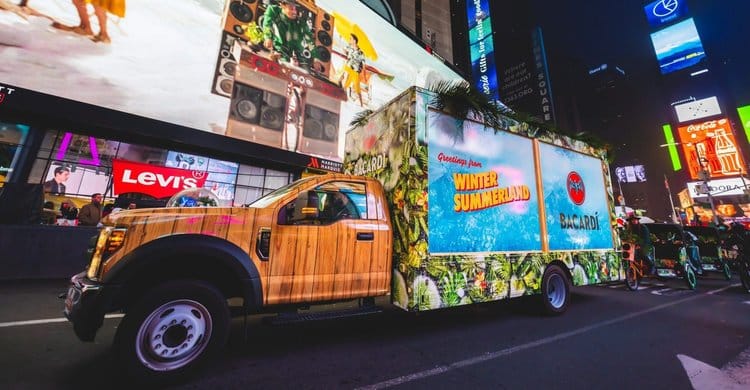
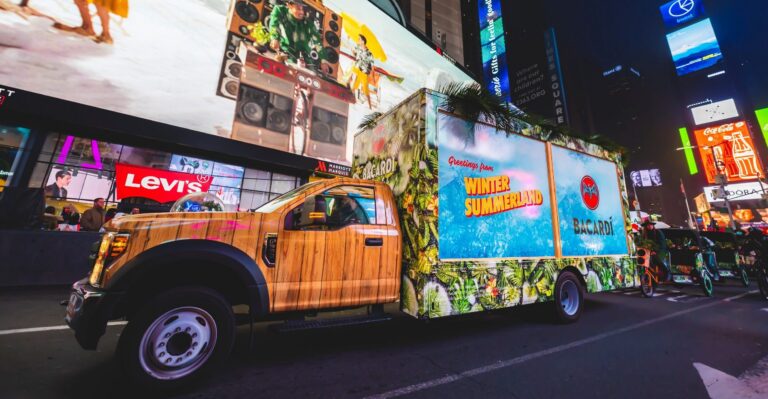
Bacardi truck with tropical designs drives through a city at night, "Winter Summerland" on side.

The line between the two formats is not always clean, and the Bacardi Winter Summerland campaign is a good illustration of a brand creating its own event in public rather than behind a guest list.

Bacardi had a seasonal problem: rum sells slowly in winter. Instead of hosting a private launch, we parked a branded glass truck in the heart of Times Square, with surprise guests, a merchandise giveaway, a coordinated flashmob, and branded pedicabs. Inside the truck we built display shelves, iced bamboo and palms, and full set dressing to execute the summer-in-winter concept.

Why it is instructive: the campaign had the production value and control of a brand event and the reach of an experiential one. Nobody was invited, the audience was whoever was in Times Square, and the build was good enough that people stopped anyway. That combination is what a well-funded experiential event can achieve, and it is a useful counterexample to the idea that public activations are the low-production option. Read more in our Bacardi case study, or browse other brand activation case studies.

How to Measure Each Format

Brand Event

  • Attendance against invitations sent, which is the first honest measure of interest.
  • Meetings booked or opportunities created, particularly in B2B.
  • Press and partner coverage generated.
  • Cost per attendee, and cost per qualified attendee, which is usually the more revealing figure.

Experiential Event

  • Interactions and samples distributed per day and location.
  • Sign-ups, scans, and redemptions captured on site.
  • Tagged posts and content produced.
  • Cost per interaction and cost per acquired customer.

The Bottom Line

Experiential events and brand events answer different questions. If you need the right people in a room and time to talk to them, host an event. If you need to reach people who have never heard of you and give them a reason to care, put something on the street.

The mistake is choosing one because it sounds more current, or because an agency that sells it described the alternative unkindly. Start from the objective and the answer is usually obvious.

If the answer points to a public activation, we design, build, permit, and staff them. Explore our brand activation services or contact our team to talk it through.

Frequently Asked Questions

A brand event is hosted by a company under its own name, usually by invitation, and gathers people who already know the brand. An experiential event is a public activation where the audience is ordinary foot traffic, so the brand has to earn the stop from people who did not come for it.

An experiential event is a live activation built around participation, staged in public space rather than a controlled venue. Examples include a branded vehicle handing out product on a busy corner, a pop-up outside a store, or a sampling presence at a festival.

A brand event is an event a company hosts under its own name, such as a launch party, showroom evening, press day, or anniversary celebration. Attendance is typically by invitation or registration and the venue and running order are fully controlled.

Neither is universally better. Brand events are stronger for deepening relationships with existing customers, press, and partners, and for complex or B2B propositions. Experiential events are stronger for acquisition, product trial, reach, and generating content.

Complete control of the environment, a known guest list, time for real conversation and demonstration, no weather or permit risk, and suitability for considered B2B purchases where getting the right twenty people in a room matters more than reaching thousands.

It mostly reaches people you already have, cost per attendee is high, turnout is a risk you carry, and events overloaded with branding tend to be remembered as marketing rather than as an experience.

You cannot choose who turns up, interactions are short so complex messages are hard to land, permits and weather are genuine exposure, and most of the spend is committed before you know whether the day worked.

Yes, and for a significant launch it is the common pattern. A press and partner event seeds coverage, a public activation reaches consumers, and the content from the activation feeds the channels promoting both.

Track attendance against invitations sent, meetings or opportunities created, press and partner coverage, and cost per attendee. Cost per qualified attendee is usually more revealing than raw attendance, particularly for B2B.

Start from the objective. If you need specific people in a room and time to talk, host an event. If you need to reach people outside your current audience and give them a reason to care, run a public activation.

FTP Free download

The Mobile Pop-Up Shop Launch Checklist

7 steps, 37 checkpoints, and a one-page brief to plan and launch a mobile pop-up shop that converts.

Instant PDF · No Cost

Benjamin Goldberg

Author

Benjamin Goldberg

CEO @ FTP Agency

Benjamin H. Goldberg is passionate about bringing brands to life on the streets. As CEO of Food Truck Promotions and co-founder of the New York and Los Angeles Food Truck Associations, he helps create unforgettable mobile experiences that blend great food, creative branding, and meaningful connections with audiences everywhere.

More posts
How to Win Over Customers with Street Marketing