How the Best Brands Win at Fashion Marketing in 2026
Fashion marketing has never been more crowded, more expensive, or more dependent on getting a real person to stop and pay attention. The feed…
Read moreBy: Benjamin Goldberg • • 9 min read
The impact of experiential marketing on consumers comes down to something advertising cannot replicate: people remember what they did far longer than what they were shown.
That is not a marketing slogan. It is one of the more consistent findings in consumer psychology, and it explains why a five-minute interaction at a branded truck can outlast months of impressions.
This guide covers what the research actually says about how experiences affect consumer behavior, why digital saturation has made that gap wider, and three real activations that show the effect in practice.
Experiential marketing is a strategy that promotes a brand by letting people interact with it directly rather than by describing it to them. It includes pop-up shops, mobile tours, sampling activations, branded vehicles, showrooms, and live events, all built around participation rather than exposure.
The distinction that matters is participation. A viewer sees an ad, while a participant does something, and those two things register differently.
This is where the case for experiential marketing stops being a matter of opinion. Decades of consumer psychology research, much of it from Cornell University, point in the same direction.
People adapt quickly to material purchases. A new object delivers an initial lift, then becomes normal. Experiences behave differently: research led by psychologist Thomas Gilovich found that people derive more enduring happiness from experiences than from possessions, in part because experiences are less subject to that adaptation and less vulnerable to unfavorable comparison with what someone else bought.
For a brand, that means an interaction lodges in memory in a way an impression does not.
The same body of work found that talking about an experience helps people relive it, deepens their attachment to it, and increases the satisfaction it produces, an effect that does not hold for material goods. Removing the ability to discuss an experience actually diminishes the enjoyment it delivers.
This is the mechanism behind word of mouth at an activation. People are not posting about your truck because you asked them to, they are posting because sharing the experience is part of enjoying it. Our guide to creating experiences that drive UGC covers how to design for that deliberately.
Researchers also found that people anticipating an experiential purchase report higher happiness than people anticipating a material one, and that even waiting in line is more pleasant when the reward is an experience.
Practically, this is why announcing an activation a week out is not wasted effort, and why a queue at a pop-up is a feature rather than a problem.
None of this means digital marketing fails. It means the competitive conditions changed.
When most brands moved most of their budget into the same handful of feeds, the result was saturation. Consumers became fluent at recognizing advertising and skilled at skipping it, and attention in those channels got more expensive to buy. The relative advantage of doing something in the physical world grew as a direct consequence.
The two also work together rather than against each other. An activation produces the photos, video, and word of mouth that then perform in the feed, which is a more credible route into social than a paid placement.
This holds even for the audience most assumed would be reachable through screens alone. Our guide to college brand activations covers why campus sampling outperforms social spend with a student audience.
Learn how to make an impact through experience marketing.
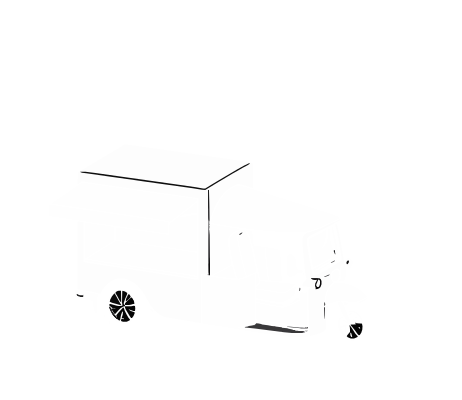
For a brand built on collectible, highly visual products, we used a glass box truck so the merchandise itself was visible from the sidewalk. Polka dots, pastel boba lemonade, and deliberate photo moments gave people a reason to stop, and the transparency meant the product was doing the advertising before anyone read a word.
The effect: visibility created the stop, and the nostalgia of the theme created the conversation. See the build in our Loungefly glass truck case study.
To announce the opening of its Soho store, the beauty brand placed a marketing vehicle on the corner offering New Yorkers a free spray of its fragrance and a complimentary coffee. Guests received a bounce-back card that led them to the in-store pop-up a few yards away, tied together by the Follow My Scent tagline.
The effect: the street activation converted foot traffic into store traffic, which is the hardest step in any retail opening, and the fragrance sample settled a question no product page can.
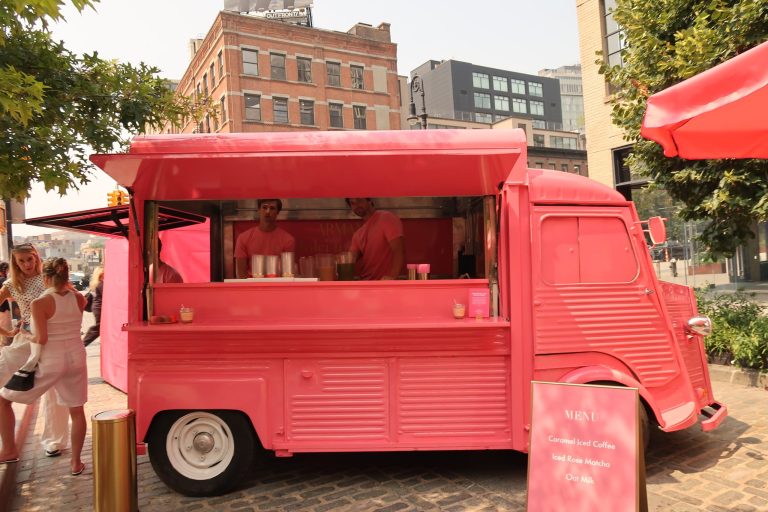
Tia marked the opening of its Santa Monica office with a pop-up cafe that traveled to Santa Monica, Playa Vista, and Brentwood, serving complimentary matcha lattes while guests learned about the company’s care model and took home a branded tote.
The effect: for a healthcare brand, trust is the whole proposition, and a face-to-face conversation over a free drink builds it faster than any advertisement. The tote then carried the brand into everyday use long after the cafe moved on.
To promote its Water Bank Hydration Collection and Lip Sleeping Mask, LANEIGE transformed a double-decker bus into a beauty pop-up offering educational product sampling, prizes, and photo opportunities in New York.
The effect: education plus trial in a single visit, which suits products whose benefit needs demonstrating rather than describing. See more work in our brand activation case studies.
The impact of experiential marketing on consumers rests on how memory and satisfaction actually work. Experiences resist the fading that possessions suffer, they generate conversation that reinforces itself, and they start paying before the day arrives. Advertising cannot manufacture those effects, which is why the in-person moment has become more valuable as digital channels have grown more crowded.
If you want to build that kind of moment for your brand, that is what we do. Explore our brand activation services or contact our team to talk through a concept.
Experiential marketing creates direct participation rather than exposure, which affects consumers differently. Research shows experiences produce more enduring satisfaction than possessions, generate more conversation, and resist the rapid habituation that causes interest in material purchases to fade.
Experiential marketing promotes a brand by letting people interact with it directly instead of describing it to them. Formats include pop-up shops, mobile tours, sampling activations, branded vehicles, showrooms, and live events, all built around participation rather than passive viewing.
People adapt quickly to things they own or see, but experiences resist that adaptation and are less vulnerable to unfavorable comparison. An experience also becomes part of someone’s personal story, which is why it stays in memory longer than an impression does.
Yes, and research suggests the mechanism is self-reinforcing. People talk about experiences more than possessions, and talking about an experience increases the satisfaction it produces, so sharing is part of enjoying it rather than a favour to the brand.
They serve different roles rather than competing. Digital delivers reach and targeting, while experiential delivers trial, memory, and word of mouth. The strongest programs use activations to generate the authentic content and conversation that then perform in digital channels.
Because most brands moved most of their budget into the same digital channels. Saturation made attention there more expensive and consumers more skilled at ignoring advertising, which increased the relative advantage of doing something memorable in the physical world.
Sampling removes the final objection by letting someone taste, smell, or use the product before committing. It is particularly effective in categories where the benefit must be experienced to be believed, such as food, beverage, fragrance, and skincare.
Track interactions and samples on site, sign-ups or bounce-back redemptions, tagged posts and organic content, recall and sentiment from short surveys, and sales lift in the activation market against a control market. Set these metrics before the activation runs.
Brands whose products need to be experienced benefit most, including food, beverage, beauty, fragrance, and apparel. It also suits brands where trust is the main barrier, such as healthcare and financial services, because face-to-face contact builds it faster than advertising.
Define what you want people to experience, the audience you need to reach, and the markets that matter. A partner can then handle concept, build, permits, staffing, and logistics. Share your timing with our team and we will map the activation around it.
Author
CEO @ FTP Agency
Benjamin H. Goldberg is passionate about bringing brands to life on the streets. As CEO of Food Truck Promotions and co-founder of the New York and Los Angeles Food Truck Associations, he helps create unforgettable mobile experiences that blend great food, creative branding, and meaningful connections with audiences everywhere.
Fashion marketing has never been more crowded, more expensive, or more dependent on getting a real person to stop and pay attention. The feed…
Read more →
Beauty marketing lives or dies on one thing: getting the product onto an actual face, in an actual hand, in front of an actual…
Read more →
The best fashion marketing campaigns do not just look good in a case study deck, they get people to show up, try something, and…
Read more →We use and share personal information through cookies and similar technologies on our sites to personalize your shopping experience and ads. Others may use this information for their own marketing and business purposes. . Check our Privacy Policy for more details.
Browser Opt-Out Honored
We use and share your personal information with others to personalize your shopping experience and show you targeted ads on other sites based on your interests and online activities.
Online Info includes cookies, pixel tags, and similar technologies connected to your browser or device. Offline Info includes information associated with your email address based on your other interactions with us.
We use and share your personal information with others to personalize your shopping experience and show you targeted ads on other sites based on your interests and online activities. Information includes cookies, pixel tags, and similar technologies connected to your browser or device (Online Info), as well as information associated with your email address based on your other interactions with us (Offline Info). Others may use this information for their own marketing and business purposes.
You can choose to opt out of sharing one or both types of information.