How to Choose a Brand Activation Company
Choosing a brand activation company is difficult for a specific reason: every portfolio looks good, and none of them show you the part that…
Read moreBy: Benjamin Goldberg • • 9 min read
The most common mistake in marketing to Gen Z is treating them as the same audience as millennials, and the gap between the two has widened considerably.
They are now separated by more than a decade. Millennials are in their thirties and early forties, running households and careers. Gen Z spans teenagers to people approaching thirty. Any campaign addressing both as young people is addressing neither.
This guide covers where the two genuinely differ, what has changed as both have aged, and how to reach each in person.
Getting this wrong undermines everything downstream, and the boundaries have shifted since most marketing content was written.
The spending shift is measurable rather than anecdotal. Millennials and adult Gen Z now command 32 percent of consumer spend, an eight-point increase since 2020, while older cohorts have seen a nearly ten-point drop over the same period.
That trajectory is the argument for adjusting now rather than later. The share is moving in one direction, and the brands establishing relationships with these audiences today are doing so while acquisition is cheaper than it will be.
Most of what gets described as generational preference is life stage. A 38-year-old with a mortgage and a 22-year-old sharing a flat behave differently regardless of when they were born. Start there rather than with a personality profile.
Promotional offers reliably move millennials, who came of age through a recession and treat a good deal as a genuine reason to act. Gen Z responds less predictably to the same lever, weighing whether the brand is worth engaging with at all before the price enters the calculation.
Millennials adopted social platforms as adults and use them alongside search, email, and traditional media. Gen Z has never known anything else, and discovery happens inside platforms rather than through them. That changes where a campaign has to appear, not just what it says.
Both generations trust people over institutions, but Gen Z applies that more strictly. A recommendation from someone who seems to actually use a product carries weight that a celebrity endorsement does not, which is why creator partnerships outperform traditional endorsement for this audience.
Both generations weigh values in purchasing decisions, and both expect brands to stand for something. That is well established and worth acting on.
The warning is about how. A brand should align with values it can actually demonstrate, and stay out of positions it cannot back with action. Vague commitments read as marketing. A concrete action, a partnership, a donation, or a product decision reads as a position. The gap between the two is exactly what these audiences are practiced at detecting.
This also cuts commercially. A brand taking a stance it has not thought through reaches an audience that will research it, and the correction is more expensive than the original campaign.
Reaching either generation in person works because it removes the credibility problem. Nobody is deciding whether to believe an advertisement, they are standing in front of the thing.
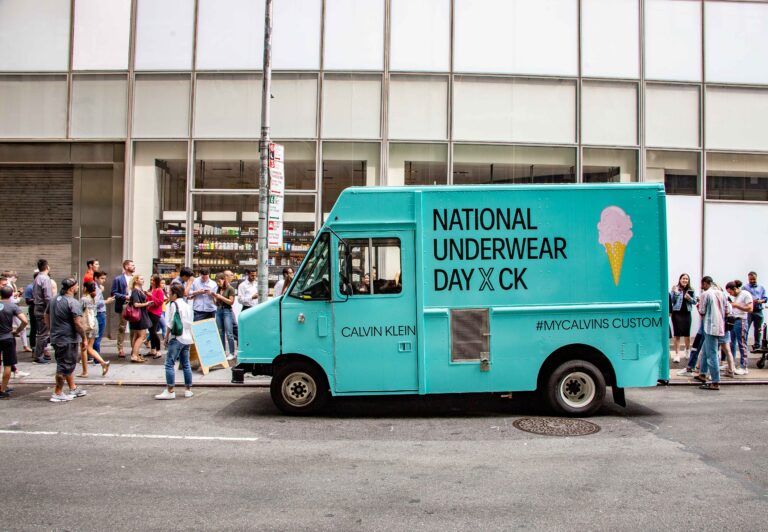
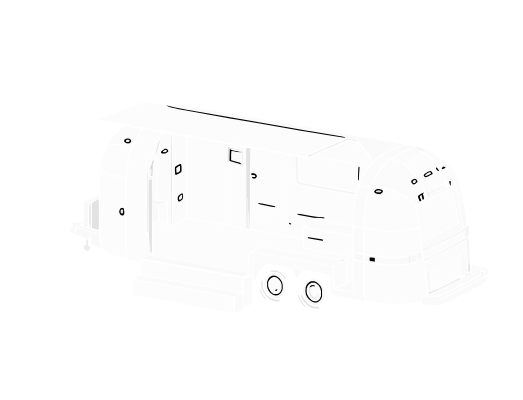
To launch a limited-edition capsule collection, Calvin Klein partnered with New York Magazine and worked with us on a mobile activation in SoHo. We transformed a custom Airstream Bambi into a working pop-up cafe, serving espresso drinks and black and white cookies. Guests left with subway-inspired cards redeemable at the Calvin Klein store for a copy of the magazine.
The results across two days: more than 7,500 in foot traffic, 5.1 million social impressions, 2.4 million online impressions, and $410,000 in earned media value.
Why the mechanics suit this audience: it was placed where the audience already was rather than advertised to them, the redemption card gave a physical reason to visit a store, and the activation was designed to photograph well, which is what turned 7,500 visitors into millions of impressions. Read the campaign in our Calvin Klein case study, or browse more brand activation case studies.
Marketing to Gen Z and millennials starts with accepting they are two audiences at different life stages, separated by more than a decade. The combined spending share is growing, which makes the distinction worth getting right rather than averaging across.
Both respond to being reached in person, for the same underlying reason: an experience they can attend and share is more credible than a message they are asked to believe.
If you want to reach either audience where they already are, we design, build, permit, and staff the activations. Explore our brand activation services or contact our team.
Millennials were born between 1981 and 1996, making them roughly 30 to 45 in 2026. Gen Z were born between 1997 and 2012, making them 14 to 29. That is a different life stage rather than simply a different taste, and it drives most of the behavioral differences.
Roughly 14 to 29 in 2026. The oldest are approaching thirty, employed, and spending as adults, while the youngest are still in secondary school. Anyone born after 2012 is Gen Alpha rather than Gen Z.
Millennials and adult Gen Z now command 32 percent of consumer spend, an eight-point increase since 2020, while older cohorts have seen a nearly ten-point drop over the same period, according to Numerator.
Less reliably than on millennials. Promotional offers move millennials consistently, while Gen Z tends to weigh whether the brand is worth engaging with before price enters the decision, which makes brand credibility the prior step.
Both generations expect it, and both are practiced at spotting a position adopted for marketing reasons. Align with values the brand can demonstrate through concrete action, and stay out of positions it cannot back, since these audiences will check.
Because it removes the credibility problem. Nobody has to decide whether to believe an advertisement when they are standing in front of the product, and both generations respond to experiences they can attend, photograph, and share.
Go where they already are, which means campuses for the older half and dense social districts generally. Design the photo moment deliberately, use creators with genuine local relevance, and keep the ask small enough to complete in seconds.
Lead with the offer, since discounts and bounce-backs move this audience reliably. Respect that many are shopping with children and executing a task, so place the activation near the purchase rather than making it a destination.
For Gen Z generally, yes. A recommendation from someone who appears to actually use a product carries more weight than a celebrity endorsement, because credibility is judged on apparent authenticity rather than on fame.
Log interactions by rough age bracket, track capture rate by audience since one mechanic may convert one group and not the other, monitor tagged posts and share rate, redemption rate, and cost per acquired customer by segment.
7 steps, 37 checkpoints, and a one-page brief to plan and launch a mobile pop-up shop that converts.
Instant PDF · No Cost
Author
CEO @ FTP Agency
Benjamin H. Goldberg is passionate about bringing brands to life on the streets. As CEO of Food Truck Promotions and co-founder of the New York and Los Angeles Food Truck Associations, he helps create unforgettable mobile experiences that blend great food, creative branding, and meaningful connections with audiences everywhere.
Choosing a brand activation company is difficult for a specific reason: every portfolio looks good, and none of them show you the part that…
Read more →
The best brand activation ideas are not the most elaborate ones. They are the ones that give a stranger a reason to stop walking.…
Read more →
Brand activation displays are the part of a build that does the selling, and they are usually designed last. The wrap gets rounds of…
Read more →We use and share personal information through cookies and similar technologies on our sites to personalize your shopping experience and ads. Others may use this information for their own marketing and business purposes. . Check our Privacy Policy for more details.
Browser Opt-Out Honored
We use and share your personal information with others to personalize your shopping experience and show you targeted ads on other sites based on your interests and online activities.
Online Info includes cookies, pixel tags, and similar technologies connected to your browser or device. Offline Info includes information associated with your email address based on your other interactions with us.
We use and share your personal information with others to personalize your shopping experience and show you targeted ads on other sites based on your interests and online activities. Information includes cookies, pixel tags, and similar technologies connected to your browser or device (Online Info), as well as information associated with your email address based on your other interactions with us (Offline Info). Others may use this information for their own marketing and business purposes.
You can choose to opt out of sharing one or both types of information.