Why Brands Should Do Food Truck Promotions Even If They Don’t Sell Food

By: Benjamin Goldberg 9 min read

food truck promotions

A food truck promotion is most useful to brands with nothing edible to sell, which is the opposite of what most people assume.

If you sell food, a truck is a distribution channel. If you sell handbags, underwear, or contactless payment technology, it is something more interesting: a way to hand someone a physical object when your actual product cannot be handed to anyone on a pavement.

This guide covers why the format works for non-food categories, what the food should be, and three campaigns from fashion, apparel, and financial services.

Key Takeaways

  • The food is the invitation, not the product: it buys the ninety seconds in which the actual brand conversation happens.
  • Non-food brands often get more from it: a food brand samples what it sells, while everyone else gets a reason to stop that they could not otherwise create.
  • Match the item to the brand, not the season alone: a drink in the brand’s exact color does work that a generic coffee does not.
  • It suits three jobs particularly well: awareness, social conversation, and shifting a perception the brand is stuck with.
  • Financial services and B2B qualify too: the less tangible the product, the more valuable a physical moment becomes.

Why the Format Works Without a Food Product

Almost nobody refuses free food, and that is the entire mechanic. A branded truck creates a queue, a queue creates dwell time, and dwell time is when a trained ambassador can actually talk to someone.

For a food brand, the sample and the product are the same thing. For everyone else they are separate, which means the giveaway has one job: earn the stop. Once someone is holding a cup, the branding on it, the vehicle behind it, and the person handing it over are all doing the work.

That is why the format spans categories that seem to have nothing to do with it. Our complete guide to branded food trucks covers the production side, and this post covers the case for using one when you do not sell food.

3 Jobs a Food Truck Promotion Does Well

1. It Warms Up Awareness

A wrapped vehicle in a high-traffic location is a mobile billboard that people walk up to rather than past. Unlike a static placement, it earns interactions as well as impressions, and it can move to a second location if the first underperforms.

Chanel used the format for its Le Rouge campaign, parking vintage vehicles across SoHo for a month and serving cups of hot chocolate in branded sleeves. The tongue-in-cheek touch was calling it hot coco, a nod to the house’s founder. It drove awareness and, more usefully, endeared the brand to New Yorkers who wanted something warm in December.

2. It Gets a Brand Talked About

Social conversation favors the specific and the unexpected. A personalised interaction on a street corner produces content that a mass campaign does not, because the people who post are attendees rather than the brand.

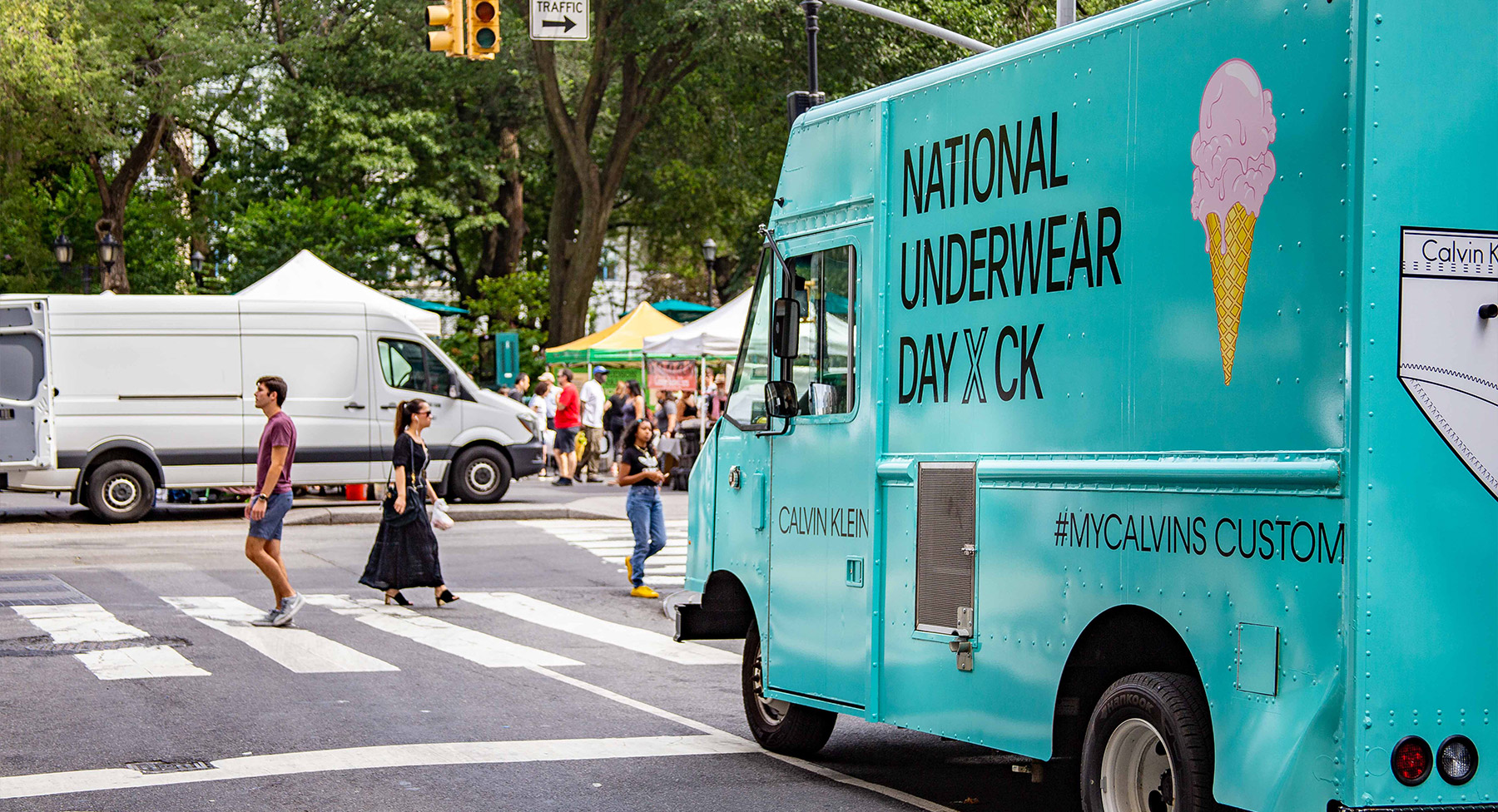
National calendar days are an efficient hook here, since they supply a reason for the activation to be happening on a particular day. A brand that genuinely owns a date can claim it outright, which is a far cheaper route to a conversation than manufacturing one.

3. It Changes a Perception

This is the most underrated use and the hardest thing to achieve through advertising. Some brands are stuck with an image that no amount of media spend shifts, because customers are not paying enough attention to update it.

Mastercard is the clearest example we have produced. Credit card companies are not what anyone thinks of as approachable, and the brand wanted to demonstrate its contactless technology rather than describe it. Partnering with Capital One, we ran a branded food truck serving food from chef JJ Johnson of Harlem’s FieldTrip, with interactive stations in front of the truck showing New Yorkers how to use the cards. Visitors also received free Metrocards for stopping by.

Why that works where an advertisement would not: people learned the technology by using it, in a queue, holding a plate of good food. The perception shifted because the experience contradicted it.

What the Food Should Be

  • Tied to the brand where possible. A drink in the exact brand color, a treat shaped like the product, or a flavour referencing the campaign all work harder than generic catering.
  • Suited to the weather. Hot chocolate in December, ice cream in August. The giveaway has to be wanted at the moment it is offered, which is a seasonal decision rather than a creative one.
  • Fast to serve. Throughput matters. Anything requiring assembly slows the queue and shortens the day.
  • Easy to hold while walking. People are en route somewhere. A cup or a cone works, a plate that needs a table does not.
  • Branded on the packaging. The cup, the sleeve, and the napkin are what travel down the street and into photographs.

Case Study: How Calvin Klein Turned a Street Corner Into a Cafe
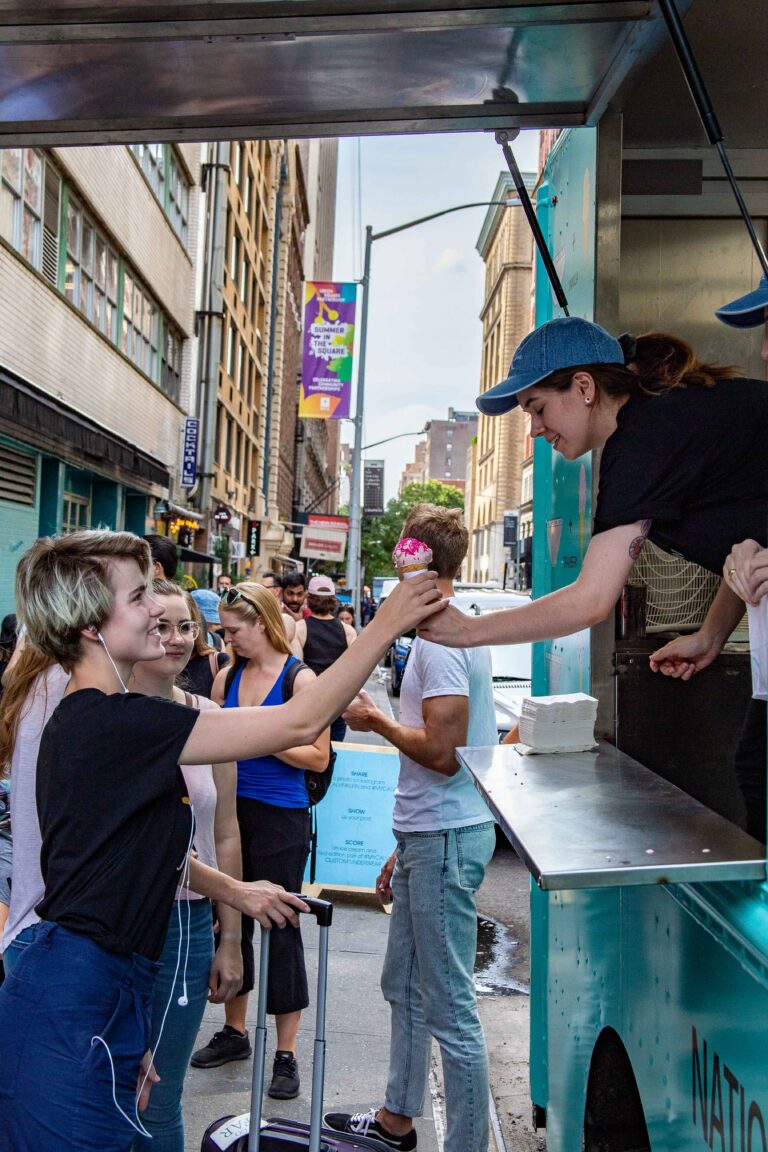
A woman gets an ice cream cone from a worker at a truck on a busy city street.

Calvin Klein has used the format more than once, and the campaign with the clearest published result is the New York Magazine partnership.

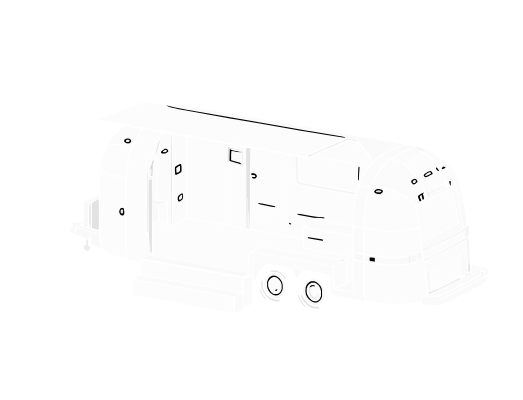
To launch a limited-edition capsule collection, we transformed a custom Airstream Bambi into a working pop-up cafe in SoHo, serving espresso drinks and black and white cookies, an understated nod to the city. Guests left with subway-inspired cards redeemable at the Calvin Klein store for a copy of the magazine.

The results across two days: more than 7,500 in foot traffic, 5.1 million social impressions, 2.4 million online impressions, and $410,000 in earned media value.

Why it belongs in a post about non-food brands: nothing on that menu was a Calvin Klein product. The coffee earned the stop, the cookies made it feel like New York rather than like marketing, and the redemption card moved people from a pavement to a store. Read the campaign in our Calvin Klein case study, or browse more brand activation case studies.

Which Non-Food Categories Suit It

  • Fashion and apparel. The product cannot be sampled, the audience is visual, and the activation photographs well.
  • Beauty and personal care. A giveaway pairs naturally with a demonstration or consultation at the same window.
  • Financial services and technology. The less tangible the product, the more a physical moment is worth, and a demonstration beats an explanation.
  • Media and entertainment. A release exists only online until somebody builds a place to go. For a younger audience specifically, our guide to targeting Generation Z and millennials covers what shifts in the approach.
  • Retail and ecommerce. A truck outside a store converts street traffic into store traffic, which is the hardest conversion in retail.

How to Measure It

  • Servings distributed per day and location, the volume metric and the one that identifies where to return.
  • Interactions and conversations logged, since the food exists to create these rather than to feed people.
  • Sign-ups, scans, and redemptions, the trackable conversion from a queue to a customer.
  • Tagged posts and earned media value, which for a well-designed activation frequently exceeds the media cost.
  • Store traffic lift where the truck is placed to drive people through a door.

The Bottom Line

A food truck promotion is not a food marketing tactic. It is a way to give someone a physical reason to stop when your product cannot provide one, which makes it more useful to a fashion house or a payments company than to a snack brand.

Choose a giveaway tied to the brand and suited to the weather, brand the packaging rather than only the vehicle, and be clear that the food is buying you a conversation rather than making a sale.

If your brand does not sell food and you want a reason for people to stop anyway, that is what we build. Explore our brand activation services or contact our team.

Frequently Asked Questions

Yes, and they often get more from it than food brands do. For a food brand the sample is the product, while for everyone else the giveaway exists purely to earn the stop, which is something fashion, technology, and financial brands cannot otherwise create on a street.

Because almost nobody refuses it. The truck creates a queue, the queue creates dwell time, and dwell time is when a trained ambassador can have a real conversation. The food is buying the ninety seconds, not making the sale.

Something tied to the brand where possible, suited to the season, fast to serve, easy to hold while walking, and branded on the packaging. A drink in the exact brand color does work that a generic coffee does not.

Fashion and apparel, beauty and personal care, financial services and technology, media and entertainment, and retail. The pattern is that the less tangible or less samplable the product, the more a physical moment is worth.

It is one of the few tactics that can. Mastercard used a branded truck with a celebrated chef to demonstrate contactless payments, letting people learn the technology by using it rather than being told about it, which contradicted the expected perception.

They can, when the fit is genuine. An observance supplies a reason for the activation to happen on a specific day, which is far cheaper than manufacturing urgency. A brand that plausibly owns a date can claim it outright.

Wrap the vehicle for distance, then brand everything the customer holds. The cup, the sleeve, the napkin, and any takeaway are what travel down the street and appear in photographs, which is where most of the reach comes from.

It varies with scale, though the numbers can be substantial. A two-day Calvin Klein activation in SoHo generated more than 7,500 in foot traffic, 5.1 million social impressions, and $410,000 in earned media value.

Particularly, because the product is intangible. A demonstration at a physical station, paired with something people actually want, gives an abstract service a moment people remember, which advertising for financial products struggles to achieve.

Track servings distributed per day and location, interactions logged by staff, sign-ups and redemptions captured, tagged posts and earned media value, and store traffic lift where the activation is placed outside a retail location.

FTP Free download

The Mobile Pop-Up Shop Launch Checklist

7 steps, 37 checkpoints, and a one-page brief to plan and launch a mobile pop-up shop that converts.

Instant PDF · No Cost

Benjamin Goldberg

Author

Benjamin Goldberg

CEO @ FTP Agency

Benjamin H. Goldberg is passionate about bringing brands to life on the streets. As CEO of Food Truck Promotions and co-founder of the New York and Los Angeles Food Truck Associations, he helps create unforgettable mobile experiences that blend great food, creative branding, and meaningful connections with audiences everywhere.

More posts
How to Approach Marketing to Gen Z and Millennials