How to Run a Rebranding Campaign People Notice

By: Ashley Elarde 9 min read

rebrand campaign

A rebranding campaign has one failure mode that matters: the company sees the change constantly and the customer never sees it at all.

Internally, a rebrand is months of work, hundreds of decisions, and a launch date everyone has been building toward. Externally, it is a slightly different logo appearing on a website somebody visits twice a year. That asymmetry is why so many rebrands land quietly.

This guide covers why in-person launches solve that, what to show and what to withhold, and a relaunch we produced for a fashion house changing its logo.

Key Takeaways

  • Announcing is not the same as being noticed: a press release reaches people already paying attention, which is not the audience a rebrand needs.
  • Show the new identity in use: a logo on a cup someone is holding communicates more than the same logo on a landing page.
  • Keep what customers actually recognize: most rebrands fail by discarding the equity people had, rather than by choosing the wrong typeface.
  • Put it where the existing customers are: outside your own stores is the highest-value placement, since those people already have an opinion to update.
  • Measure recognition, not impressions: the question is whether people noticed and understood the change, which needs asking rather than counting.

Why Rebrands Get Missed

Most rebrand launches are announced through channels that reach people who were already engaged: a press release, a social post, an email to a list. Those audiences already know you, and they were never the problem.

The people a rebrand is meant to reach are the ones with an outdated impression, and they are not reading your announcements. They will encounter the new identity incidentally, months later, and may not register that anything changed at all.

An in-person launch inverts that. Instead of announcing the change to people who follow you, it puts the new identity physically in front of people going about their day, including customers who stopped paying attention years ago.

When a Rebrand Justifies an Activation

  • A visual identity change. New logo, new colors, new packaging. These are the easiest to communicate physically and the hardest to communicate online, where they read as a minor design update.
  • A repositioning. If the brand is moving up or across a market, showing the new positioning is considerably more persuasive than claiming it.
  • Recovering from a reputational problem. Face-to-face contact rebuilds trust in a way advertising cannot, because a person is standing behind the claim.
  • A merger or name change. Where customers need to connect an old name to a new one, physical continuity helps more than a notice.
  • A category shift. Moving into a new product area gives people something to try rather than something to be told about.

What to Put in Front of People

The Identity, Applied Rather Than Displayed

A logo on a sign is a logo on a sign. The same logo on a cup somebody is holding, a bag they are carrying, and a vehicle they walked past is the identity in use, which is how people actually encounter a brand.

The Product, Unchanged

This matters more than most rebrand plans allow for. A visual change makes people wonder what else changed, and letting them taste, hold, or try the product answers that immediately. Continuity is reassuring, and reassurance is usually what a rebrand needs.

A Reason the Change Happened

Staff should be able to explain the rebrand in a sentence. Not a brand statement, a plain explanation. People will ask, and a shrug at the window undoes the work.

Something Worth Keeping

A branded item in the new identity that people take home extends the launch past the day, and it is one of the few ways a new logo enters someone’s life rather than passing through their feed.

Case Study: How Miu Miu Launched a New Logo on a SoHo Street

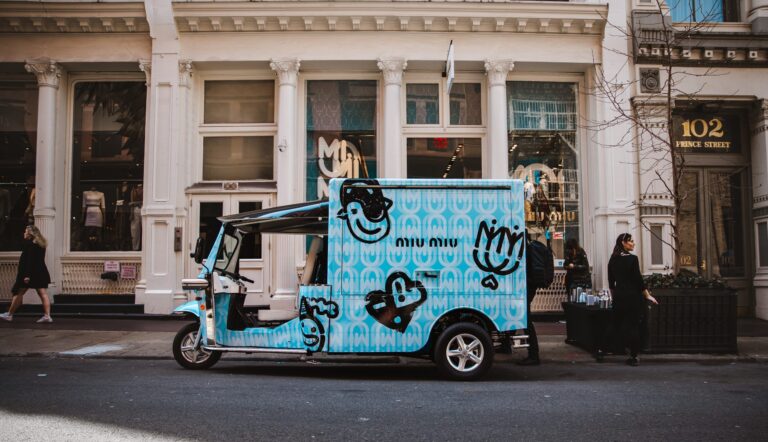
Blue tuk-tuk with cartoon designs parked by a white building; person stands nearby at a table.

Miu Miu unveiled a new logo for Paris Fashion Week, which is the conventional way a fashion house announces a change and reaches an audience of people who follow fashion houses.

The harder job was reaching everyone else. We produced a branded vehicle carrying the new logo and parked it outside the brand’s flagship store in SoHo, handing out cups of hot chocolate with marshmallows, both branded with the new label, on a cold spring day. The interior did double duty, serving on one side and displaying the season’s handbags on the other.

Miu Miu unveiled the logo at Paris Fashion Week, and the street activation is what took it beyond that audience.

Why the execution suited the brief: the new logo arrived in people’s hands rather than on a runway. Anyone who took a cup held the new identity, looked at it, and probably photographed it, which is a far more durable introduction than seeing it in a fashion week roundup.

It also stayed true to the brand’s own description of itself as independent and unconventional, which is the second job of a rebrand launch. The change has to feel like the brand rather than like a committee. Browse more work in our brand activation case studies.

Where to Place a Relaunch Activation

  • Outside your own stores. The highest-value placement, since those customers already have an impression to update and are physically nearby.
  • Where the new audience is. If the rebrand targets a different customer, the activation should go where that customer already spends time rather than where the old one does.
  • At a relevant industry moment. A trade show, fashion week, or category event puts the change in front of press and retail partners at once.
  • Across several markets. A rebrand is national even when the launch is not, so a short tour reaches more of the audience whose impression needs changing. Our guide to brand activation events covers activating around assembled crowds.

What Not to Do

  • Do not explain the strategy. Customers do not care about the positioning work. They care what it looks like and whether the product is the same.
  • Do not discard recognizable assets. A color, a shape, or a name people already associate with you is equity. Changing everything at once means starting over.
  • Do not launch quietly and hope. A rebrand that nobody notices has cost money and changed nothing.
  • Do not skip the staff brief. If ambassadors cannot explain the change plainly, the activation raises a question it does not answer. Our guide to hiring a mobile tour brand ambassador covers what a brief needs to contain, and a rebrand brief needs one extra line: the plain explanation.

How to Measure a Rebrand Activation

  • Recognition, asked directly. A short question at the activation, on whether people noticed the change and what they think it signals, is worth more than any impression count.
  • Interactions and items distributed, since each one is the new identity entering circulation. For context on why physical channels suit this, out of home advertising has grown for 19 consecutive quarters. 
  • Tagged posts featuring the new identity, which shows whether the change is legible enough to be shared.
  • Press pickup, particularly trade coverage, which is where a rebrand is judged professionally.
  • Sentiment in the questions asked, because the objections people raise at a window are the objections the rebrand will face everywhere.

The Bottom Line

A rebranding campaign succeeds when people who had an old impression form a new one, and that does not happen through a channel those people were never following.

Put the new identity into circulation physically, keep the product recognisably the same, give staff a plain explanation, and go where your existing customers already are rather than where your announcement will be read.

If a relaunch is coming, we design, build, permit, and staff the activation around it. Explore our brand activation services or contact our team.

Frequently Asked Questions

Put the new identity physically in front of people rather than only announcing it. A press release reaches an audience already paying attention, while an in-person launch reaches customers whose impression is outdated and who are not following your announcements.

Because the company sees the change constantly and the customer barely sees the brand at all. Announcements reach engaged audiences who already know you, while the people with an outdated impression encounter the new identity incidentally, if ever.

For a visual identity change, a repositioning, recovery from a reputational problem, a merger or name change, or a move into a new category. All are easier to demonstrate physically than to explain online.

The identity applied rather than displayed, on cups, bags, and vehicles people handle. The product unchanged, so people know what did not change. A plain explanation staff can give. And something branded worth taking home.

No. Customers do not care about positioning work. They want to know what it looks like now and whether the product is the same. Staff should be able to explain the change in one plain sentence, not a brand statement.

Outside your own stores first, since those customers already have an impression to update. Then wherever the new target audience spends time, at a relevant industry moment, and ideally across several markets since a rebrand is national.

Discarding recognizable assets. A color, shape, or name that customers already associate with you is accumulated equity, and changing everything at once means starting from zero rather than building on what existed.

Ask about recognition directly at the activation rather than counting impressions. Also track interactions and items distributed, tagged posts featuring the new identity, press and trade pickup, and the objections people raise in conversation.

It is one of the few things that can. Face-to-face contact rebuilds trust in a way advertising cannot, because a person is standing behind the claim and can answer the question directly rather than restating a message.

Longer than a single day if budget allows. A rebrand needs repetition across an audience that is not paying close attention, so a short tour across several markets typically outperforms one launch event in one city.

A branded promotional truck on a city street

Merlin AI

See your brand on a promotional truck in 30 secs.

Pick a vehicle, drop in your website, and Merlin AI brings your brand activation to the streets instantly.

Try It Now

Take Your Brand to the Streets.®

Ashley Elarde

Author

Ashley Elarde

Social Media Manager @ FTP Agency

Ashley Elarde is a social media strategist, content creator, and experiential marketing professional with experience bringing brands to life through engaging digital content. She has helped execute campaigns for brands across beauty, fashion, retail, and entertainment, developing campaigns that drive engagement and meaningful consumer connections.

More posts
Top 5 Back to School Marketing Ideas for Brands