How to Choose a Brand Activation Company
Choosing a brand activation company is difficult for a specific reason: every portfolio looks good, and none of them show you the part that…
Read moreBy: David Botbol • • 9 min read
A brand masterclass is what happens when an activation stops handing things over and starts teaching people something.
The difference matters commercially. A sample answers whether someone likes the product. A short demonstration answers why it works, how to use it, and what they were doing wrong with the thing they currently own, which is a considerably harder objection to overcome any other way.
This guide covers when education beats sampling, the formats that work in a small footprint, how to staff one, and a campaign built entirely around teaching.
A brand masterclass is an activation format where customers are taught something rather than simply given something. It can be a two-minute demonstration at a truck window, a scheduled twenty-minute session inside a build, or a hands-on workshop with a small group.
The common thread is that the customer leaves knowing how to do something, and the product is what made that possible. Beauty brands run application sessions, spirits brands run tastings, and food brands run technique demonstrations, all on the same principle.
Sampling is faster, cheaper, and reaches more people. It is the right choice most of the time. Education is the better answer in four specific situations.
Skincare, supplements, and technical products often do not demonstrate themselves in a single trial. If someone needs to understand a routine, a sequence, or a mechanism, handing them a sachet will not do it.
Plenty of categories lose sales to misuse rather than to competitors. If people apply too much, use it at the wrong time, or skip a step, teaching the correct method is the shortest route to a repeat purchase.
A premium product has to explain itself. Showing the difference is far more persuasive than claiming it, and a demonstration lets a customer reach the conclusion themselves rather than being told.
New formats, new ingredients, and new technology all carry a knowledge barrier before they carry a preference. Education removes the barrier; sampling assumes it is not there.
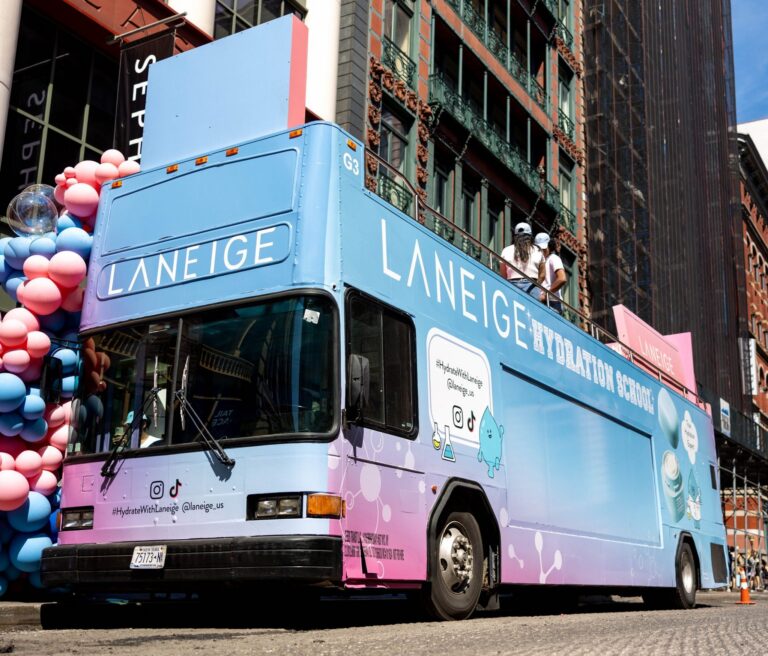
LANEIGE needed people to understand a hydration range rather than simply try it, which is a textbook case for teaching over sampling.
We turned a double-decker bus into a two-floor beauty experience in New York. Guests spun a prize wheel on arrival and won one of five prizes, then sampled products at a hydration booth after a short educational talk, then climbed a colorful staircase to a rooftop styled entirely in pink around the Lip Sleeping Mask, with giant product props and a lip-shaped couch in front of a candy wall.
Why the structure worked: the education came before the sample rather than instead of it, so people understood what they were about to try. The two floors separated two products so each got real attention, and the prize collected on arrival gave everyone a reason to complete the whole journey rather than leaving after the first stage.
That is the guided journey format executed properly: teach at each stage, and design the route so people reach the end. See the activation in our LANEIGE beauty pop-up case study, or browse more brand activation case studies.
This is where the format most often fails, and it is not the same hire as a sampling activation.
Be clear-eyed about this before committing. A sampling truck can serve several hundred people in an afternoon. A masterclass format will reach a fraction of that.
The trade is depth for volume. Someone who spent four minutes learning how to use a product is far more likely to buy it than someone who spent fifteen seconds accepting a sachet, but you will have far fewer of them. Judge the campaign on conversion and redemption rather than on servings, or the numbers will look like a failure.
A brand masterclass is the right format when the barrier to purchase is understanding rather than trial. It reaches fewer people, costs more per interaction, and converts better, which is a good trade for a premium, technical, or misunderstood product and a poor one for something people already know how to use.
Teach before you sample, staff it with people who can genuinely answer a question, and send everyone home able to repeat what they learned.
If your product needs explaining rather than handing over, that is what we build. Explore our brand activation services or contact our team.
A brand masterclass is an activation where customers are taught something rather than simply given something. It ranges from a two-minute demonstration at a truck window to a scheduled session inside a build, with the product as what makes the lesson possible.
When the benefit is not obvious from one use, when people are using the category incorrectly, when you need to justify a premium price, or when the product is unfamiliar enough that a knowledge barrier sits in front of any preference.
A ninety-second demonstration at the window, a one-to-one consultation, a scheduled session promoted in advance, a guided journey teaching one thing per stage, or a take-home lesson delivered through a card, QR code, or kit.
You need depth rather than energy. A sampling ambassador needs warmth and stamina, while a masterclass needs someone who genuinely understands the product and can handle a follow-up question. Professionals carry authority in beauty and technical categories.
Yes, considerably. A sampling truck can serve several hundred in an afternoon while a masterclass format reaches a fraction of that. The trade is depth for volume, so the campaign should be judged on conversion rather than servings.
Before. Someone who understands what they are about to try evaluates it properly, while someone handed a sample cold is guessing. The LANEIGE hydration activation ran a short educational talk ahead of the sampling booth for exactly this reason.
The ability to repeat what they learned. A card, a QR code linking to a walkthrough, or a kit containing the products used all extend the lesson past the day, which is what converts a demonstration into a habit.
Beauty and skincare where application matters, spirits and food where tasting benefits from context, supplements where a routine needs explaining, and technical products where the mechanism is the selling point.
Track sessions delivered rather than samples distributed, average dwell time per interaction, the questions people ask, redemption rate on any code issued, and cost per acquired customer as the only fair comparison against sampling.
Yes, and the footprint shapes the format. A vehicle supports demonstrations, consultations, and guided journeys well, while longer seated sessions need either a larger build or a scheduled approach with limited numbers per session.
7 steps, 37 checkpoints, and a one-page brief to plan and launch a mobile pop-up shop that converts.
Instant PDF · No Cost
Author
EVP, Managing Director @ FTP Agency
David Botbol thrives on turning bold ideas into real-world brand moments. As Executive VP and Managing Director of Food Truck Promotions, and a leader within the New York and Los Angeles Food Truck Associations, he draws on a background in business development and startups to help brands connect with audiences through creative, unforgettable mobile experiences.
Choosing a brand activation company is difficult for a specific reason: every portfolio looks good, and none of them show you the part that…
Read more →
The best brand activation ideas are not the most elaborate ones. They are the ones that give a stranger a reason to stop walking.…
Read more →
Brand activation displays are the part of a build that does the selling, and they are usually designed last. The wrap gets rounds of…
Read more →We use and share personal information through cookies and similar technologies on our sites to personalize your shopping experience and ads. Others may use this information for their own marketing and business purposes. . Check our Privacy Policy for more details.
Browser Opt-Out Honored
We use and share your personal information with others to personalize your shopping experience and show you targeted ads on other sites based on your interests and online activities.
Online Info includes cookies, pixel tags, and similar technologies connected to your browser or device. Offline Info includes information associated with your email address based on your other interactions with us.
We use and share your personal information with others to personalize your shopping experience and show you targeted ads on other sites based on your interests and online activities. Information includes cookies, pixel tags, and similar technologies connected to your browser or device (Online Info), as well as information associated with your email address based on your other interactions with us (Offline Info). Others may use this information for their own marketing and business purposes.
You can choose to opt out of sharing one or both types of information.