What Brand Activation Management Actually Involves

By: David Botbol 9 min read

food truck college tour brand activation

Brand activation management is the part of the job nobody photographs, and the part that decides whether the campaign happens on the date you planned.

Concept and design get the attention because they are the visible work. Permits, staffing, stock forecasting, transport, and contingency planning are what actually consume the timeline, and they are where campaigns fail.

This guide covers the full scope of what management involves, what it costs you in lead time, and what to expect from a partner who does it properly.

Key Takeaways

  • Permits set the calendar, not creative: approval timelines are outside your control and usually determine the earliest possible date.
  • Every market is its own project: a nine-city tour is nine permit processes, not one repeated nine times.
  • Stock forecasting is a real discipline: running out at two in the afternoon ends the activation while people are still arriving.
  • Contingency is the difference between a delay and a cancellation: dates move, weather turns, and staff drop out.
  • Ask who absorbs the risk: the answer separates a production partner from a supplier who hands problems back to you.

What Is Brand Activation Management?

Brand activation management is the operational delivery of a live campaign: everything between an approved concept and a completed activation. It covers permits and location agreements, fabrication scheduling, staffing and briefing, product and stock logistics, transport and load-in, on-site supervision, and reporting.

It is distinct from the creative work and it is usually the larger share of the effort. A concept can be settled in a fortnight. Permitting a multi-city route cannot.

For the wider category, see our guide to what a brand activation is.

The Scope of the Work for a Brand Activation

Here’s what’s involved in launching a brand activation. 

Permits and Location Agreements

Street activations need a city permit. Private property needs an agreement with the owner or property manager. Anything served needs health department approval and food handler certification on top of both.

Requirements vary by city and frequently by neighborhood, and the process is genuinely different in each. Trade bodies such as the New York Food Truck Association exist partly because navigating those rules is a specialism in itself. This is the single largest source of delay in the industry and the reason experienced partners quote lead times that sound conservative.

Fabrication Scheduling

The build has to be finished, inspected, and ready to travel before the first date, which means working backwards from the activation rather than forwards from approval. Custom interiors, wraps, and themed set dressing each carry their own lead times, and holiday builds compete for the same shop capacity as everyone else’s.

Staffing and Briefing

Recruiting ambassadors is the easy part. Briefing them on the product, the single action you want, what they cannot claim, and what to record is the work that determines performance. On multi-market runs, someone has to own quality in every city.

Product and Stock Logistics

Forecasting volumes per market, ordering with lead time, arranging storage, and restocking between stops. Under-forecast and a later city gets a worse experience than the first one. Over-forecast and you have paid for product nobody received.

Transport and Load-In

Drive time between markets, overnight parking, load-in windows that are often before dawn, and access restrictions that vary by site. In a financial district or a convention center this is a scheduling problem as much as a driving one.

On-Site Supervision

Someone has to own the day: managing the queue, coordinating with property managers and local authorities, handling the conditions attached to the permit, and making decisions when something changes.

Reporting

Capturing what happened while it is happening. Samples distributed, scans captured, questions asked, and content shot, per stop rather than reconstructed afterwards from memory.

Case Study: How a 9-City Tour Was Actually Run

Gerry's Partisan Pizza Truck Tour

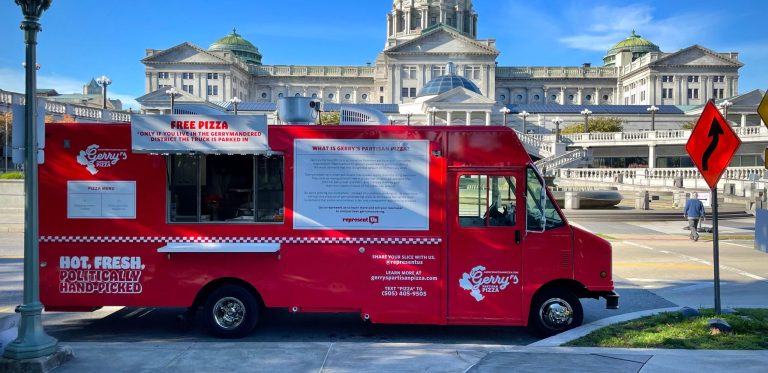
RepresentUs, a nonpartisan nonprofit focused on election reform, needed to explain redistricting to people in the places it affected most. The creative answer was straightforward: pizza cut into deliberately uneven slices, served from a branded truck.

The management was not. We took the Gerry’s Partisan Pizza tour to five states and nine cities: Raleigh and Greensboro in North Carolina, Annapolis in Maryland, Tallahassee and Orlando in Florida, Harrisburg and Pittsburgh in Pennsylvania, and Appleton and Madison in Wisconsin.

What that involves in practice: nine separate permit processes on nine separate timelines, health approvals in five states with different requirements, transport days between markets that produce no activity but cost money, food volumes forecast city by city, and staff briefed to the same standard in every location so the campaign read as one thing rather than nine.

The concept could be explained in a sentence. The delivery took months. That gap is what brand activation management is. Read the full campaign in our Gerry’s Partisan Pizza case study, or browse more brand activation case studies.

Realistic Lead Times

  • Six to eight weeks is the floor for a straightforward single-market activation.
  • Longer for custom fabrication, since a built interior cannot be compressed.
  • Eight to twelve weeks for peak December placements, where themed builds and prime locations are contested.
  • Two to three months for prime summer weekends in major markets.
  • Multi-city tours need longer still, because each market runs its own approval process. The pattern across all of them: permits and fabrication set the date, not the concept.

What Goes Wrong, and How It Is Managed

  • A permit is refused. Shortlist alternates during scouting so a second permitted location already exists.
  • The launch date moves. Confirm early what a change costs and whether the build and permits can be held.
  • Weather turns. A wet-weather plan and a covered footprint should exist before the day, not on it.
  • Staff drop out. On a multi-week run somebody will. Cover needs to be arranged before it is needed.
  • Stock runs out. Forecast with a buffer and hold reserve stock accessible mid-route.
  • A location changes conditions late. Property managers add restrictions. Someone has to renegotiate on the day.

What to Ask a Brand Activation Company

Management quality is difficult to assess from a portfolio, because portfolios only show the days that went well. These questions get closer:

  • Which cities have you permitted in, and what lead time do you need? Specific answers indicate real experience.
  • Who supervises on the day, and who do we call if something changes?
  • What happens if our date moves, and what does it cost?
  • How do you forecast stock, and what happens if we run out?
  • Tell me about an activation that went wrong. Anyone who has run enough has a story, and the answer reveals how they handle it. Our guide to choosing a brand activation company covers the wider evaluation.

How to Measure Management, Not Just the Campaign

  • Activation days delivered against days planned, the simplest measure of whether the operation held.
  • Permit success rate, meaning locations secured against locations applied for.
  • Stock accuracy, comparing forecast against actual distribution per market.
  • Staffing consistency, measured by interactions per hour across cities rather than in aggregate.
  • Issues escalated to the client, where fewer indicates a partner absorbing rather than forwarding problems.

The Bottom Line

Brand activation management is unglamorous and it is most of the job. Permits determine your calendar, staffing determines your results, stock determines whether the last city gets the same campaign as the first, and contingency determines whether a problem becomes a delay or a cancellation.

When evaluating brand activation services, the creative is the part you can judge from a portfolio. The management is the part you have to ask about.

We handle all of it in house. Explore our brand activation services or contact our team to talk through a campaign.

Frequently Asked Questions​

Brand activation management is the operational delivery of a live campaign, covering everything between an approved concept and a completed activation: permits and location agreements, fabrication scheduling, staffing, stock logistics, transport, on-site supervision, and reporting.

Because requirements vary by city and often by neighborhood, and each application runs on the issuing authority’s timeline rather than yours. Street activations, private property, and food service each require different approvals, and prime dates in major markets are claimed months ahead.

Six to eight weeks is a realistic floor for one market. Custom fabrication needs longer, peak December placements need eight to twelve weeks, prime summer weekends are claimed two to three months out, and multi-city tours need longer still.

Every market is its own project. A nine-city tour means nine permit processes on nine timelines, potentially several states’ health requirements, transport days between stops, stock forecast per city, and staff briefed to one standard everywhere.

A permit refused, a launch date moved, weather turning, staff dropping out, stock running short, or a property manager adding conditions late. All are foreseeable, which is why alternates, contingency, and reserve stock are planned rather than improvised.

From comparable activations in similar locations, adjusted for expected foot traffic and hours, with a buffer added. Running out mid-afternoon ends the activation while people are still arriving, so under-forecasting costs more than over-forecasting.

Someone should own the day: managing the queue, coordinating with property managers and local authorities, complying with permit conditions, and making decisions when circumstances change. On multi-market runs that role exists in every city.

Which cities they have permitted in and what lead time they need, who supervises on the day, what a date change costs, how stock is forecast, and what happened on an activation that went wrong. Specific answers indicate real experience.

It should be, though the scope varies considerably. Some agencies produce concepts and subcontract delivery, which introduces a gap between what was promised and what arrives. Confirm who handles permits, staffing, and logistics before signing.

Track activation days delivered against days planned, permit success rate, stock forecast accuracy, staffing consistency measured by interactions per hour across cities, and how many issues were escalated to you rather than absorbed.

FTP Free download

The Mobile Pop-Up Shop Launch Checklist

7 steps, 37 checkpoints, and a one-page brief to plan and launch a mobile pop-up shop that converts.

Instant PDF · No Cost

David Botbol

Author

David Botbol

EVP, Managing Director @ FTP Agency

David Botbol thrives on turning bold ideas into real-world brand moments. As Executive VP and Managing Director of Food Truck Promotions, and a leader within the New York and Los Angeles Food Truck Associations, he draws on a background in business development and startups to help brands connect with audiences through creative, unforgettable mobile experiences.

More posts
Why You Should Launch a Custom Food Truck Campaign