Why Your Brand Should Use Glass Box Trucks for Marketing

By: Benjamin Goldberg 9 min read

glass box trucks

Glass box trucks solve a problem every other marketing vehicle has: people have to be told what is inside.

With a wrapped food truck, the graphics do the talking and the product stays hidden until someone reaches the window. With a glass truck, the product is visible from the sidewalk, from across the street, and from a passing car. The display is the advertisement.

This guide covers what glass box trucks are, what they are genuinely good at, the practical demands most brands do not anticipate, when a different vehicle is the better call, and three real activations we built.

Key Takeaways

  • The product becomes the ad: full-length windows mean people see what you are showing before they read a word of copy.
  • They work parked and moving: a glass truck functions as a mobile billboard in transit and a pop-up showroom once it stops.
  • Interior design carries the campaign: with the inside on permanent display, the build quality is the brand impression.
  • Light and heat need planning: glass amplifies sun, so product placement, cooling, and evening lighting all have to be designed in.
  • They are not always the right choice: for sampling volume or tight urban streets, a food truck, cart, or tuk tuk usually performs better.

What Are Glass Box Trucks?

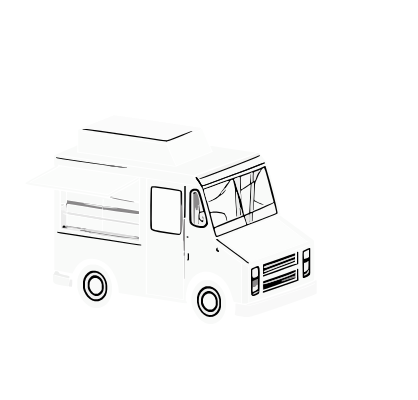
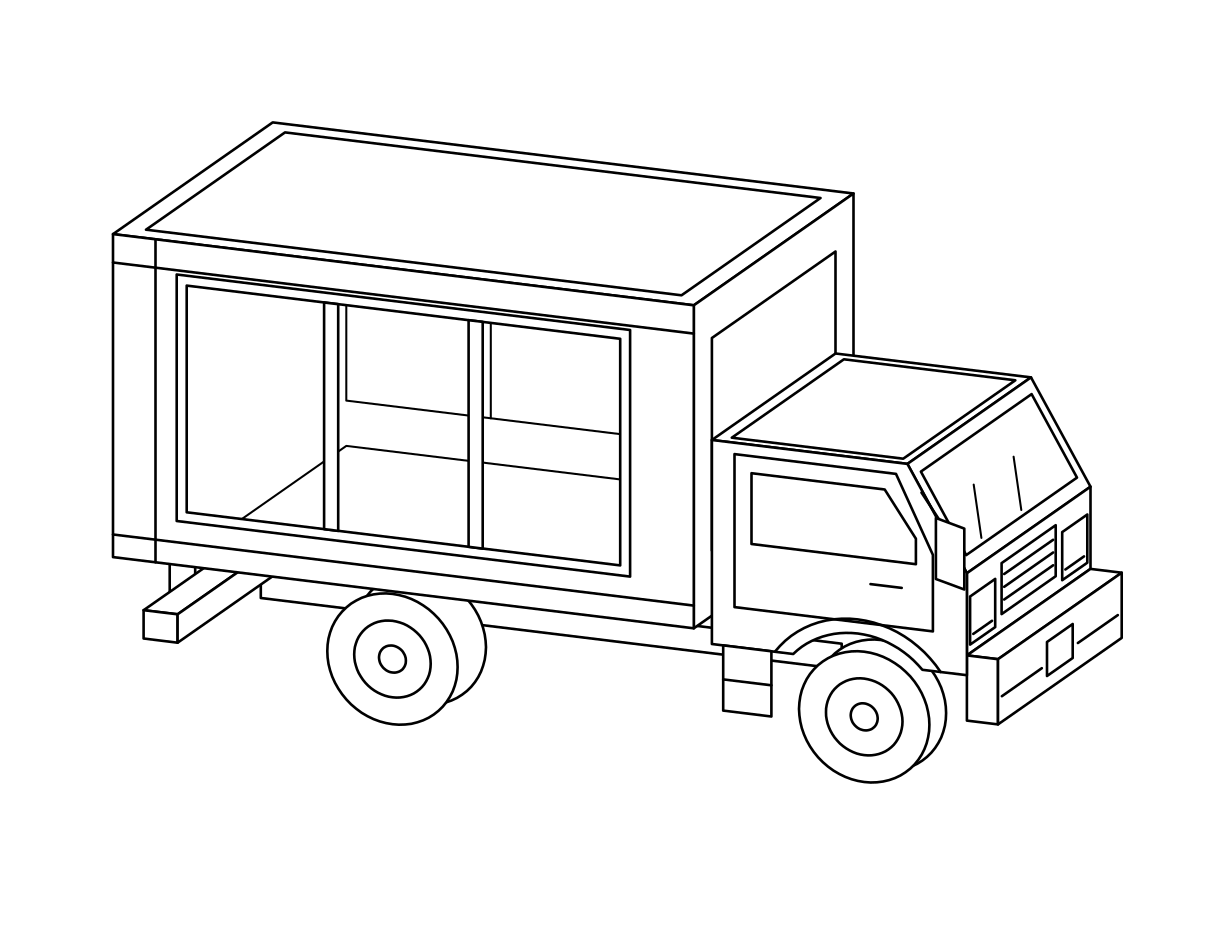
A glass box truck is an experiential marketing vehicle whose cargo box has full-length transparent walls, so the interior is visible from outside. Instead of a serving window cut into a solid panel, the entire side becomes a display case that can be seen into from the street.

That single design difference changes what the vehicle is for. A standard branded food truck is a service point that happens to carry graphics. A glass box truck is a display that happens to be mobile, which suits product launches, collections, and any campaign where seeing the item is the point.

The Marketing Benefits of a Glass Box Trucks 

Here are the top benefits of using a glass box truck for an activation.

Visibility Without Explanation

A passerby understands what is happening in about a second. For collectible, colorful, or visually distinctive products, that removes the hardest part of street-level marketing, which is getting someone to care before they have read anything.

Working as a Mobile Billboard

The vehicle earns impressions while driving between locations, not only while parked. A route through dense traffic corridors turns transit time into reach, which is why these builds suit campaigns measured on impressions as well as interactions.

Interior Build-Out as the Campaign

Because the inside is permanently on show, the fabrication is the creative. Brands use the space as a mobile showroom, a retail floor, or a set, and everything from shelving to lighting is visible at all times. Our custom fabrication team builds these interiors in house.

Travelling Well

Unlike carts and tuk tuks, a glass truck is a full-size vehicle that handles highway transit comfortably, which makes it a practical choice for a multi-city tour rather than a single-market activation.

Photographing From Any Angle

Transparency means there is no bad side. Attendees can shoot the product, the interior, and themselves in front of it, which is why these builds consistently produce more content than solid-panel vehicles. Our guide to creating experiences that drive UGC covers how to design that in deliberately.

The Practical Demands Most Brands Do Not Anticipate

This is the part rarely covered, and it is where a glass build succeeds or disappoints.

  • Sun and heat. Glass amplifies both. Product that melts, warps, or fades needs shading, cooling, or repositioning away from the sun-facing wall, and that is a design decision rather than a day-of fix.
  • Lighting after dark. The effect that makes a glass truck work in daylight reverses at night unless the interior is lit properly. Evening activations need a lighting plan built into the fabrication.
  • Nothing can be hidden. There is no back room. Stock, cables, bins, and staff bags are all visible, so storage has to be designed into the build rather than improvised.
  • Security. A transparent vehicle displaying merchandise needs a plan for overnight parking and for crowd management at busy stops.
  • Cleaning. Fingerprints and road dust show immediately on glass, so daily cleaning is part of the operating routine on a tour.
  • Footprint and permits. This is a full-size truck, so permitting and placement follow the same rules as any large vehicle, and tight streets can rule it out.

When a Different Vehicle Is the Better Choice

  • High-volume sampling: a food truck with a proper service window moves a queue faster than a display-led build.
  • Dense or narrow streets: carts and tuk tuks reach places a box truck cannot park.
  • Premium hospitality: an Airstream suits a lounge or spa format better than a display case.
  • Products that are not visual: if the item does not reward being looked at, you are paying for transparency you will not use. Our guide to experiential marketing trucks compares the full range of formats side by side.

Case Study: Zara at WorldPride

Woman in purple shirt gives items to group near colorful cans and large white ZARA letters.

WorldPride came to New York in 2019 for the fiftieth anniversary of Stonewall, the first time the global celebration was held in the United States. Zara wanted a presence at the heart of the parade rather than an ad about it.

We transformed a three-sided glass truck into a 3D Pride flag built from 9,000 colorful bottles sponsored by JUST Water, lined inside the glass in a rainbow of flavors. Brand ambassadors in Zara apparel handed out free cold water to parade-goers on a hot summer day, and attendees staged photos in front of the truck.

Why the format mattered: the installation only worked because it was visible. Nine thousand bottles behind a solid panel is a storage problem; behind glass it is a landmark. By the end of the day the truck was completely empty, and the activation generated over one million impressions. Read the full build in our Zara WorldPride glass truck case study.

Two More Glass Truck Activations

Bacardi Winter Summerland

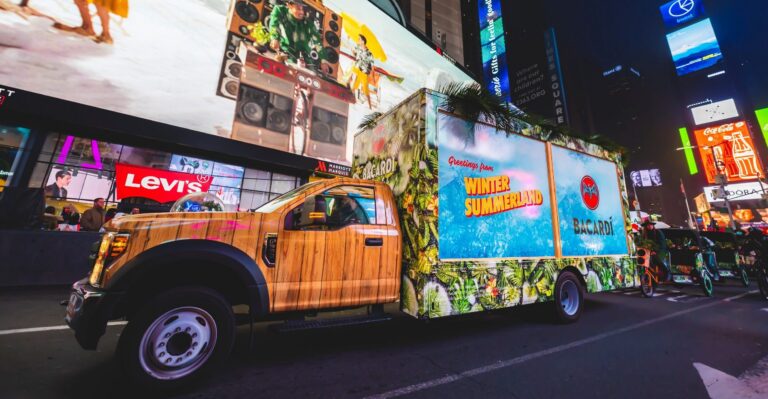
The centerpiece of Bacardi’s Winter Summerland campaign was a mobile showroom that stopped at New York hotspots including Times Square. The interior was stocked with merchandise and giveaways for guests to browse, using the holiday window when competition for attention is at its highest. See the build in our Bacardi activation case study.

Loungefly Polka Dot Pop-Up

Loungefly turned a glass truck into a polka dot pop-up celebrating its collection, timed to National Polka Dot Day. The exterior caught attention and the glass gave passersby a clear view of the collection display inside, which was the focal point of the promotion. Guests enjoyed a photo moment and free tea, browsed the collection, could purchase on site, and had the chance to win discounts. Read the Loungefly glass truck case study, or browse more brand activation case studies.

How To Measure a Glass Truck Activation

  • Impressions in transit and at rest: the mobile billboard value, estimated from route and dwell locations.
  • Visitors and dwell time: how many stopped and how long they stayed at the display.
  • Products sold or claimed: the conversion where the truck operates as retail.
  • Tagged posts and content captured: transparency should produce a higher content rate than a solid build.
  • Sign-ups collected: the asset that outlasts the activation.

The Bottom Line

Glass box trucks earn their place when the product deserves to be seen. They turn a vehicle into a display, work as a mobile billboard between stops, and photograph from every angle. What they ask in return is a properly designed interior, a plan for sun and light, and somewhere to hide the things you would rather people did not see.

If a launch or collection would benefit from that treatment, we design, build, and run these. Explore our mobile showroom services or contact our team to talk it through.

Frequently Asked Questions

A glass box truck is an experiential marketing vehicle whose cargo box has full-length transparent walls, making the interior visible from outside. Instead of a serving window in a solid panel, the entire side becomes a display case that can be seen into from the street.

Because the product becomes the advertisement. People understand what is being shown before reading any copy, the vehicle earns impressions while driving between stops, and the transparent interior photographs from every angle, producing more content than a solid build.

A food truck is a service point with graphics outside and a window for handing things over. A glass truck is a display that happens to be mobile. Food trucks suit sampling volume; glass trucks suit launches, collections, and showroom formats.

Yes. It generates impressions while in transit as well as when parked, so routing through dense traffic corridors turns travel time into reach. That dual function is one of the main reasons brands choose the format over a fixed installation.

Glass amplifies sun and heat, nothing can be hidden from view, evening activations need an interior lighting plan, and the glass needs daily cleaning on a tour. It is also a full-size vehicle, so tight streets and permitting can rule it out.

Yes, but only with lighting designed into the build. The daylight effect reverses after dark, so an unlit interior disappears while a properly lit one becomes more striking than it is during the day. Plan this at the fabrication stage.

Accordion

Visually distinctive ones: collections, collectibles, packaging-led products, apparel, and anything with strong color or shape. If a product does not reward being looked at, you are paying for transparency the campaign will not use.

Yes. Many brands run them as mobile retail, with the interior fitted as a shop floor and a point of sale on board. That requires the build to include stock storage and a checkout position, since none of it can be hidden.

Yes. Unlike carts and tuk tuks, it is a full-size vehicle suited to highway transit, which makes it practical for multi-city tours. Factor in transport days between markets and daily cleaning to keep the glass presentable.

Start with the product, the markets, and the window you want to activate in. From there we handle concept, 3D renderings, fabrication, permits, and staffing. Share your timing with our team and we will map the build and route around it.

FTP Free download

The Mobile Pop-Up Shop Launch Checklist

7 steps, 37 checkpoints, and a one-page brief to plan and launch a mobile pop-up shop that converts.

Instant PDF · No Cost

Benjamin Goldberg

Author

Benjamin Goldberg

CEO @ FTP Agency

Benjamin H. Goldberg is passionate about bringing brands to life on the streets. As CEO of Food Truck Promotions and co-founder of the New York and Los Angeles Food Truck Associations, he helps create unforgettable mobile experiences that blend great food, creative branding, and meaningful connections with audiences everywhere.

More posts
How to Launch a Brand Activation at Coachella Music Festival